Annual Leave Entitlements: The 4 Weeks, the Loading, the Payout
Every full-time employee accrues 4 weeks of paid annual leave a year under the National Employment Standards. This guide covers how it accrues, who gets the 17.5% loading and the shiftworker fifth week, and how unused leave is taxed when you leave.
How much annual leave do you get in Australia?
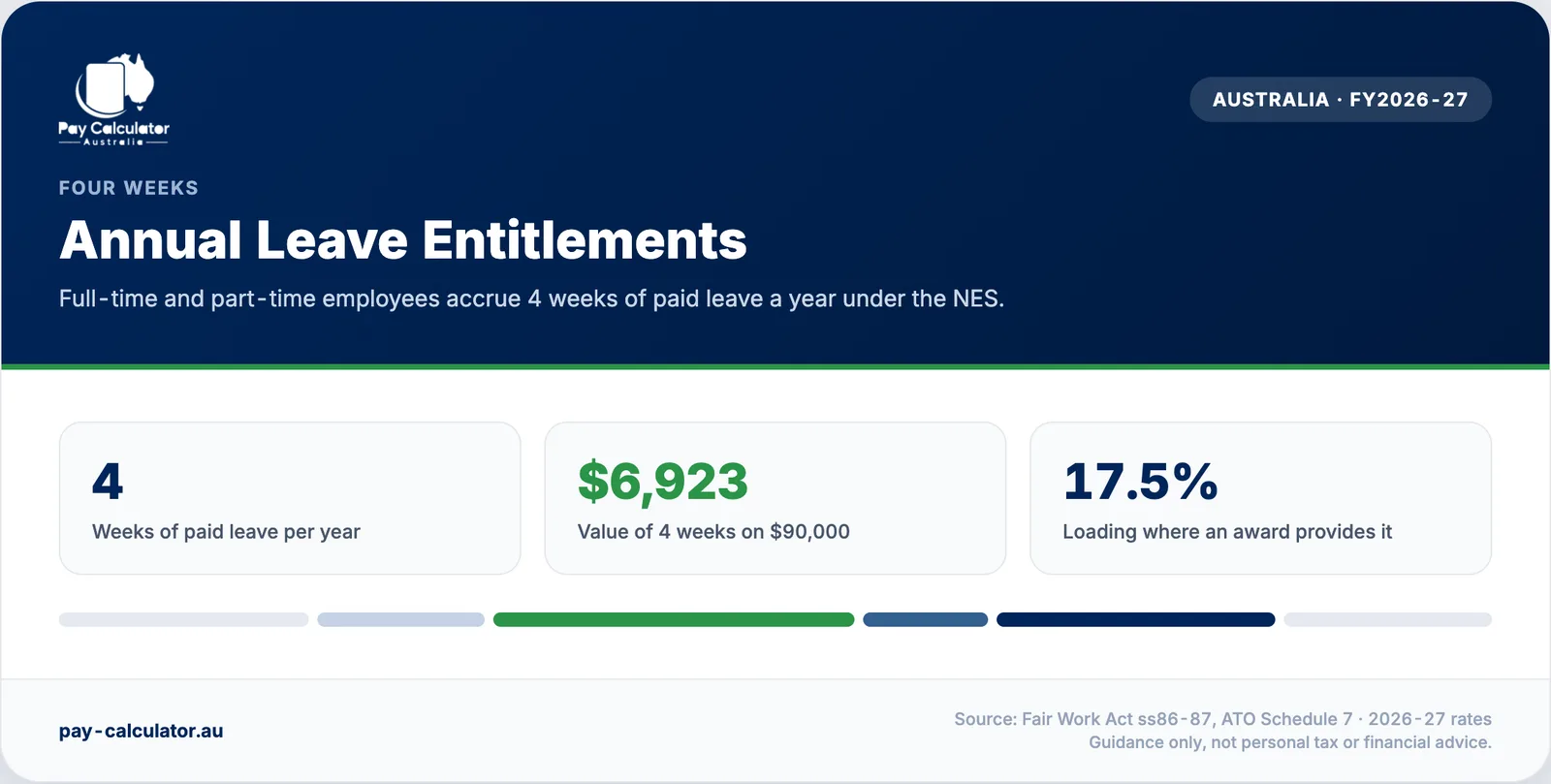
The National Employment Standards give every full-time and part-time employee 4 weeks of paid annual leave for each year of service. The entitlement is based on your ordinary hours, which is what makes part-time fair: a 20-hour-a-week employee accrues 80 hours a year, and that is still 4 of their weeks. Nobody on part-time hours gets fewer weeks, only fewer hours per week.
Leave is paid at your base rate for ordinary hours. The 4 weeks is a floor, not a ceiling; awards and agreements can provide more, and some shiftworkers get a fifth week, covered below. The entitlement comes from the Fair Work Act 2009, ss86-87, so it does not depend on your contract mentioning it, and it cannot be traded away for a higher hourly rate the way a casual's leave effectively is.
How does annual leave accrue?
From day one, progressively through the year, with no expiry. Accrual scales with your ordinary hours.
Annual leave starts accruing on your first day, including during probation, and builds progressively through the year rather than arriving as a lump on your anniversary. Unused leave rolls over indefinitely. There is no use-it-or-lose-it rule in the NES.
| Ordinary hours per week | Leave accrued per year | Accrual per week worked |
|---|---|---|
| 38 hours (full-time) | 152 hours (4 weeks) | 2.92 hours |
| 30 hours | 120 hours (4 weeks) | 2.31 hours |
| 20 hours | 80 hours (4 weeks) | 1.54 hours |
Computed as 4 weeks multiplied by ordinary weekly hours, spread across 52 weeks. Source: Fair Work Act 2009 ss86-87, Fair Work Ombudsman, Annual leave (updated 25 March 2026).
To watch your own balance build, or to value what you have already banked, use the leave calculator.
Does annual leave keep accruing while you are on leave?
Paid leave types generally accrue more leave. Unpaid leave types generally do not.
| While you are on | Annual leave keeps accruing? |
|---|---|
| Paid annual leave | Yes |
| Paid sick and carer's leave | Yes |
| Paid family and domestic violence leave | Yes |
| Community service leave, including jury duty | Yes |
| Long service leave | Yes |
| Unpaid annual leave | No |
| Unpaid sick or carer's leave | No |
| Unpaid parental leave | No |
| A period covered by cashed-out leave | No |
Source: Fair Work Ombudsman, Annual leave (updated 25 March 2026). The government Paid Parental Leave scheme does not count as paid leave for accrual purposes.
The pattern is consistent: leave accrues on service that is paid by your employer. A year that includes six months of unpaid parental leave accrues roughly half the usual 4 weeks, which surprises many people returning to work.
Who gets 5 weeks of annual leave as a shiftworker?
Some shiftworkers accrue 5 weeks of annual leave a year instead of 4. The extra week is not automatic for anyone who works shifts. It applies where an award or registered agreement includes shiftwork provisions, defines which employees count as shiftworkers for this purpose, and provides the fifth week for them. Typical definitions capture employees regularly rostered on Sundays and public holidays in continuous operations.
If you work a rotating roster, check your award's shiftworker definition rather than assuming either way. The difference is 38 hours of paid leave a year for a full-timer, and it compounds in a final-pay calculation because unused leave is paid out on termination. Shift patterns usually come with penalty rates too, which our overtime and penalty rates guide covers in dollar terms.
Do casual employees get annual leave?
No. Casual employees accrue no annual leave under the NES, no matter how regular or long-running their shifts are. The standard 25% casual loading is paid partly in compensation for that missing leave, along with paid sick leave, notice and redundancy pay.
Whether the 25% actually covers 4 missing weeks depends on the year you have. The arithmetic of that trade, including a computed permanent-versus-casual annual comparison, is in our casual loading guide. Casuals who convert to permanent employment start accruing leave from the conversion date, not retrospectively.
What is annual leave loading and who gets 17.5%?
Leave loading is an extra payment on top of your base rate while you are on annual leave, and the standard rate is 17.5% where it applies. It is not a universal entitlement. You get it where your award or registered agreement provides it, which is common in awards that historically covered workers who lost overtime and penalty earnings while on holiday.
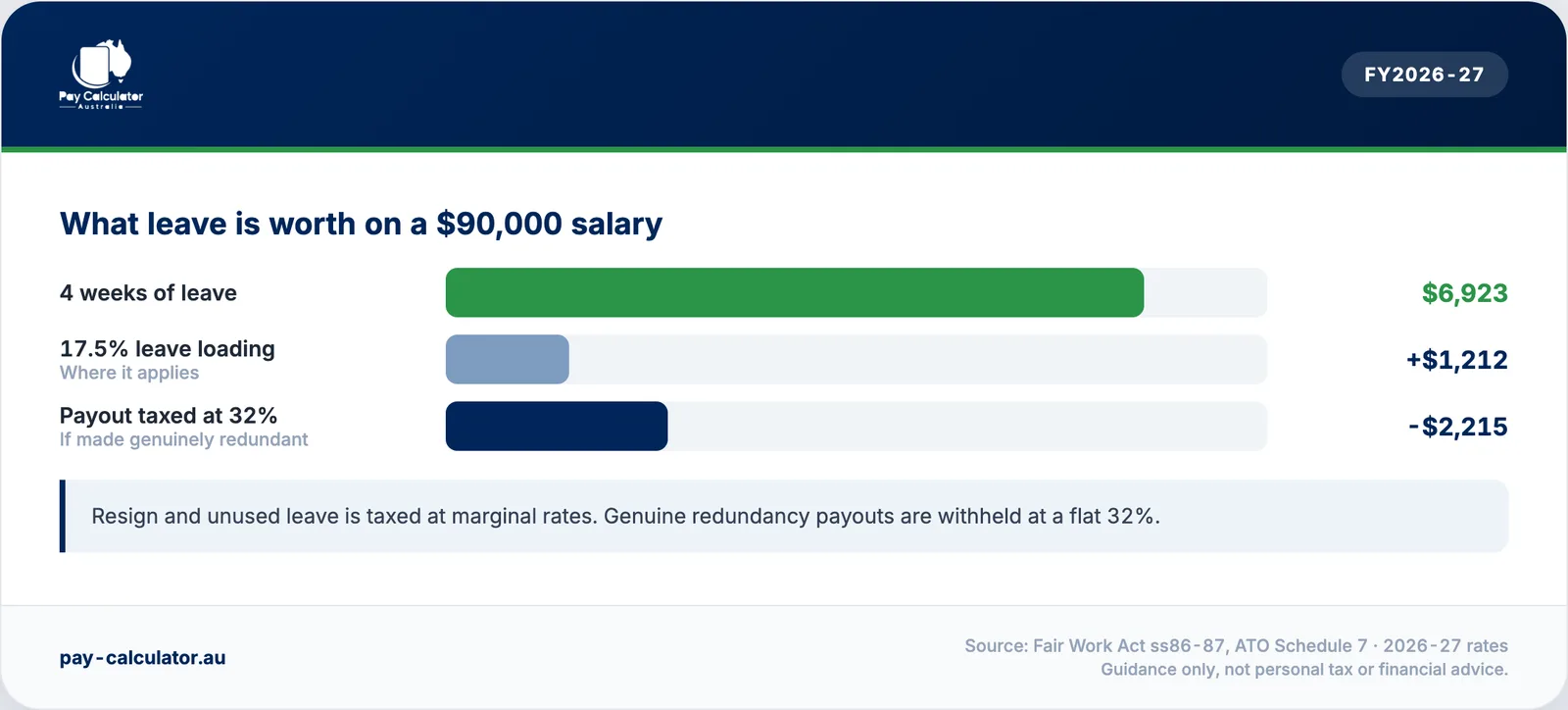
The numbers on a $90,000 salary (2026-27): a week of leave pays the usual $1,730.77. Four weeks is $6,923.08, and the 17.5% loading adds $1,211.54 on top, making the holiday worth $8,134.62 gross. The loading is ordinary income and is withheld like normal pay; there is no special loading tax rate.
Where loading exists, it follows your leave everywhere, including into your final pay. That termination rule is stronger than most people expect, as the next section shows.
What happens to unused annual leave when you leave?
All of it is paid out. Your final pay must include every hour of unused annual leave, valued at your base rate, under Fair Work Act 2009 s90(2). Unused sick and carer's leave, by contrast, is not paid out at all.
The rule that catches employers: annual leave loading is payable on that payout wherever you would have received loading during employment, even if an award, enterprise agreement or contract says it is not paid on termination. Fair Work states this explicitly, and it is a common underpayment. If you received 17.5% loading on holidays, your leave payout carries it too.
Most awards require final pay within 7 days of your last day. To price a full final pay, including notice and any redundancy component, use the final pay calculator; for the leave component alone, the leave calculator covers it.
How is a leave payout taxed on termination?
The reason you leave changes the withholding. ATO Schedule 7 (NAT 3351), published 17 June 2026.
Unused leave paid on termination is withheld under ATO Schedule 7, and the rate depends on why you are leaving. Resign or retire, and unused annual leave and loading accrued after 17 August 1993 are withheld at marginal rates, using a method that spreads the payment across a year of pay periods. Leave in a genuine redundancy, invalidity or approved early retirement scheme, and the same balance is withheld at a flat 32%, whatever your income.
| Payment | Reason for leaving | Withholding |
|---|---|---|
| Annual leave and loading (accrued after 17 Aug 1993) | Resignation, retirement, termination for inefficiency | Marginal rates |
| Annual leave and loading (any accrual date) | Genuine redundancy, invalidity, early retirement scheme | Flat 32% |
| Annual leave and loading (accrued before 18 Aug 1993) | Resignation or retirement | Flat 32% |
| Long service leave (accrued after 17 Aug 1993) | Resignation or retirement | Marginal rates |
| Long service leave (accrued after 17 Aug 1993) | Genuine redundancy, invalidity, early retirement scheme | Flat 32% |
| Long service leave (16 Aug 1978 to 17 Aug 1993) | Any reason | Flat 32% |
| Long service leave (accrued before 16 Aug 1978) | Any reason | 5% of the payment, at marginal rates |
Source: ATO Schedule 7 (NAT 3351, QC107125), published 17 June 2026, applying to payments from 1 July 2026. No study and training loan (HECS-HELP) amount is withheld from these payments.
Here is the same payout under both reasons, computed for 2 weeks of unused leave plus 17.5% loading. The resignation column estimates the marginal-rate withholding as your 2026-27 marginal tax rate plus the 2% Medicare levy; employers calculate the exact figure with the Schedule 7 method and the weekly tax table.
| Salary | Payout (2 weeks + 17.5% loading) | Est. withheld if you resign | Withheld if made redundant (32%) |
|---|---|---|---|
| $40,000 | $1,807.69 | $307.31 | $578.46 |
| $60,000 | $2,711.54 | $867.69 | $867.69 |
| $90,000 | $4,067.31 | $1,301.54 | $1,301.54 |
| $150,000 | $6,778.85 | $2,643.75 | $2,169.23 |
Computed with this site's 2026-27 tax engine. Withholding is the payday estimate, not your final tax: a low earner withheld at the flat 32% in a redundancy typically gets the difference back at tax time, and a top-bracket earner may owe more.
Notice the two ends of the table. On a $40,000 salary the flat 32% takes roughly double what marginal rates would, and the excess comes back as a refund when you lodge. On $150,000 the flat 32% is 7 points below the 37% bracket plus Medicare, so redundancy withholding runs light instead. The redundancy pay calculator handles the full redundancy picture, including the tax-free component.
What about long service leave?
Long service leave is a separate entitlement from annual leave, and unlike the NES it is set by state and territory law rather than one national standard. The qualifying period, the amount of leave and the pro-rata rules on termination differ by jurisdiction, so check the long service leave authority for your state or territory for your exact entitlement. We have not reproduced state-by-state figures here because we have not yet verified them against each Act.
The tax side is national and is in the Schedule 7 table above. Long service leave accrued after 17 August 1993 is withheld at marginal rates when you resign or retire, and at a flat 32% in a genuine redundancy, invalidity or early retirement scheme. Older accruals have their own rows, which mostly matter for very long-serving employees. Annual leave keeps accruing while you are on long service leave, which quietly adds to the final balance.
Annual leave questions
Where these figures come from
- Fair Work Act 2009 ss86-87 (annual leave entitlement and accrual) and s90(2) (payment of unused leave on termination).
- Fair Work Ombudsman, Annual leave, updated 25 March 2026.
- Fair Work Ombudsman, Final pay, updated 15 May 2026.
- Fair Work Ombudsman library, Calculating annual leave loading (K600323), for the 17.5% loading.
- ATO Schedule 7, Tax table for unused leave payments on termination of employment (NAT 3351, QC107125), published 17 June 2026.
Last verified 23 July 2026. Dollar examples are computed live from this site's 2026-27 tax engine and the stated salaries.
Written by Marcus Kelleher, editor, pay and tax content at pay-calculator.au. He works from ATO and Fair Work source documents and is not a registered tax agent. If your termination mixes leave, an ETP and redundancy caps, a registered tax agent is worth the money.