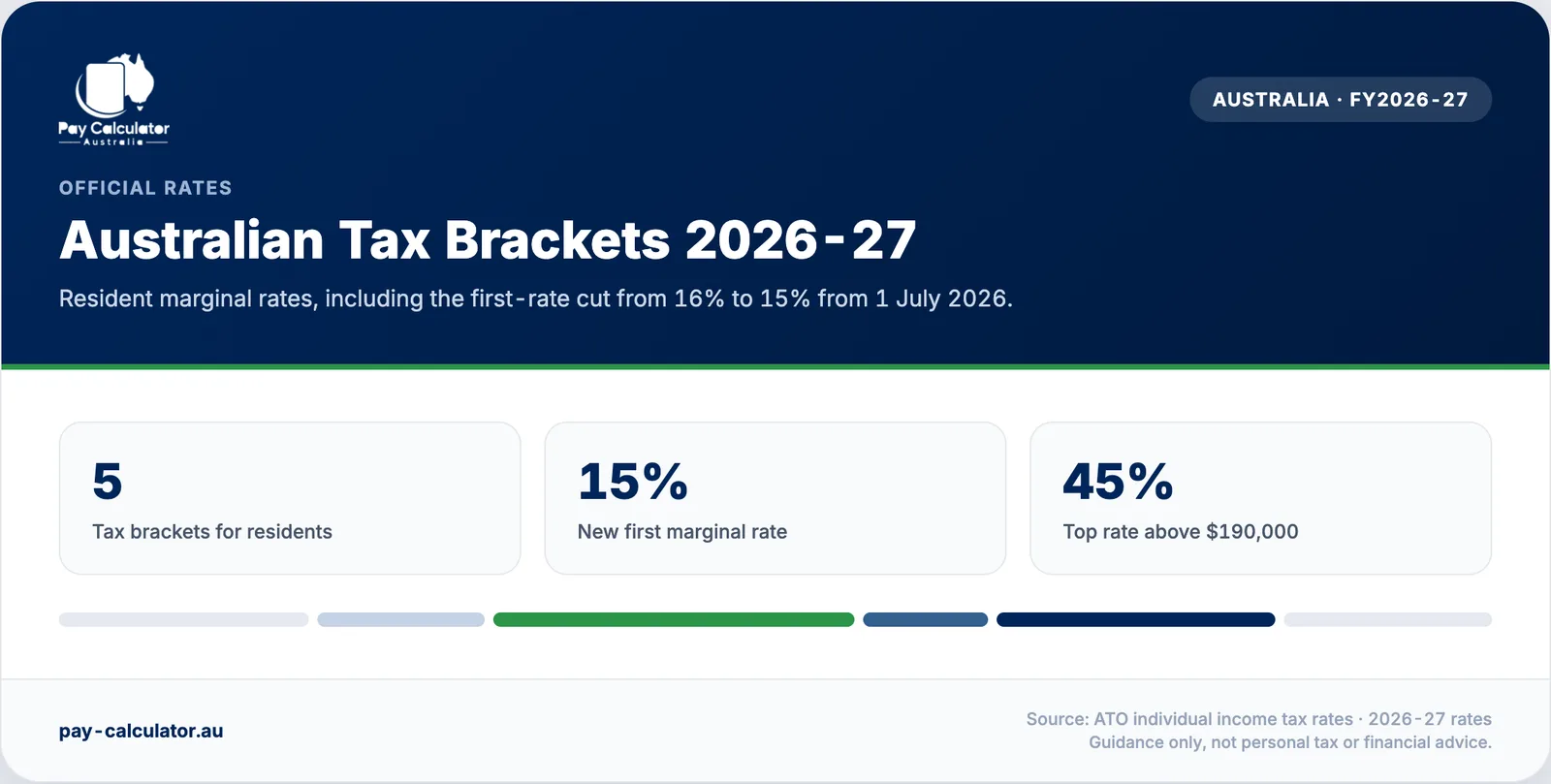
For 2026-27, Australian residents pay no tax on the first $18,200, then 15%, 30%, 37% and 45% as income rises through the brackets. The 15% rate is new: it was cut from 16% on 1 July 2026, and it saves most full-time workers $268 a year. This guide lists every 2026-27 bracket for residents, foreign residents and working holiday makers, shows what you actually pay at common incomes, and explains the two rates (marginal and effective) that people constantly mix up.
Key takeaways
- Residents pay nothing on the first $18,200, then 15%, 30%, 37% and 45% (2026-27).
- The first taxed rate fell from 16% to 15% on 1 July 2026, worth up to $268 a year.
- The bracket thresholds did not move: $18,200, $45,000, $135,000 and $190,000 are unchanged.
- The 2% Medicare levy sits on top of the bracket rates for most residents.
- Your effective rate is always lower than your marginal rate. On $90,000 they are 21.5% and 30%.
What are the Australian tax brackets for 2026-27?
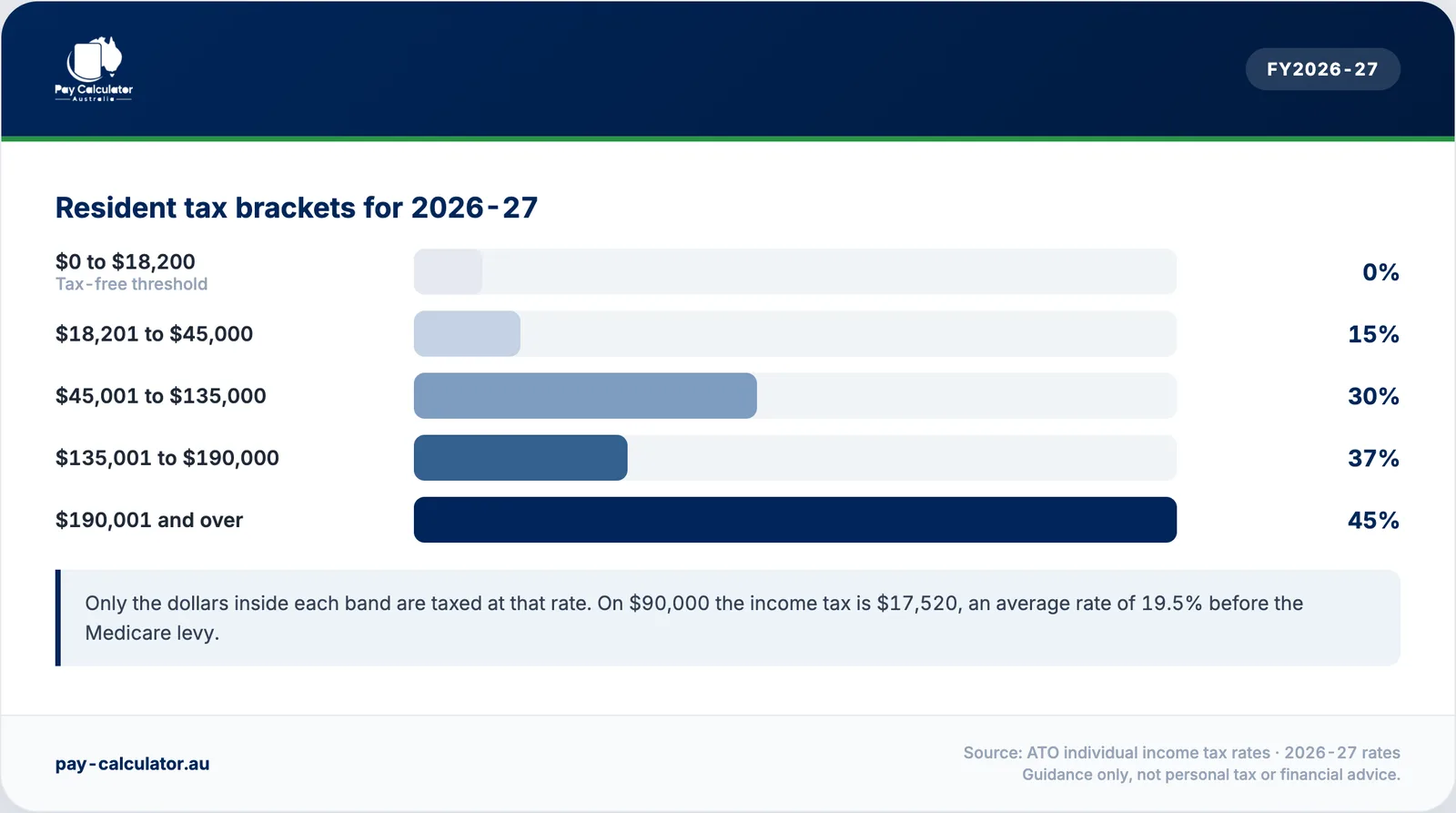
An Australian resident in 2026-27 pays tax at five marginal rates, starting at nil and topping out at 45%. Each rate applies only to the income inside its band, never to your whole salary. These figures come from the legislated 15% first rate and the unchanged ATO thresholds, and they exclude the 2% Medicare levy.
| Taxable income (2026-27) | Rate | Tax on this income |
|---|---|---|
| $0 to $18,200 | 0% | Nil (tax-free threshold) |
| $18,201 to $45,000 | 15% | 15c for each $1 over $18,200 |
| $45,001 to $135,000 | 30% | $4,020 plus 30c for each $1 over $45,000 |
| $135,001 to $190,000 | 37% | $31,020 plus 37c for each $1 over $135,000 |
| $190,001 and over | 45% | $51,370 plus 45c for each $1 over $190,000 |
The base amounts ($4,020, $31,020 and $51,370) are the tax accumulated in the bands below each threshold. To see the bands applied to your own salary, use the income tax calculator.
What changed on 1 July 2026?
One rate changed: the $18,201 to $45,000 band fell from 16% to 15%. The cut is law under the Income Tax Rates Amendment (Tax Reform No. 1) Act 2026, and the ATO confirms a further cut to 14% from 1 July 2027. No threshold moved, and the $18,200 tax-free threshold is unchanged.
The cut is worth 1 percentage point on up to $26,800 of income, so the maximum saving is $268 a year. Anyone with taxable income of $45,000 or more gets the full $268. Below $45,000 the saving is 1% of your income above $18,200. You can see it in the base amounts, which each dropped by exactly $268: $4,288 became $4,020, $31,288 became $31,020, and $51,638 became $51,370.
The other change for 2026-27 is a new standard deduction of up to $1,000 for work-related expenses, claimable on your 2026-27 return without receipts. It reduces taxable income, so it is worth up to $1,000 times your marginal rate, roughly $170 to $470 including the Medicare levy. It is claimed at tax time, not through payday withholding, so it will not appear in your regular pay.
How is tax actually calculated across the brackets?
Your income is sliced into bands and each slice is taxed at its own rate. Moving into a higher bracket only raises the rate on the dollars above the threshold, so earning $1 more never reduces your after-tax income. Here is a $90,000 salary built band by band for 2026-27:
- The first $18,200 is tax-free: $0.
- $18,201 to $45,000 is $26,800 taxed at 15%: $4,020.
- $45,001 to $90,000 is $45,000 taxed at 30%: $13,500.
Total income tax is $17,520. The 2% Medicare levy adds $1,800, bringing the total to $19,320 and leaving $70,680 before super and any study loan. The employer pays 12% super on top of the $90,000, not out of it.
On $90,000 your marginal rate is 30%, but your average rate including the Medicare levy is 21.5% (2026-27). The first is what the next dollar costs you. The second is what you actually paid across the whole year.
How much tax do you pay at common incomes?
The table below applies the 2026-27 brackets, subtracts the Low Income Tax Offset where it applies, and adds the 2% Medicare levy. Every figure is computed from the same engine that powers the take-home pay calculator, so it matches what you would see there.
| Taxable income | Income tax (after LITO) | Medicare levy | Total tax | Average rate |
|---|---|---|---|---|
| $30,000 | $1,070 | $199 | $1,269 | 4.2% |
| $40,000 | $2,695 | $800 | $3,495 | 8.7% |
| $50,000 | $5,270 | $1,000 | $6,270 | 12.5% |
| $60,000 | $8,420 | $1,200 | $9,620 | 16% |
| $70,000 | $11,520 | $1,400 | $12,920 | 18.5% |
| $80,000 | $14,520 | $1,600 | $16,120 | 20.2% |
| $90,000 | $17,520 | $1,800 | $19,320 | 21.5% |
| $100,000 | $20,520 | $2,000 | $22,520 | 22.5% |
| $120,000 | $26,520 | $2,400 | $28,920 | 24.1% |
| $135,000 | $31,020 | $2,700 | $33,720 | 25% |
| $150,000 | $36,570 | $3,000 | $39,570 | 26.4% |
| $180,000 | $47,670 | $3,600 | $51,270 | 28.5% |
| $200,000 | $55,870 | $4,000 | $59,870 | 29.9% |
Assumes a full-year resident claiming the tax-free threshold, with no study loan and no private health considerations. The Medicare levy uses the single low-income thresholds, which for 2026-27 have not yet been published by the ATO; the 2025-26 values ($28,011 and $35,013) are carried forward until they are.
What are the foreign resident tax brackets for 2026-27?
Foreign residents pay 30c from the very first dollar. There is no tax-free threshold and no Medicare levy. The 2026-27 first-rate cut did not touch this scale, because the lowest foreign resident rate is already 30%.
| Taxable income (2026-27) | Rate | Tax on this income |
|---|---|---|
| $0 to $135,000 | 30% | 30c for each $1 |
| $135,001 to $190,000 | 37% | $40,500 plus 37c for each $1 over $135,000 |
| $190,001 and over | 45% | $60,850 plus 45c for each $1 over $190,000 |
The difference at the low end is stark. A resident on $45,000 pays $4,595 in total for 2026-27; a foreign resident on the same income pays $13,500. Run your own numbers on the non-resident tax calculator.
What tax rates do working holiday makers pay in 2026-27?
Working holiday makers on a 417 or 462 visa pay 15c from the first dollar up to $45,000, with no tax-free threshold. The scale is unchanged for 2026-27 because its first bracket was already 15%. The ATO published the 2026-27 table in Schedule 15 (tax table for working holiday makers) on 17 June 2026.
| Taxable income (2026-27) | Rate | Tax on this income |
|---|---|---|
| $0 to $45,000 | 15% | 15c for each $1 |
| $45,001 to $135,000 | 30% | $6,750 plus 30c for each $1 over $45,000 |
| $135,001 to $190,000 | 37% | $33,750 plus 37c for each $1 over $135,000 |
| $190,001 and over | 45% | $54,100 plus 45c for each $1 over $190,000 |
A working holiday maker earning $45,000 pays $6,750 for 2026-27, against a resident on the same income paying $4,595 after LITO and the levy. The working holiday tax calculator covers both visa subclasses.
How does the Low Income Tax Offset interact with the brackets?
LITO knocks up to $700 off the income tax the brackets produce, for taxable incomes up to $66,667 (2026-27, unchanged by the tax cuts). It is applied automatically at assessment. It is non-refundable: it can cut your income tax to $0 but is never paid out, and it does not reduce the Medicare levy.
| Taxable income (2026-27) | LITO amount |
|---|---|
| $37,500 or less | $700 (maximum) |
| $37,501 to $45,000 | $700 minus 5c for every $1 above $37,500 |
| $45,001 to $66,667 | $325 minus 1.5c for every $1 above $45,000 |
| $66,668 and over | $0 |
On $30,000 you get the full $700, cutting income tax from $1,770 to $1,070 (2026-27). On $60,000 the offset is $100, and by $66,667 it is gone. The withdrawal has a side effect: between $45,001 and $66,667 each extra dollar loses 1.5c of LITO on top of the 30% bracket rate, so the true marginal rate there is 31.5% before the Medicare levy.
What is the difference between your marginal and effective tax rate?
Your marginal rate is the bracket rate on your next dollar. Your effective (average) rate is your total tax divided by your total income, and it is always lower, because the first $18,200 is tax-free and the early bands are taxed gently. The table below computes both for 2026-27, including the 2% Medicare levy and LITO.
| Taxable income | Marginal bracket rate | Marginal incl. 2% levy | Effective rate (total tax) |
|---|---|---|---|
| $50,000 | 30% | 32% | 12.5% |
| $70,000 | 30% | 32% | 18.5% |
| $90,000 | 30% | 32% | 21.5% |
| $110,000 | 30% | 32% | 23.4% |
| $130,000 | 30% | 32% | 24.7% |
| $150,000 | 37% | 39% | 26.4% |
| $170,000 | 37% | 39% | 27.9% |
| $200,000 | 45% | 47% | 29.9% |
| $250,000 | 45% | 47% | 33.3% |
Between $45,001 and $66,667 the LITO taper adds a further 1.5c per dollar to the true marginal rate. The gap between the two columns is why a pay rise feels smaller than expected but is never a loss. The full argument, with a computed demonstration, is in the guide to marginal vs average tax rates.
Do the tax brackets include the Medicare levy?
No. Most residents pay a Medicare levy of 2% of taxable income on top of the bracket rates, so the practical top rate on a middle income is 32%, not 30%. Low earners pay a reduced levy or none: for singles the levy is nil up to $28,011 and phases in at 10c per $1 up to $35,013. Those are the 2025-26 thresholds; the ATO has not yet published the 2026-27 low-income thresholds, and this page will be updated when it does. Foreign residents pay no levy at all. The Medicare levy calculator handles the shade-in for you.
Note also that the brackets describe your final tax, not what comes out of each pay. Your employer withholds using ATO schedules that approximate the year in advance, which is why the payslip deduction rarely matches the bracket arithmetic exactly. That gap is the subject of the guide to PAYG withholding.
Will the tax brackets change again in 2027-28?
Yes, one more legislated step is coming: the 15% rate falls to 14% on 1 July 2027, under the same act that delivered the 2026-27 cut. That will be worth up to another $268 a year on the same $26,800 band. The thresholds themselves have no legislated change, which means bracket creep continues: as wages rise with inflation, more of each salary drifts into the 30% and 37% bands even though the rates look unchanged. This page covers 2026-27 only, and will be superseded by a 2027-28 edition when those rates take effect.
Frequently asked questions
Sources
All rates verified against the named documents. Last verified 23 July 2026.
- ATO, Tax rates: Australian residents (tax-rates-australian-residents), last updated 1 June 2026. The 2026-27 base amounts are exact arithmetic from the legislated 15% rate and unchanged thresholds.
- ATO, Personal income tax: new tax cuts for every Australian taxpayer (new-legislation), last updated 13 May 2026. Confirms the 16% to 15% cut from 1 July 2026 and 15% to 14% from 1 July 2027. Income Tax Rates Amendment (Tax Reform No. 1) Act 2026.
- ATO, Standard deduction for work-related expenses (new-legislation), last updated 26 June 2026. Treasury Laws Amendment (Tax Reform No. 1) Act 2026.
- ATO, Tax rates: foreign residents (tax-rates-foreign-residents), last updated 1 June 2026.
- ATO, Schedule 15: tax table for working holiday makers, published 17 June 2026.
- ATO, Low income tax offset, last updated 8 June 2026.
- ATO, Medicare levy reduction for low-income earners, last updated 30 June 2026 (2025-26 thresholds, carried forward pending 2026-27 publication).