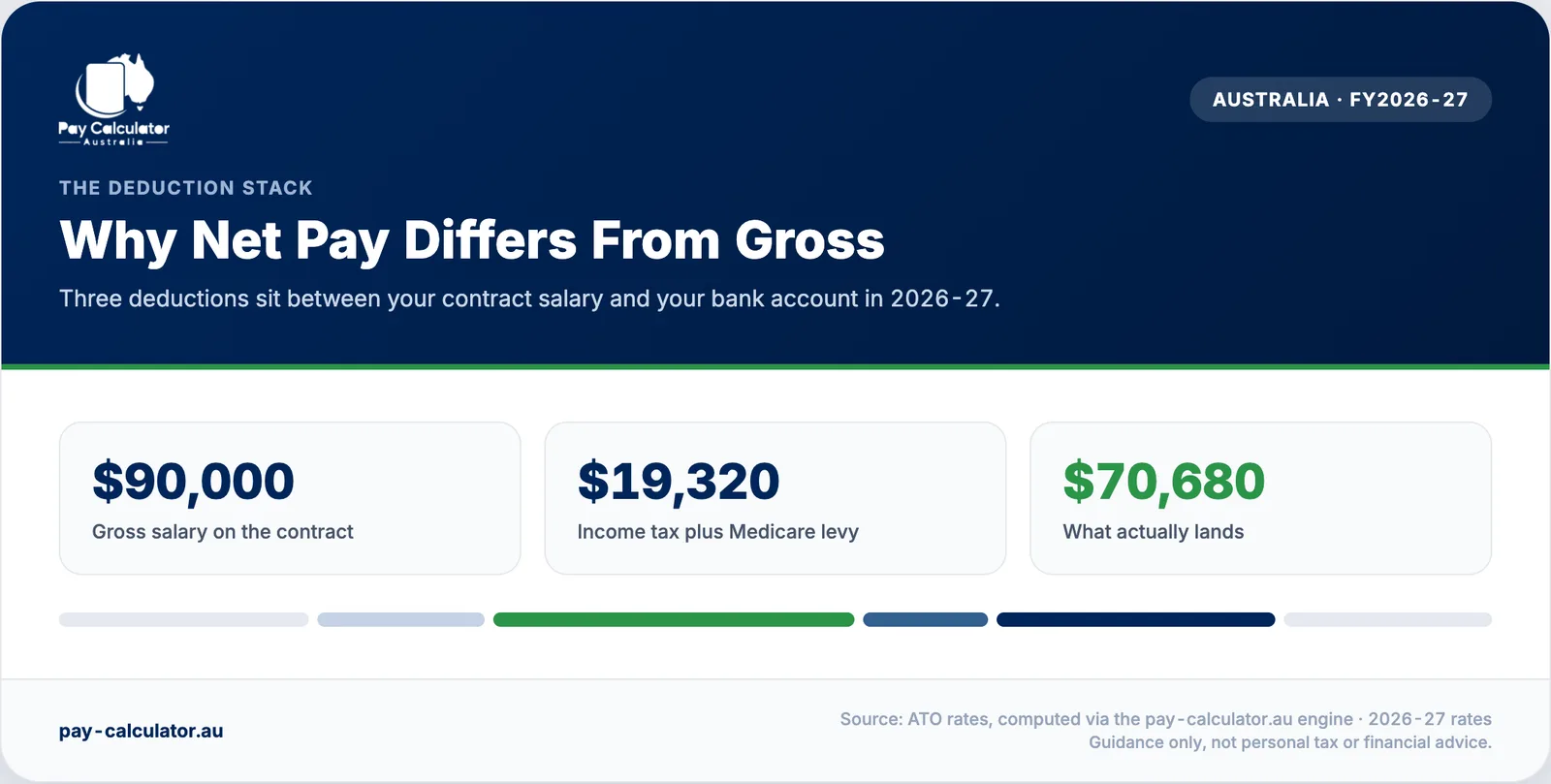
Your contract says one number and your bank account shows another. The gap is not random and it is not negotiable line by line, but it is completely explainable. For most employees it is exactly three things: income tax, the Medicare levy, and a HECS-HELP repayment if you have a study loan. This guide walks the whole stack on a $90,000 salary using 2026-27 rates, and clears up the most persistent myth of all, that superannuation is one of the deductions.
Key takeaways
- On $90,000 in FY2026-27, $19,320 comes out for income tax and Medicare, leaving $70,680.
- A HECS-HELP debt adds a $3,071 repayment, cutting net pay to $67,609.
- The 12% super guarantee is paid on top of gross salary. It is not part of the gap.
- Payslip tax is withholding, an estimate. Actual tax is settled at your return.
- You keep about 87.5% of a $50,000 salary but 73.6% of $150,000, because marginal rates climb.
Why is your net pay less than your gross pay?
Because Australia collects income tax as you earn it. On a $90,000 salary in 2026-27, your employer withholds $19,320 across the year for income tax and the Medicare levy, so $70,680 is what actually reaches your account. Gross pay is the price your employer pays for your work. Net pay is gross pay minus the amounts the law requires your employer to send to the ATO on your behalf, plus any deductions you personally agreed to, such as salary sacrifice or union fees.
The system doing the collecting is PAYG withholding, described in our PAYG withholding guide. The point of it is that a year's tax arrives in 26 painless slices rather than one dreadful bill in October.
What comes out of your pay, and in what order?
The stack below applies to a resident employee who claims the tax-free threshold. Each line is calculated on your income for the pay period, and everything after gross pay flows to the ATO through the same withholding payment.
| Step | What it is | Who sets it |
|---|---|---|
| Gross pay | Salary or wages for the period, before anything comes out | Your contract or award |
| Income tax | Marginal rates from 0% to 45% across the 2026-27 brackets | ATO, federal law |
| Medicare levy | 2% of taxable income for most residents | ATO, federal law |
| HECS-HELP (STSL) | Study loan repayment, only above $69,528 of income (FY2026-27) | ATO, federal law |
| Agreed deductions | Salary sacrifice, union fees, novated lease payments | You, by written agreement |
| Net pay | What lands in your bank account | The remainder |
Superannuation is deliberately absent from that stack. It sits alongside it, not inside it, as covered below. What each line looks like on a real payslip is in the payslip guide.
How much comes out of a $90,000 salary?
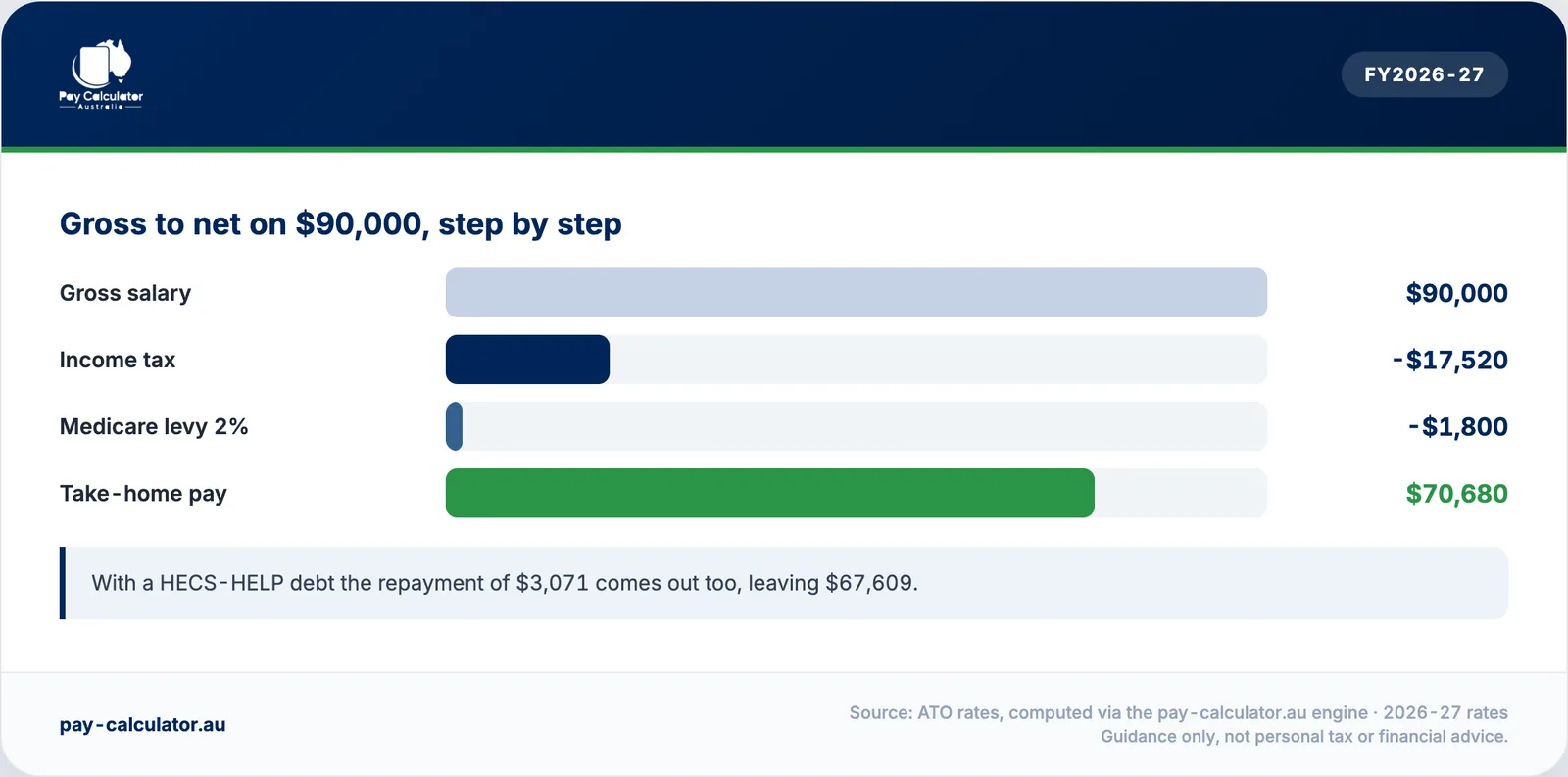
Here is the full walkthrough on $90,000 for FY2026-27, computed with the same engine that runs our calculators. The income tax builds band by band: the first $18,200 is tax-free, the slice to $45,000 is taxed at 15% ($4,020), and the slice from $45,000 to $90,000 at 30% ($13,500), giving $17,520 of income tax.
| Line | No study loan | With HECS-HELP |
|---|---|---|
| Gross salary | $90,000 | $90,000 |
| Income tax | $17,520 | $17,520 |
| Medicare levy (2%) | $1,800 | $1,800 |
| HECS-HELP repayment | $0 | $3,071 |
| Net pay for the year | $70,680 | $67,609 |
| Net per fortnight | $2,718 | $2,600 |
| Super paid on top (12%) | $10,800 | $10,800 |
Without a study loan you keep 78.5% of the gross figure. Your marginal rate is 30%, but your average tax rate including Medicare is only 21.5%, because the early slices of income are taxed gently. That distinction, marginal versus average, explains most pay rise disappointment and is worth two minutes in the marginal vs average tax rate guide.
Is superannuation a deduction from your pay?
No. The super guarantee is $10,800 on a $90,000 salary in FY2026-27, and every dollar of it is employer money paid on top of your salary, directly to your super fund. It shows up on your payslip because Fair Work rules require it to be shown, and that visibility convinces many people it was taken from them. It was not. Gross pay $90,000 minus the withheld amounts equals net pay $70,680, with no super anywhere in the subtraction.
The one exception is voluntary. If you salary sacrifice into super, part of your pre-tax salary is redirected to your fund, and that genuinely does lower your net pay in exchange for a lower tax bill and a bigger balance. The trade is examined in the salary sacrifice calculator. If your contract quotes a package including super, the arithmetic changes too: a $100,800 package including super is a $90,000 salary, not a $100,800 one. Our superannuation calculator splits packages either way.
What does the Medicare levy take?
For most residents the Medicare levy is 2% of taxable income, which is $1,800 on $90,000 for 2026-27. It funds the public health system and sits on top of the income tax brackets rather than inside them. On a payslip it has no line of its own: the ATO's withholding formulas fold it into the same PAYG amount as income tax.
Low earners are shielded. The levy phases in between a lower and upper threshold, and below the lower threshold no levy is payable at all. The ATO has not yet published the 2026-27 low-income thresholds, so the 2025-26 single figures apply for now: nil up to $28,011, phasing in to the full 2% by $35,013. This page will be updated when the new thresholds are released. The Medicare levy calculator applies the shade-in for you.
How does a HECS-HELP debt change your take-home pay?
A study loan turns a third tap on. For 2026-27, compulsory repayments start once repayment income passes $69,528 and are charged at 15c per dollar above that threshold under the marginal system, rising for incomes above $129,717. On $90,000 that is $3,071 for the year, which drops net pay from $70,680 to $67,609.
Two details matter. The repayment is based on repayment income, which adds back items like reportable super contributions and net investment losses, so it can be higher than the number on your payslip suggests. And the amounts withheld each payday do not touch your loan during the year; the loan is only credited when your return is assessed. The full mechanics are in the HECS-HELP repayments guide, and the repayment calculator gives you your own figure.
Why does the tax withheld differ from the tax you owe?
Because they are two different calculations. Withholding is a payday estimate, worked out from ATO tax tables (the fortnightly table is NAT 1006, and the underlying formulas are Schedule 1, NAT 1004) using only that pay's amount and your declarations. Your actual tax is worked out once, after 30 June, on your real annual income minus your deductions.
The two rarely match exactly. Deductions are claimed at return time, not payday, so withholding ignores them. Bonuses, overtime spikes, job changes and second jobs all push the estimate off target. Withhold too much and the difference returns to you as a refund; too little and it becomes a bill. Neither outcome means the payslip was wrong. It means an estimate met reality, which is the system working as designed. To see which side of the line you are on, try the tax refund calculator.
What is net pay at common salaries?
The table below runs the full stack at common salaries for FY2026-27: resident rates, tax-free threshold claimed, no study loan, super paid on top. The income tax column includes the Low Income Tax Offset where it applies (worth up to $700 for lower earners).
| Gross salary | Income tax | Medicare levy | Net pay | Share kept |
|---|---|---|---|---|
| $50,000 | $5,270 | $1,000 | $43,730 | 87.5% |
| $60,000 | $8,420 | $1,200 | $50,380 | 84% |
| $70,000 | $11,520 | $1,400 | $57,080 | 81.5% |
| $80,000 | $14,520 | $1,600 | $63,880 | 79.9% |
| $90,000 | $17,520 | $1,800 | $70,680 | 78.5% |
| $100,000 | $20,520 | $2,000 | $77,480 | 77.5% |
| $120,000 | $26,520 | $2,400 | $91,080 | 75.9% |
| $150,000 | $36,570 | $3,000 | $110,430 | 73.6% |
Read the last column top to bottom and the shape of the system appears: the share you keep falls as income rises, but gradually, never off a cliff. Earning more always leaves you with more. For any salary between the rows, the gross to net calculator gives the exact figure.
How can you lift your net pay?
Three legitimate levers exist, and none of them is a trick. First, make sure the tax-free threshold is claimed with your main employer and only your main employer; claiming it twice leads to a bill, claiming it nowhere shrinks every pay unnecessarily. Second, claim your deductions at tax time. New for 2026-27, residents with work income can claim a standard deduction of up to $1,000 for work-related expenses without receipts (ATO, measure confirmed as law, page updated 26 June 2026), and genuine expenses above that can still be claimed the usual way. Money returns as a refund rather than in each pay.
Third, salary sacrifice, which cuts your net pay now but converts highly-taxed salary into concessionally-taxed super. Whether that trade suits you depends on your marginal rate and your patience; the super vs take-home comparison makes the trade visible. Beyond that, be wary of anything promising to beat the stack. The stack is federal law, and it is the same for everyone earning the same income in the same circumstances.
Gross vs net FAQ
Sources
- ATO, Individual income tax rates for 2026-27 (15% first marginal rate from 1 July 2026 under the Treasury Laws Amendment (More Cost of Living Relief) Act 2025).
- ATO, Medicare levy and low-income reduction thresholds. 2026-27 low-income thresholds not yet published; 2025-26 values ($28,011 to $35,013 single) carried forward.
- ATO, Study and training support loans rates and repayment thresholds ($69,528 minimum threshold, marginal rates), updated 30 June 2026.
- ATO, Standard deduction for work-related expenses (up to $1,000, first applies to 2026-27 returns), updated 26 June 2026.
- ATO, Schedule 1 Statement of formulas (NAT 1004) and Fortnightly tax table (NAT 1006), 2026-27 editions.
- ATO, Super guarantee rate (12% for 2026-27).
Last verified 23 July 2026. All worked figures computed with this site's FY2026-27 tax engine.