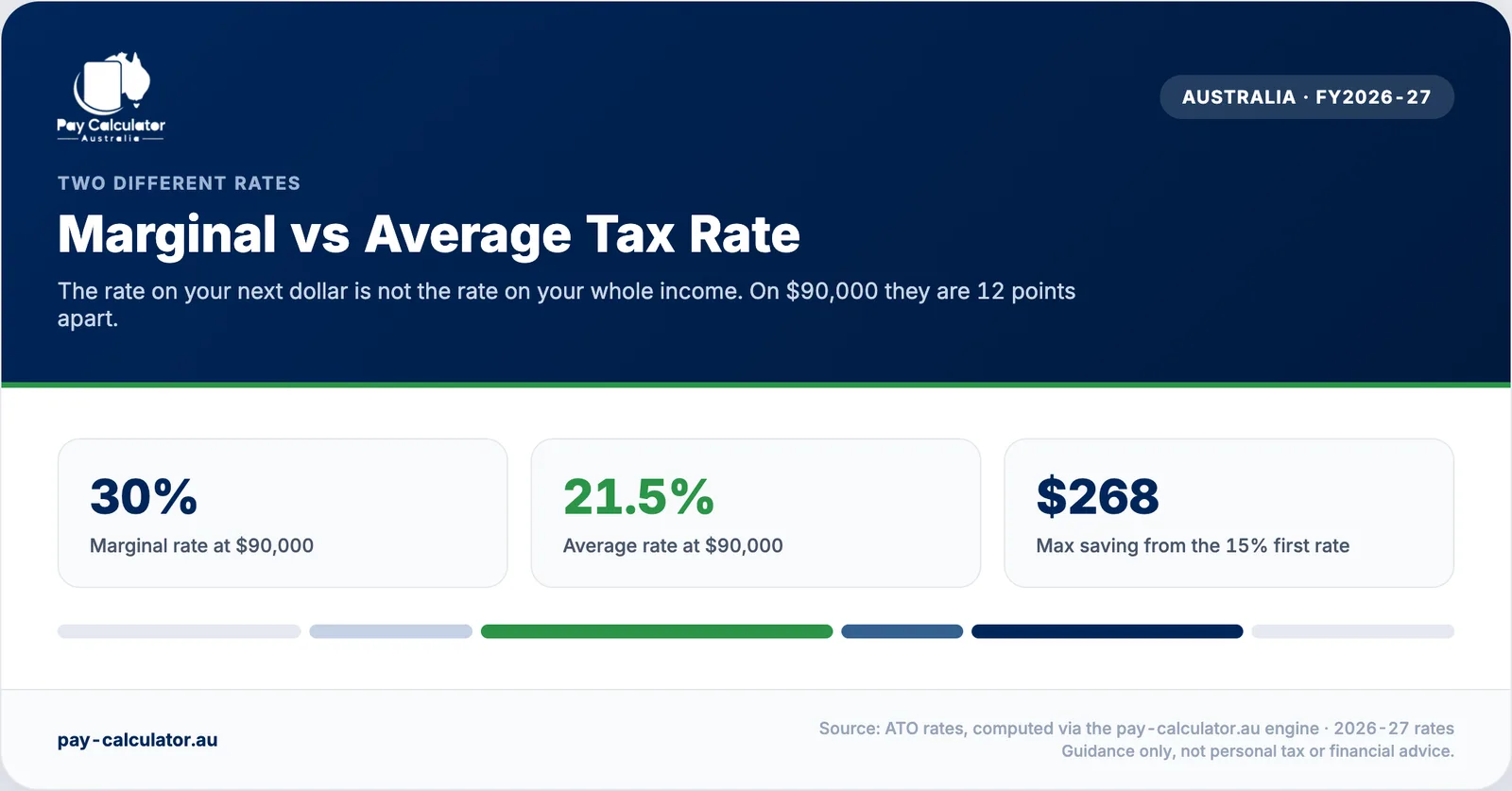
On $90,000 your marginal rate is 30%, but your average rate is 21.5% including the Medicare levy (2026-27). The first is what the next dollar costs you. The second is what you actually paid across the whole year. People quote the first and budget with the second, which is why a pay rise usually feels smaller than expected but is rarely as bad as feared. This guide computes both rates across common salaries, demolishes the pay-rise myth with real numbers, and explains bracket creep.
Key takeaways
- Marginal rate: the bracket rate on your next dollar (15%, 30%, 37% or 45% for residents in 2026-27).
- Average rate: total tax divided by total income, always lower than the marginal rate.
- A pay rise can never leave you with less after tax. Only the extra dollars are taxed at the higher rate.
- On a $2,000 rise from $44,000 to $46,000 you keep $1,445 (2026-27).
- Bracket creep lifts your average rate over time because thresholds stay fixed while wages grow.
What is the difference between your marginal and average tax rate?
Two numbers describe the same taxpayer and they are routinely confused. Your marginal tax rate is the rate of the bracket your top dollar sits in: 15%, 30%, 37% or 45% for a resident in 2026-27, plus 2% Medicare levy for most people. Your average tax rate (also called the effective rate) is your total tax divided by your total income.
The average is always lower because Australia taxes income in slices. The first $18,200 is free, the next $26,800 costs 15c per dollar, and only the income above each threshold pays the higher rates. Your top rate applies to your top slice only. Averaged over every slice, the blended figure lands well below the headline. The full slice-by-slice mechanics are in the guide to the 2026-27 tax brackets.
What is your marginal tax rate in 2026-27?
Find the band your taxable income sits in; the rate on your next dollar is the rate of that band, or the next one if you are sitting exactly on a threshold. A resident on $60,000 has a 30% marginal rate, since $60,000 falls in the $45,001 to $135,000 band. Add the 2% Medicare levy and the practical marginal rate is 32%: of the next $100 you earn, $32 goes to tax and levy.
The marginal rate is the one that moved on 1 July 2026 for low and middle bands: the $18,201 to $45,000 band fell from 16% to 15% under the Income Tax Rates Amendment (Tax Reform No. 1) Act 2026. Note that the rate withheld from each payslip is a separate thing again, an estimate made by your employer under the ATO withholding schedules. How that estimate works is covered in the guide to PAYG withholding.
How is your average tax rate calculated?
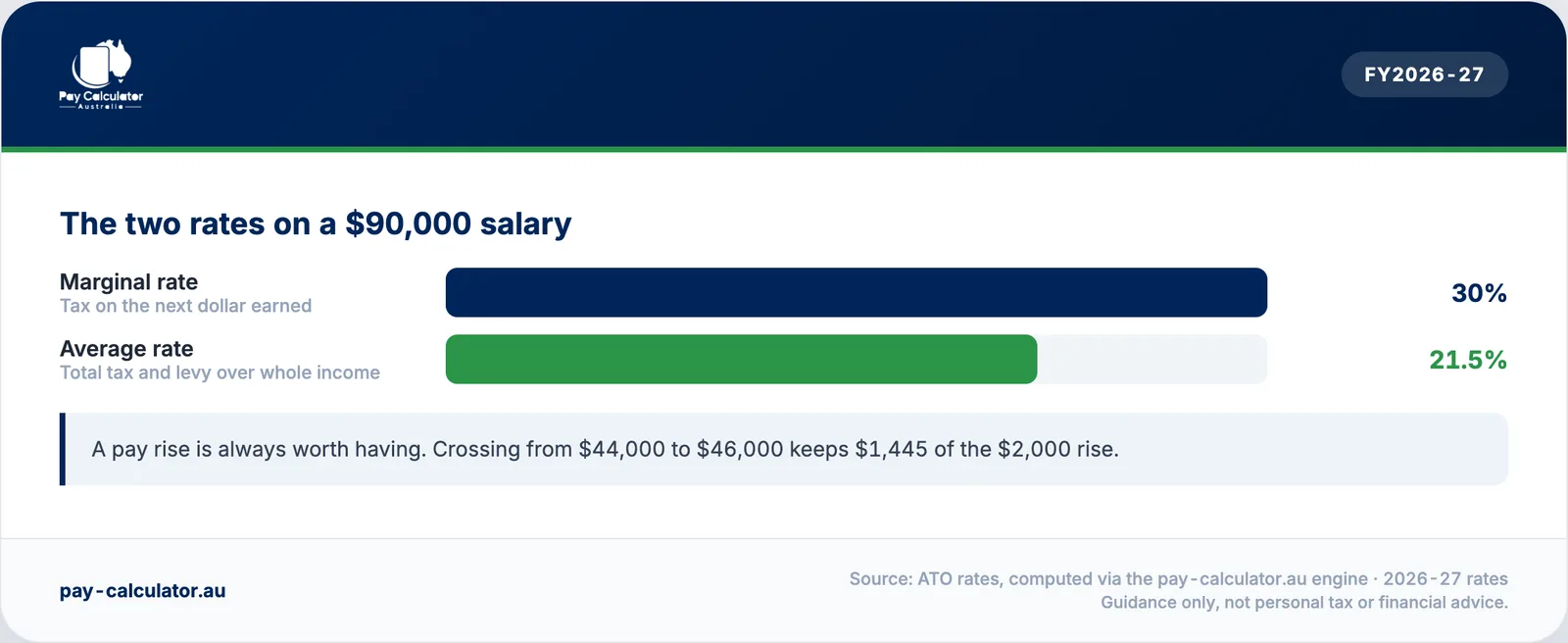
Total tax divided by total income. For a resident on $90,000 in 2026-27: income tax is $17,520, the Medicare levy adds $1,800, so total tax is $19,320. Divide by $90,000 and the average rate is 21.5%. The same person quotes a marginal rate of 30% at a barbecue, yet only 21.5% of their income actually left as tax.
Which one is your real tax rate? Both, for different questions. The marginal rate answers questions about change: what a rise, a deduction or extra overtime is worth. The average rate answers questions about totals: how much of the year went to tax, what your take-home is per dollar earned.
What are the two rates at common salaries?
The table computes both rates for 2026-27 residents, after the Low Income Tax Offset and including the 2% Medicare levy. The marginal column shows the bracket rate on the next dollar, excluding the levy.
| Taxable income | Total tax (incl. levy) | Average rate | Marginal bracket rate | Marginal incl. 2% levy |
|---|---|---|---|---|
| $30,000 | $1,269 | 4.2% | 15% | 17% |
| $45,000 | $4,595 | 10.2% | 30% | 32% |
| $60,000 | $9,620 | 16% | 30% | 32% |
| $75,000 | $14,520 | 19.4% | 30% | 32% |
| $90,000 | $19,320 | 21.5% | 30% | 32% |
| $110,000 | $25,720 | 23.4% | 30% | 32% |
| $135,000 | $33,720 | 25% | 37% | 39% |
| $160,000 | $43,470 | 27.2% | 37% | 39% |
| $190,000 | $55,170 | 29% | 45% | 47% |
| $250,000 | $83,370 | 33.3% | 45% | 47% |
Notice how slowly the average climbs. Even at $190,000, where the marginal rate hits 45%, the average is only 29% (2026-27). Nobody pays their marginal rate on everything. The Medicare levy figures use the single low-income shade-in with 2025-26 thresholds, as the ATO has not yet published the 2026-27 values. Check your own salary on the income tax calculator.
Does a pay rise ever leave you worse off after tax?
No. The myth says a rise that pushes you into a higher bracket taxes your whole salary at the new rate. That is not how the brackets work. Crossing a threshold changes the rate on the dollars above it and nothing else. Here is the demonstration, computed from the 2026-27 scale with LITO and the Medicare levy included:
| Pay rise | Extra gross | Extra tax and levy | You keep | Kept |
|---|---|---|---|---|
| $44,000 to $46,000 (crosses into the 30% bracket) | $2,000 | $555 | $1,445 | 72.3% |
| $88,000 to $92,000 (stays inside the 30% bracket) | $4,000 | $1,280 | $2,720 | 68% |
| $134,000 to $136,000 (crosses into the 37% bracket) | $2,000 | $710 | $1,290 | 64.5% |
| $188,000 to $192,000 (crosses into the 45% bracket) | $4,000 | $1,720 | $2,280 | 57% |
Take the first row. The rise from $44,000 to $46,000 crosses the $45,000 threshold into the 30% band, the move that the myth says is dangerous. Extra tax and levy come to $555 on $2,000 of extra pay, so you keep $1,445. Your $44,000 continues to be taxed exactly as it was. In every row, at every threshold, the kept column is positive. What a rise does do is lift your average rate slightly, which is why the extra cash feels smaller than the headline figure. Model your own rise on the pay rise calculator.
One honest caveat: tax itself can never send you backwards, but income-tested things outside the tax scale (a study loan repayment, a government payment that phases out) can bite around their own thresholds. Those are separate systems with their own rules, not the tax brackets.
What is bracket creep?
Bracket creep is what happens when wages rise with inflation but the bracket thresholds stay put. Each year a little more of your income sits above $45,000, or above $135,000, so your average tax rate drifts up even though no rate changed and your real buying power may not have moved. It is a tax rise nobody legislates.
The 2026-27 settings show both sides of it. The thresholds ($18,200, $45,000, $135,000 and $190,000) are unchanged from 2025-26, so creep continues. Against that, the first rate was cut from 16% to 15%, worth up to $268 a year, and a further cut to 14% is legislated for 1 July 2027. Rate cuts like these hand back some of what creep collected, but because they change rates rather than thresholds, the drift resumes immediately. Watching your average rate year over year, not your bracket, is how you notice it.
How do LITO and the Medicare levy change your true marginal rate?
The headline bracket rate understates the true cost of the next dollar in two zones. First, the Low Income Tax Offset withdraws as income rises: at 5c per dollar between $37,501 and $45,000, and 1.5c per dollar between $45,001 and $66,667 (2026-27). Losing offset is the same as paying extra tax, so the true marginal rate in those ranges is 20% and 31.5% respectively, before the levy.
Second, the Medicare levy phases in at 10c per dollar across the low-income shade-in band (from $28,011 to $35,013 for singles, 2025-26 thresholds carried forward), which briefly makes the true marginal rate on those dollars much higher than the 15% bracket suggests. Above the shade-in the levy settles at a flat 2% on top. These quirks matter for anyone weighing up extra hours or salary sacrifice near those income points; the Medicare levy calculator shows the shade-in on your own income.
Which rate should you use for a deduction or salary sacrifice decision?
The marginal rate, always. A deduction removes dollars from the top of your income, so it saves tax at your top rate. The new $1,000 standard work deduction for 2026-27 is worth about $320 to someone in the 30% band including the levy, but only $170 to someone in the 15% band. Salary sacrifice works the same way: pre-tax super contributions dodge your marginal rate and get taxed at 15% in the fund instead, so the higher your marginal rate, the stronger the case. The arithmetic for your own salary is on the salary sacrifice calculator.
Which rate should you use for budgeting?
The average rate, because it is the one that describes your whole pay packet. If your average rate including the levy is 21.5% on $90,000 (2026-27), then roughly 78.5% of your gross lands in your account before super and any study loan. Budgeting with your marginal rate overstates your tax dramatically; assuming 32% of $90,000 goes to tax overshoots the real figure by about $9,480. The take-home pay calculator gives you the precise net figure per week, fortnight or month, which beats both approximations.
Frequently asked questions
Sources
All figures verified against the named documents. Last verified 23 July 2026.
- ATO, Tax rates: Australian residents, last updated 1 June 2026, with the 2026-27 15% first rate per the Income Tax Rates Amendment (Tax Reform No. 1) Act 2026.
- ATO, Personal income tax: new tax cuts for every Australian taxpayer (new-legislation), last updated 13 May 2026 (15% from 1 July 2026, 14% from 1 July 2027).
- ATO, Low income tax offset (taper rates of 5c and 1.5c per dollar), last updated 8 June 2026.
- ATO, Medicare levy reduction for low-income earners, last updated 30 June 2026 (2025-26 shade-in thresholds, carried forward pending 2026-27 publication; 10c phase-in per Medicare Levy Act 1986 s7).
- ATO, Standard deduction for work-related expenses (new-legislation), last updated 26 June 2026.