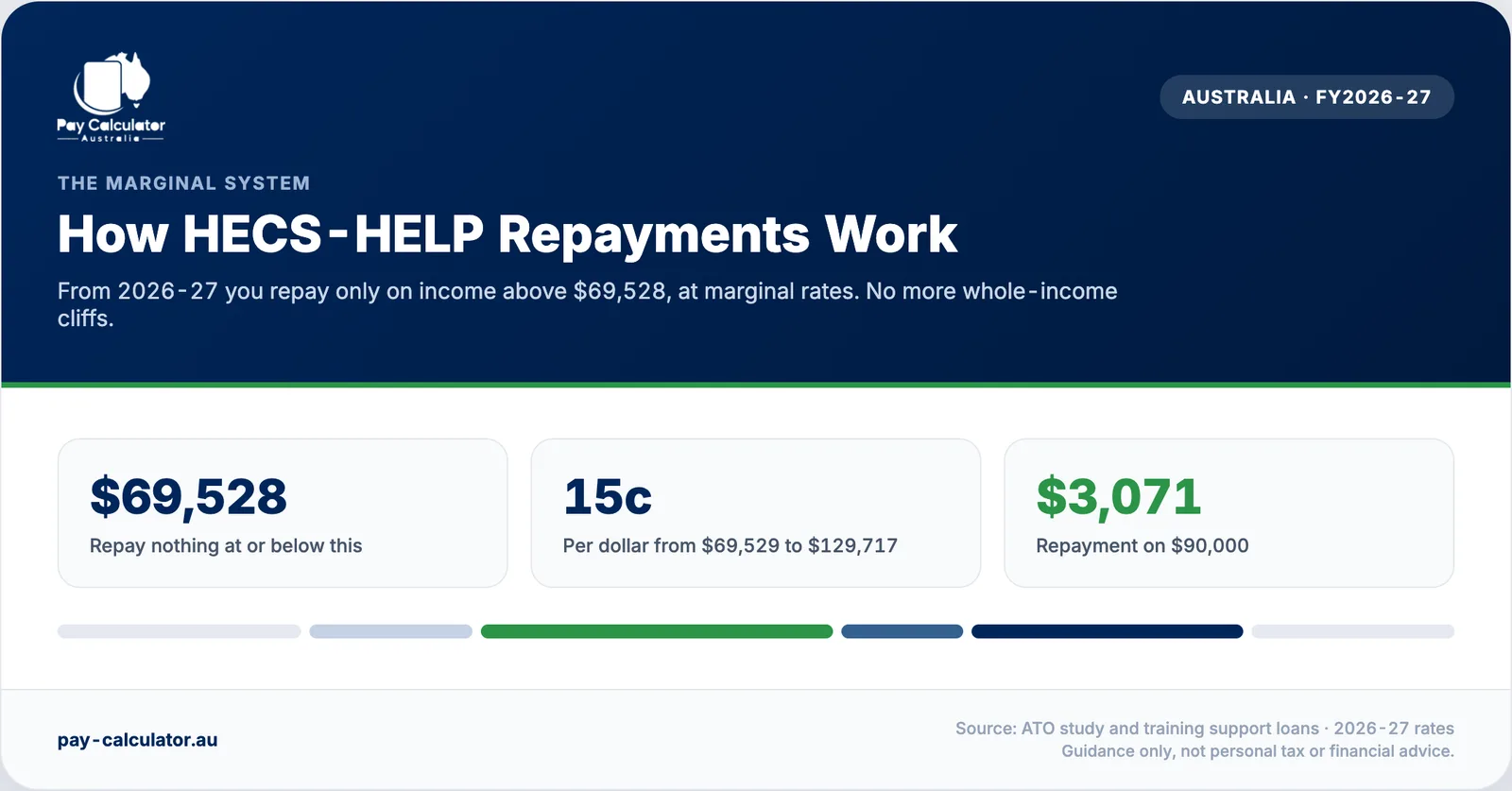
If your repayment income is $69,528 or less in 2026-27, you make no compulsory HECS-HELP repayment at all. Above that, you repay at marginal rates, 15c and then 17c per dollar, on the income above the threshold rather than on your whole salary. That marginal design is recent, it started in 2025-26, and it changed the answer for almost everyone with a student loan. This guide explains the 2026-27 thresholds, how the repayment is calculated and collected, how indexation grows the balance, and whether paying the loan off early makes sense.
Key takeaways
- No compulsory repayment at or below $69,528 of repayment income (FY2026-27).
- Above the threshold you repay 15c per $1 up to $129,717, then $9,028 plus 17c per $1, then a flat 10% of whole income from $186,051.
- On a $90,000 income the 2026-27 repayment is $3,071, about 3.4% of income.
- Extra tax withheld each pay does not touch your balance. The repayment is applied once, after you lodge your return.
- Indexation on 1 June 2026 was 2.8%, the lowest of CPI and the Wage Price Index.
What is a HECS-HELP repayment?
A HECS-HELP repayment is a compulsory payment towards your student loan, collected through the tax system once your repayment income passes $69,528 in 2026-27. The ATO calls the whole family of loans Study and Training Support Loans, or STSL. One set of thresholds and rates covers HECS-HELP, FEE-HELP, OS-HELP, SA-HELP, VET Student Loans, SFSS, Student Start-up Loans, ABSTUDY SSL and Australian Apprenticeship Support Loans.
If you hold more than one loan type, compulsory repayments are applied in a fixed order: HELP first, then VSL, SFSS, SSL, ABSTUDY SSL and AASL. You do not choose which loan is paid down. The calculation is identical whichever loan sits behind it.
What is the HECS repayment threshold for 2026-27?
The minimum repayment threshold is $69,528 for 2026-27, up from $67,000 in 2025-26. At or below $69,528 of repayment income you repay nothing for the year. The ATO indexes the repayment thresholds each year in line with average weekly earnings, which is why the threshold moves every 1 July. The figure comes from the ATO study and training support loans rates and repayment thresholds page, last updated 30 June 2026.
The threshold is a starting line, not a cliff. Crossing it does not trigger a repayment on your whole income. It only starts the meter running on the dollars above it, at 15c per dollar.
How is your HECS repayment calculated in 2026-27?
Your repayment is calculated marginally, the same way income tax brackets work. Each band of repayment income above $69,528 attracts its own rate, and only the top band is different: at $186,051 and over, the repayment is a flat 10% of your total repayment income. The full 2026-27 table:
| Repayment income (2026-27) | Repayment on this income |
|---|---|
| $0 to $69,528 | Nil |
| $69,529 to $129,717 | 15c for each $1 over $69,528 |
| $129,718 to $186,050 | $9,028 plus 17c for each $1 over $129,717 |
| $186,051 and over | 10% of total repayment income |
The $9,028 base is not arbitrary. It is the 15c band fully used up: 15% of the $60,189 between $69,528 and $129,717 comes to $9,028. The 10% top band is designed to join smoothly too, so there is no cliff anywhere in the table. For the band-by-band detail, see our HELP repayment thresholds 2026-27 guide.
How much HECS do you repay at common salaries?
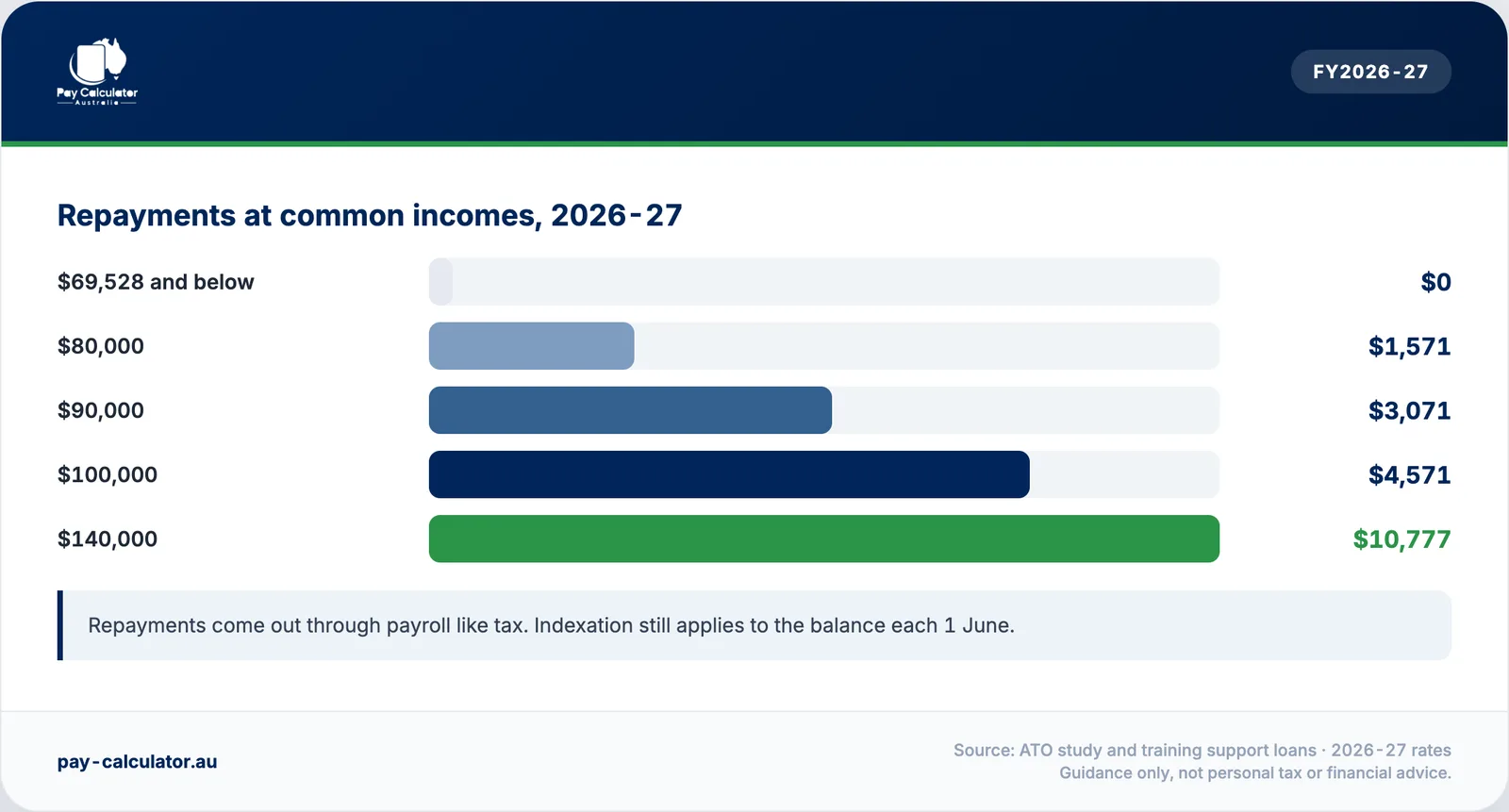
On a $90,000 repayment income the 2026-27 compulsory repayment is $3,071, which is 3.4% of income. The table below is computed directly from the 2026-27 band table, so every figure follows the marginal method.
| Repayment income | Annual repayment (2026-27) | Share of income |
|---|---|---|
| $60,000 | $0 | 0% |
| $70,000 | $71 | 0.1% |
| $80,000 | $1,571 | 2% |
| $90,000 | $3,071 | 3.4% |
| $100,000 | $4,571 | 4.6% |
| $110,000 | $6,071 | 5.5% |
| $120,000 | $7,571 | 6.3% |
| $130,000 | $9,076 | 7% |
| $140,000 | $10,776 | 7.7% |
| $160,000 | $14,176 | 8.9% |
| $180,000 | $17,576 | 9.8% |
| $200,000 | $20,000 | 10% |
These are the amounts assessed at tax time, not what appears on each payslip. Your employer withholds an estimate through the year, which is a different number for reasons covered below. To see the repayment alongside tax, Medicare and super on your own salary, use the HECS-HELP repayment calculator.
What does the calculation look like step by step?
Take a repayment income of $90,000 in 2026-27. It falls in the second band, so only the income above the threshold matters. $90,000 minus $69,528 leaves $20,472, and 15% of that is $3,070.80, which the ATO rounds to $3,071. On $100,000 the excess is $30,472 and the repayment is $4,570.80, rounding to $4,571.
Higher up, the third band adds its base. On $140,000 the repayment is $9,028 plus 17% of the $10,283 above $129,717, which is $10,776.11. And at $200,000 the whole-income rule applies: a flat 10%, or $20,000.
The ATO publishes its own 2026-27 examples, and this engine reproduces them exactly. Christina on $86,380 repays $2,527.80. Barry on $137,064 repays $10,276.99. Priya on $254,780 repays $25,478, 10% of her whole repayment income.
What changed from the old whole-income system?
Until 2024-25, one rate applied to your whole repayment income. You looked up your income band, read off a single percentage between 1% and 10%, and multiplied it by everything you earned. Crossing a band boundary by $1 lifted the rate on every dollar, not only the new one, which produced genuine cliffs in take-home pay.
The ATO published a contrast using 2025-26 figures. Grace, on a repayment income of $80,000, would have repaid $2,800 under the old whole-income method, 3.5% of the full $80,000. Under the new marginal method she repays $1,950, 15% of the $13,000 above the $67,000 threshold that applied in 2025-26. The ATO states that most people repay less from their 2026 tax return onwards, some people below the new minimum no longer repay at all, and nothing changes for people at or above the top band, where 10% of whole income is the same under both systems.
The change is law, in force from the 2025-26 income year, and it applies to 2026-27 with indexed thresholds. If your repayment felt smaller this year than the year before on the same salary, that is why.
What income counts as repayment income?
Repayment income is taxable income plus four add-backs, so it is usually equal to or higher than the figure on your notice of assessment. The full definition, from the ATO thresholds page, is the sum of:
- Taxable income, excluding any assessable First Home Super Saver released amounts.
- Reportable fringe benefits, regardless of whether your employer is FBT exempt.
- Total net investment loss, including net rental losses.
- Reportable super contributions, for example salary-sacrificed super.
- Exempt foreign employment income.
The add-backs exist so the repayment cannot be reduced by salary sacrificing into super, negative gearing or packaging fringe benefits. Sacrificed super still lowers your income tax, which you can test on the salary sacrifice calculator, but it does not lower your HECS repayment. For a wage earner with none of the add-backs, repayment income equals taxable income. Repayment is assessed on your income alone, never a spouse or parent.
How are HECS repayments collected from your pay?
Two mechanisms run side by side, and confusing them causes most HECS complaints. First, withholding. When you tick the study loan box on a Tax file number declaration (NAT 3092), or a Withholding declaration (NAT 3093) if already employed, your employer withholds an extra amount from each pay using the ATO study and training support loans tax tables. That extra withholding is a payday estimate. It sits with the ATO as ordinary PAYG withholding and does not reduce your loan balance during the year.
Second, assessment. When you lodge your return, the ATO calculates the actual compulsory repayment from your repayment income and puts it on your notice of assessment. Only then is the repayment applied to your loan, as a single lump sum. If the year of withholding added up to more than the assessed repayment, the excess comes back in your refund, provided no other tax or Commonwealth debt is outstanding. The repayment works like income tax in this respect, which is explained more broadly in our guide to how Australian income tax works.
How does indexation work?
On 1 June each year the ATO indexes the part of your loan that has been unpaid for more than 11 months. On 1 June 2026 the rate was 2.8%, the lowest since 2021. There is no interest on a HELP debt. Indexation exists to hold the real value of the balance, and since the 2023 reform the rate is the lower of CPI and the Wage Price Index, calculated after the December figures are released.
| Year (applied 1 June) | Indexation rate |
|---|---|
| 2026 | 2.8% |
| 2025 | 3.2% |
| 2024 | 4% (previously 4.7%) |
| 2023 | 3.2% (previously 7.1%) |
| 2022 | 3.9% |
| 2021 | 0.6% |
Two retrospective reforms are worth knowing. The 2023 rate was cut from 7.1% to 3.2% and the 2024 rate from 4.7% to 4%, with affected accounts credited. And a one-off 20% reduction was applied to every study and training support debt that existed on 1 June 2025, before that year of indexation was recalculated on the smaller balance, under the Universities Accord (Cutting Student Debt by 20 Per Cent) Act.
Keep the two indexes apart. Your balance is indexed by the lower of CPI or WPI. The repayment thresholds, the $69,528 table above, are indexed separately by average weekly earnings.
Should you pay off your HECS early?
A voluntary repayment reduces your balance immediately, but it does not reduce the compulsory repayment for that year. While a loan remains and your repayment income is above $69,528 (FY2026-27), the tax-time repayment still applies in full. The one timing lever that reliably helps is paying before 1 June, because indexation is applied to the balance on that date, so a smaller balance gets indexed.
Whether early repayment is worth it depends on what the money would otherwise do. Indexation ran at 2.8% on 1 June 2026, which is low by recent standards, and a HELP debt has no interest, no repayment obligation below the threshold, and is wiped if you die. Money paid into the loan cannot come back out. For most people the honest comparison is between 2.8% indexation avoided and what the same cash earns elsewhere, and that is a personal decision, not a calculation this site can make for you. To see what your take-home pay looks like once the debt clears and the extra withholding stops, run your salary through the take-home pay calculator with the HELP toggle off.
Frequently asked questions
The minimum repayment threshold is $69,528 for 2026-27. If your repayment income is $69,528 or less you make no compulsory repayment. Above it you repay 15c for each $1 over $69,528, with a 17c band from $129,718 and a flat 10% of whole income from $186,051. Source: ATO study and training support loans rates and repayment thresholds.
Only the part above the threshold, for everyone except the very top band. Since 2025-26 the system is marginal, like income tax. You pay a rate on each dollar above $69,528, not one rate on your entire income. The exception is repayment income of $186,051 or more in 2026-27, where the repayment is a flat 10% of total repayment income.
The extra amount withheld each pay is held by the ATO as a prepayment, not applied to your loan. Your compulsory repayment is only calculated and applied to the loan as one lump sum after you lodge your tax return. If too much was withheld, the excess is refunded at assessment, provided you have no other tax or Commonwealth debt.
2.8%, the lowest rate since 2021. Indexation is applied on 1 June each year to the part of the loan unpaid for more than 11 months, and the rate is the lower of CPI or the Wage Price Index. The next indexation is due 1 June 2027 and that rate is not yet published.
No. A voluntary repayment reduces your outstanding balance directly, but while a loan remains and your repayment income is above $69,528 (2026-27), the compulsory repayment worked out at tax time still applies. Many people time a voluntary payment before 1 June so a smaller balance gets indexed.
Yes, in limited cases. If you have a spouse or dependants and, because of low family income, you are entitled to a Medicare levy reduction or are exempt from the levy, you are not required to make a compulsory repayment. You can ask your employer to stop the extra withholding with a Medicare levy variation declaration (NAT 0929).
Sources
- ATO, Study and training support loans rates and repayment thresholds (2026-27 band table, repayment income definition, worked examples), last updated 30 June 2026.
- ATO, Compulsory repayments (collection mechanics, employer notification, low family income exemption), last updated 3 June 2026.
- ATO, Study and training loans, what is new (marginal system change, old versus new contrast, 20% debt reduction), last updated 30 June 2026.
- ATO, Study and training support loans indexation rates (indexation rule and rate table), last updated 17 April 2026.
- Department of Education, HELP indexation and debt reduction, and FAQs for the HELP Indexation Credit.
- StudyAssist, Indexation of 2.8% will be applied to your study loan on 1 June 2026.
All sources accessed 19 July 2026. Page last reviewed 23 July 2026. Repayment figures on this page are computed from the 2026-27 ATO band table by the same engine that powers the calculators.