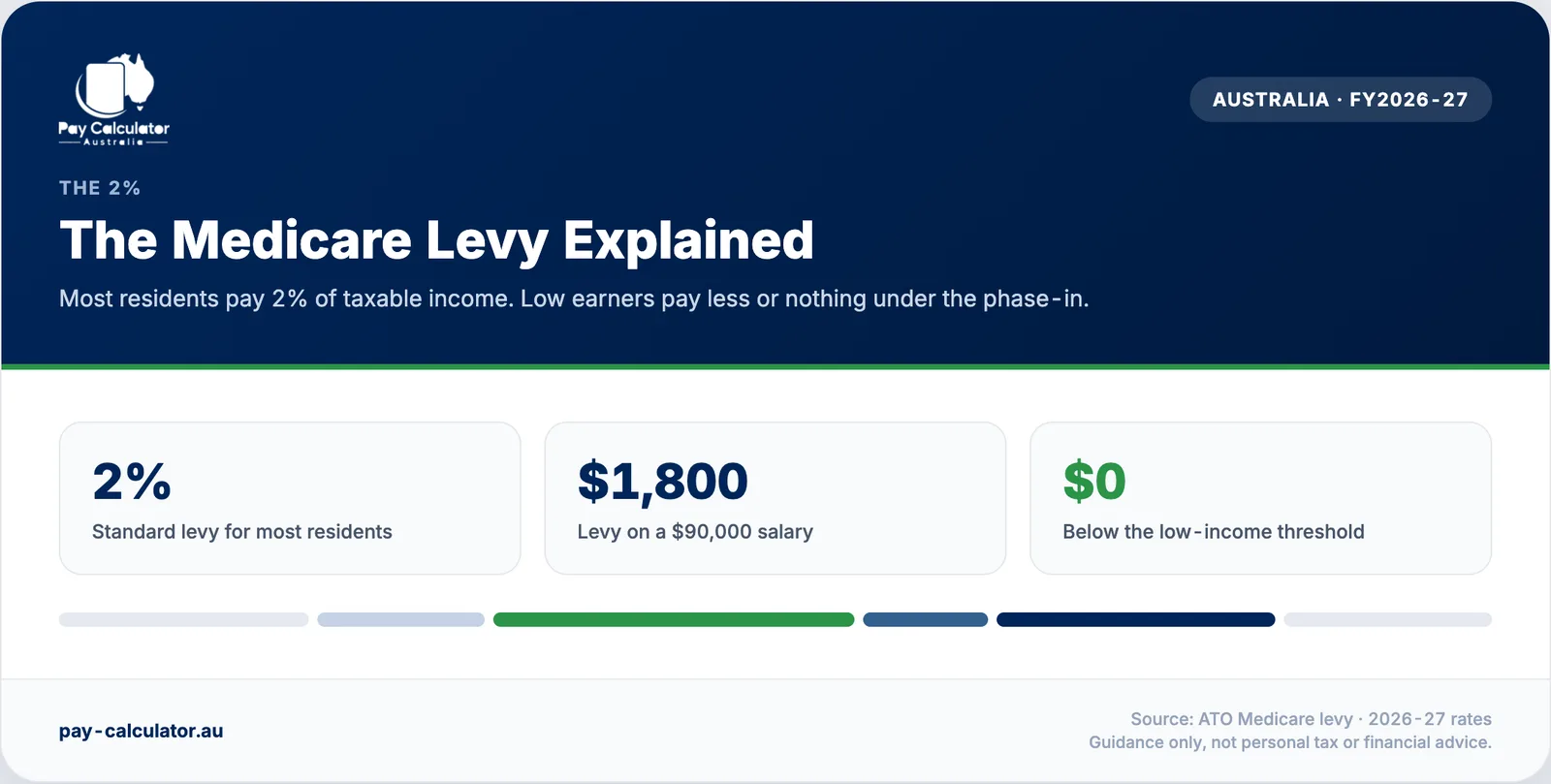
The Medicare levy is 2% of your taxable income in 2026-27, charged on top of your income tax to help fund the public health system. On a $90,000 income that is $1,800 a year. Most Australian residents pay the full 2%, low earners pay a reduced levy or none, and a few groups are exempt entirely. This guide covers the rate, the low-income reduction for singles and families, the exemption categories, and the difference between the levy and the higher-income surcharge that is so often confused with it.
Key takeaways
- The levy is 2% of taxable income for most residents (FY2026-27, verified against the ATO).
- On $90,000 it is $1,800. On $60,000 it is $1,200.
- Singles pay nothing at or below $28,011 and phase in at 10c per $1 up to $35,013 (2025-26 thresholds carried forward; 2026-27 not yet published).
- Foreign residents and working holiday makers do not pay the levy.
- Private hospital cover does not reduce the levy. It only affects the separate surcharge.
What is the Medicare levy?
The Medicare levy is 2% of your taxable income, paid in addition to the income tax worked out from the brackets. The ATO states it directly: the Medicare levy is 2% of your taxable income (What is the Medicare levy?, last updated 30 April 2026). The rate is verified for 2026-27 and has not changed this year.
Because the levy sits outside the brackets, it does not appear in the rate tables on our income tax calculator bands but is added on top. The ATO worked example is Matthew: assessable income of $76,000 less $1,000 of deductions gives taxable income of $75,000, and the levy is 2% of that, $1,500. The same formula covers the standard case at any income: levy equals 0.02 times taxable income, unless a reduction or exemption applies.
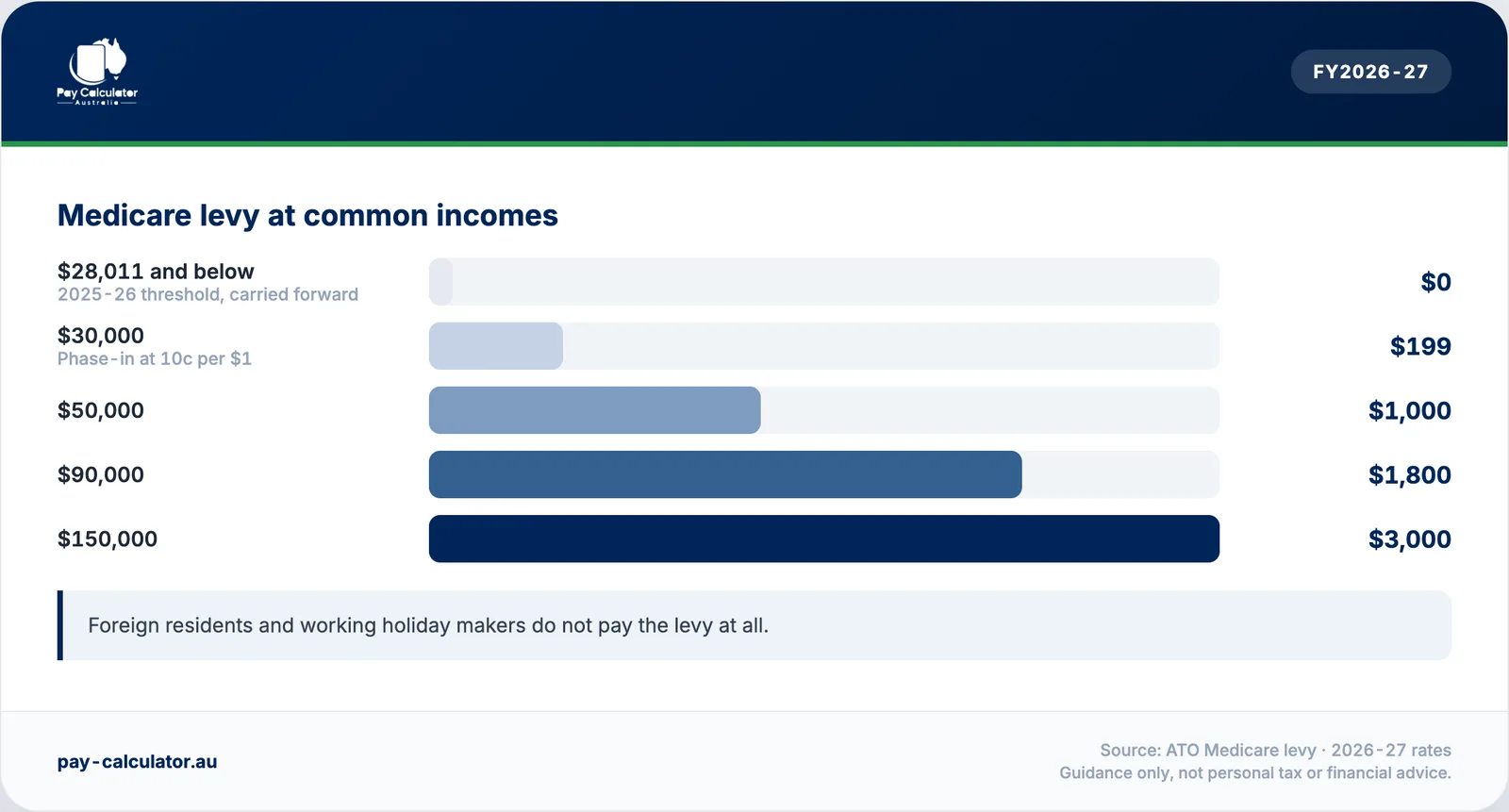
How much Medicare levy do you pay at common incomes?
On $60,000 of taxable income the levy is $1,200 for 2026-27, and on $90,000 it is $1,800. The table below is computed for a single resident who is not entitled to the seniors offset. The reduced rows between $28,011 and $35,013 use the 2025-26 low-income thresholds carried forward, because the ATO has not yet published 2026-27 figures.
| Taxable income | Medicare levy | Position |
|---|---|---|
| $20,000 | $0 | Nil (at or below lower threshold) |
| $25,000 | $0 | Nil (at or below lower threshold) |
| $28,011 | $0 | Nil (at or below lower threshold) |
| $30,000 | $199 | Reduced (phase-in) |
| $32,000 | $399 | Reduced (phase-in) |
| $34,000 | $599 | Reduced (phase-in) |
| $36,000 | $720 | Full 2% |
| $40,000 | $800 | Full 2% |
| $50,000 | $1,000 | Full 2% |
| $60,000 | $1,200 | Full 2% |
| $75,000 | $1,500 | Full 2% |
| $90,000 | $1,800 | Full 2% |
| $120,000 | $2,400 | Full 2% |
| $150,000 | $3,000 | Full 2% |
Above the upper threshold the levy is a straight 2% of every dollar, not only the dollars above a line. That is why it grows in proportion to income rather than in brackets. To see the levy alongside income tax on your own salary, use the Medicare levy calculator.
Who pays no levy or a reduced levy?
Singles pay no levy at or below $28,011 of taxable income, a reduced levy up to $35,013, and the full 2% above that. Seniors and pensioners entitled to SAPTO get higher thresholds. These are the 2025-26 amounts. The ATO has not yet published the 2026-27 low-income thresholds, which are usually announced around the following Federal Budget, so the figures below are the 2025-26 values carried forward and will be updated when the new ones are released.
| Single category | Lower threshold (no levy) | Upper threshold (full 2%) |
|---|---|---|
| All other taxpayers | $28,011 | $35,013 |
| Entitled to SAPTO | $44,268 | $55,335 |
Between the thresholds the levy phases in at 10c for each $1 over the lower threshold, rather than jumping straight to 2% of everything. The 10c rate comes from the Medicare Levy Act 1986 (s7); the ATO consumer page says only that the reduction is worked out for you, but the rate is consistent with the published thresholds. The ATO example is Angie, single on $29,000: the calculator returns a reduced levy of $98.90, which matches the formula, 10% of the $989 above $28,011, computed here as $98.90.
How does the family reduction work?
If your own income is above the single upper threshold, you may still get a reduction based on family taxable income, the combined taxable income of you and your spouse, or your own if a sole parent. It applies where you have a spouse, are entitled to an invalid or invalid-carer offset for a child, or have sole care of dependent children. As with the single thresholds, the 2026-27 family figures are not yet published, so these are the 2025-26 values carried forward:
| Family category | Lower family threshold | Upper family threshold |
|---|---|---|
| Non-SAPTO | $47,238 | $59,047 |
| SAPTO entitled | $61,623 | $77,028 |
Each dependent child lifts the lower family threshold by $4,338 and the upper by $5,423 (2025-26 amounts carried forward). No levy applies if family income sits at or below the lower threshold, a reduced levy between the two, and the full 2% above. The ATO example is Ashton, 68 and SAPTO entitled, with taxable income of $49,700 and a spouse on $21,700. Family income of $71,400 sits between the SAPTO family thresholds, and the ATO calculator returns a reduced levy of $92.90.
Who is exempt from the Medicare levy?
Three exemption categories exist, and each can be full or half depending on your dependants. They are assessed separately from the low-income reduction.
- Medical exemption. For example blind pensioners, or people entitled to full free medical treatment for all conditions under Defence Force or Veterans Affairs arrangements, subject to conditions. Half exemptions apply where only some dependants are also in an exemption category.
- Foreign resident exemption. Foreign residents for tax purposes do not pay the levy. The same goes for working holiday makers on 417 and 462 visas, whose tax scale already excludes it. See the resident vs non-resident tax guide for how residency is decided.
- Not entitled to Medicare benefits. Certain visa holders can claim an exemption, usually by obtaining a Medicare Entitlement Statement from Services Australia.
A part-year exemption is also possible, for example where your circumstances changed during the year. In that case the levy is charged for the part of the year you were liable.
Is the levy the same as the Medicare levy surcharge?
No. They are two separate charges, and you can pay one, both, or neither. The levy is the flat 2% of taxable income that most residents pay. The Medicare levy surcharge is an extra 1% to 1.5% charged only to higher earners, above $105,000 for singles and $210,000 for families in 2026-27, who do not hold adequate private hospital cover. The surcharge also uses a broader income base than taxable income.
The two are worked out independently. A single on $90,000 with no private cover pays the $1,800 levy and no surcharge, because $90,000 is under the surcharge threshold. A single on $130,000 with no cover pays both. The full tier table, the income definition and the hospital cover rules are in our Medicare levy surcharge guide, and you can test your own position on the MLS calculator.
Does private health insurance reduce the levy?
No. Private hospital cover has no effect on the 2% levy. Every resident above the low-income thresholds pays it, insured or not. This is the single most common misunderstanding about Medicare and private health, and insurers do not always rush to correct it. Hospital cover matters only for the surcharge: holding an approved policy for the full year lets a higher earner avoid the extra 1% to 1.5%. It never touches the 2%.
So if you hold hospital cover mainly for tax reasons and earn under the surcharge threshold, the cover is saving you no tax at all. The decision then rests on the health value of the policy, not on Medicare charges.
How is the levy collected from your pay?
The levy is calculated once, when you lodge your tax return, on your actual taxable income for the year. But you do not feel it as a bill, because the PAYG withholding your employer takes from each pay already includes an amount to cover it. Withholding is the payday estimate; the levy itself is assessed at tax time, and the two reconcile in your refund or bill.
If low family income means you qualify for a reduction or exemption, you can stop the estimate running too high during the year by lodging a Medicare levy variation declaration (NAT 0929) with your employer. The same declaration matters for HECS-HELP borrowers, because a levy reduction or exemption also switches off the compulsory study loan repayment, as covered in our HECS-HELP guide.
Frequently asked questions
It is 2% of your taxable income, paid on top of your income tax, to help fund the public health system. Most Australian resident taxpayers pay it in 2026-27. The ATO calculates it when you lodge your tax return, and employer withholding through the year generally already covers it.
For a resident with no reduction or exemption, the levy is 2% of $90,000, which is $1,800 for 2026-27. It sits on top of income tax rather than inside the brackets.
No. Private hospital cover does not reduce the 2% Medicare levy at all. It only lets higher earners avoid the separate Medicare levy surcharge, the extra 1% to 1.5% charged to people above the surcharge thresholds without adequate hospital cover.
Not below the thresholds. As a single taxpayer, no levy is payable at or below $28,011, a reduced levy applies between $28,011 and $35,013, and the full 2% applies above $35,013. Higher thresholds apply to seniors and pensioners and to families. These are 2025-26 thresholds carried forward, because the ATO had not published 2026-27 figures as at 19 July 2026.
No. Foreign residents for tax purposes and working holiday makers on 417 and 462 visas do not pay the Medicare levy. Their tax scales already exclude it, which partly offsets the loss of the tax-free threshold.
Three: a medical exemption (full or half, for example blind pensioners or people entitled to full free medical treatment under Defence or Veterans Affairs arrangements), a foreign resident exemption, and an exemption for people not entitled to Medicare benefits, which usually requires a Medicare Entitlement Statement from Services Australia.
Sources
- ATO, What is the Medicare levy? (the 2% rate and the Matthew example), last updated 30 April 2026.
- ATO, Medicare levy reduction for low-income earners (single thresholds and the Angie example), last updated 30 June 2026.
- ATO, Medicare levy reduction, family income (family thresholds, per-child increases and the Ashton example), last updated 30 June 2026.
- ATO, Medicare levy exemption (the three exemption categories), last updated 29 April 2026.
- Medicare Levy Act 1986, s7 (the 10c per $1 phase-in rate).
- ATO Medicare levy calculator (cross-check for reduction edge cases).
All sources accessed 19 July 2026. Page last reviewed 23 July 2026. The 2% rate is verified for 2026-27. The low-income reduction thresholds shown are 2025-26 amounts carried forward, and this page will be updated when the ATO publishes the 2026-27 figures.