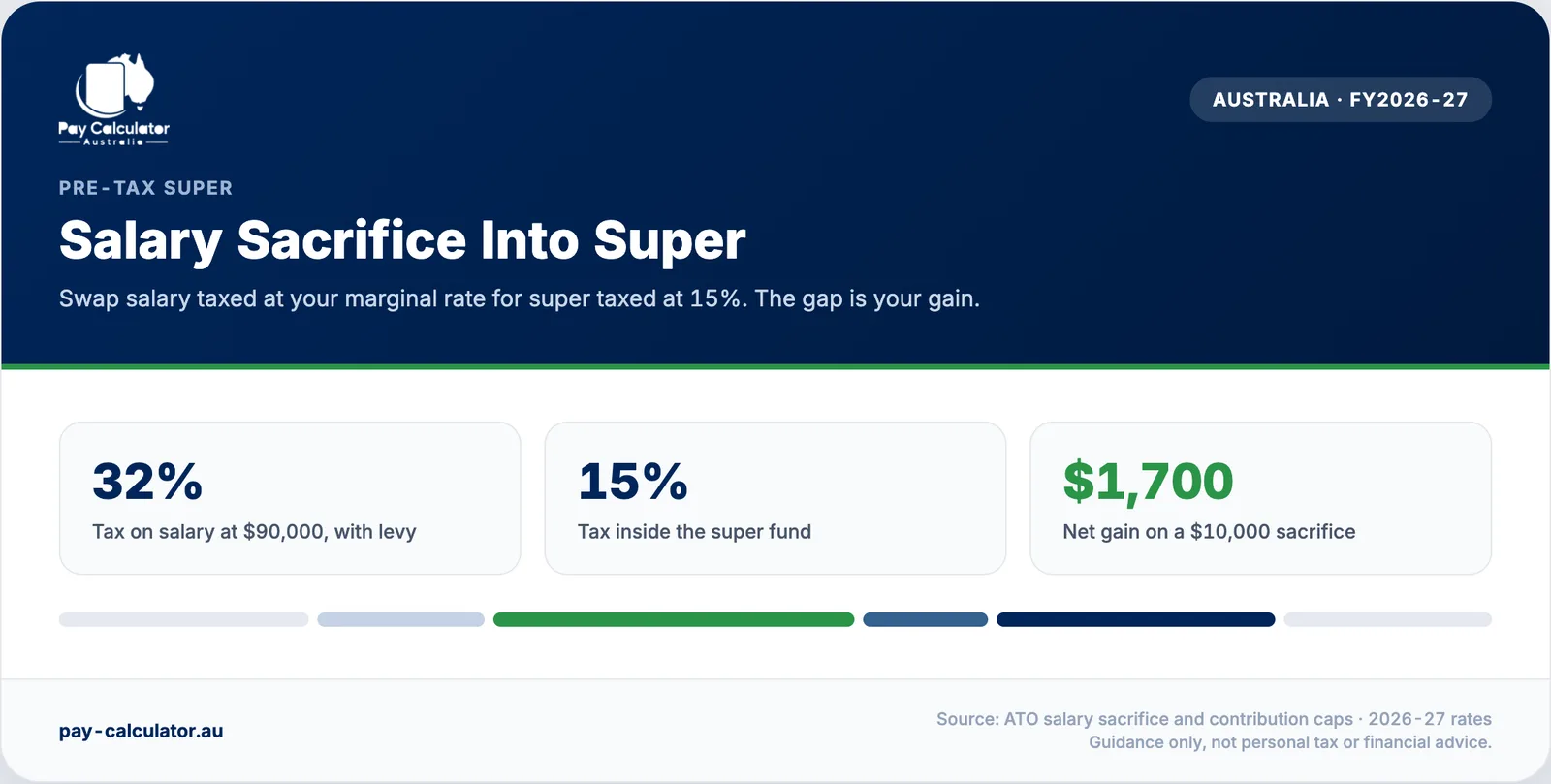
Salary sacrificing into super means part of your pre-tax pay goes to your fund instead of your bank account, taxed at 15% rather than your marginal rate. On a $90,000 salary, sacrificing $10,000 in 2026-27 saves about $1,700 in tax. The catch is that the money is locked in super until retirement, and it shares a $32,500 annual cap with your employer's 12% contributions. This guide works through the mechanics, the savings at common salaries, and the limits.
Key takeaways
- Sacrificed super is taxed at 15% in the fund instead of your marginal rate, which is 30% to 47% including the Medicare levy for most workers (2026-27).
- Sacrificing $10,000 on a $90,000 salary saves about $1,700 in 2026-27.
- The concessional cap is $32,500 for 2026-27, and your employer's 12% SG counts toward it.
- The arrangement must be agreed with your employer before you earn the money.
- From 1 July 2026, sacrificing cannot reduce the super your employer owes you.
What is salary sacrificing into super?
Salary sacrifice is an agreement with your employer to pay some of your before-tax salary into your super fund instead of paying it to you as cash. The agreement must be made in advance. You cannot sacrifice pay you have already earned, so the arrangement covers future pay periods only. The rules are set out on the ATO's salary sacrificing for employees page and Moneysmart's salary packaging page (last updated 14 July 2026).
Sacrificed amounts are concessional contributions, the same category as your employer's 12% super guarantee. They are taxed at 15% when they reach the fund, and they count toward the same $32,500 concessional cap for 2026-27. If you would rather not touch your payroll setup, you can achieve the same tax outcome by making a personal contribution and claiming a deduction for it in your return. Both routes get identical concessional treatment.
How does salary sacrifice save you tax?
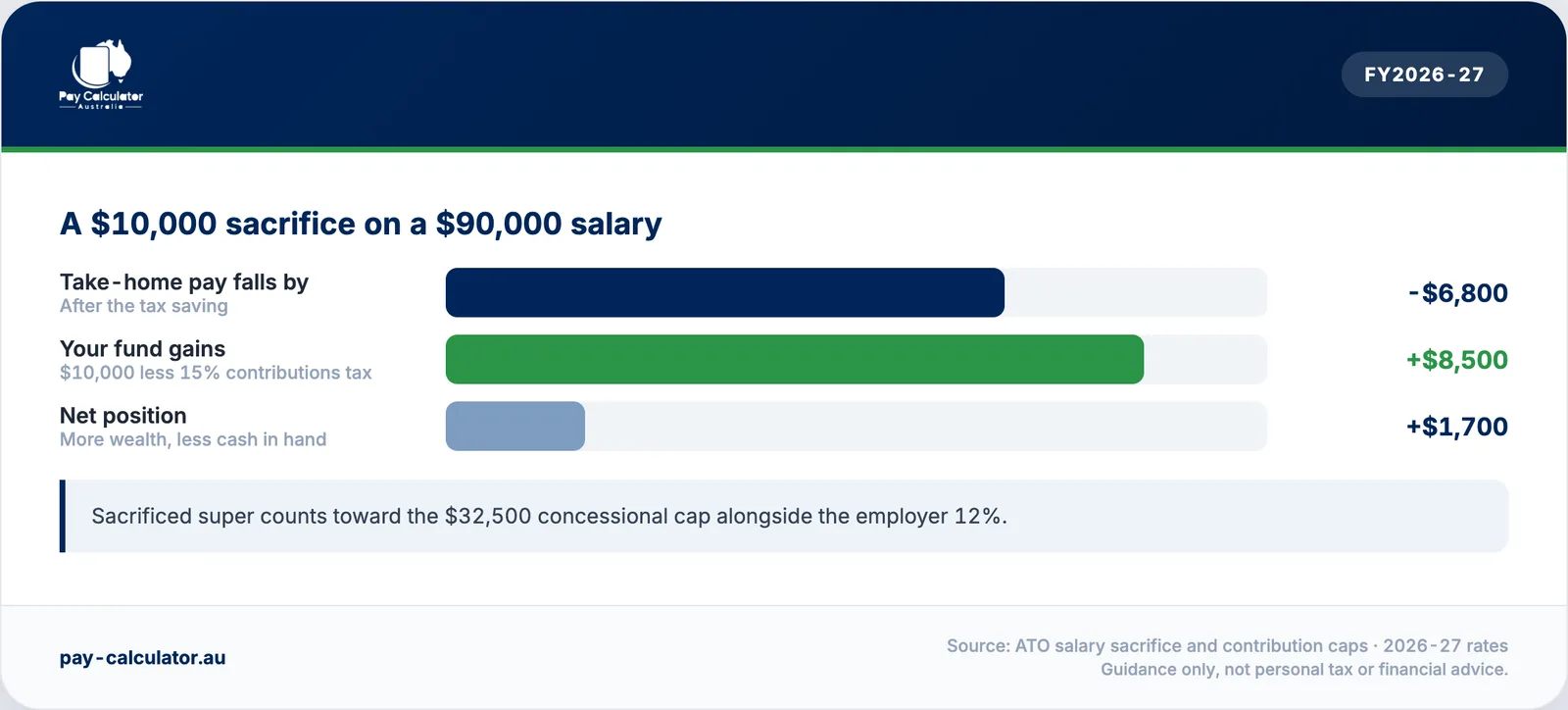
The saving is the gap between your marginal tax rate and the 15% contributions tax. On a $90,000 salary in 2026-27, your top slice of income sits in the 30% bracket, so with the 2% Medicare levy each extra dollar taken as cash loses 32%. The same dollar sacrificed into super loses 15%. The gap, 17 cents in the dollar, is the benefit.
Run the numbers on a $10,000 sacrifice from that $90,000 salary. Taken as salary, the $10,000 loses $3,200 to tax and Medicare levy, leaving $6,800 in your pocket. Sacrificed, it loses $1,500 to contributions tax, leaving $8,500 in your fund. Same pre-tax money, $1,700 less tax. The method follows Moneysmart's tax and super guidance; the figures are computed from the 2026-27 resident scales.
The flip side is where the money sits. The cash option is spendable today. The super option is preserved, generally until you reach preservation age and retire. Salary sacrifice is a tax saving you cannot spend for decades, which is exactly why it suits retirement savings and nothing else.
How much could you save at your salary?
Sacrificing $10,000 saves between roughly $1,700 and $3,200 a year across common salaries in 2026-27. The table below is computed from the 2026-27 resident tax brackets, the Low Income Tax Offset and the 2% Medicare levy, against the flat 15% contributions tax.
| Salary | Tax on the last $10,000 as cash | Tax at 15% in super | Annual saving |
|---|---|---|---|
| $60,000 | $3,350 | $1,500 | $1,850 |
| $75,000 | $3,225 | $1,500 | $1,725 |
| $90,000 | $3,200 | $1,500 | $1,700 |
| $100,000 | $3,200 | $1,500 | $1,700 |
| $120,000 | $3,200 | $1,500 | $1,700 |
| $150,000 | $3,900 | $1,500 | $2,400 |
| $200,000 | $4,700 | $1,500 | $3,200 |
Two things stand out. Below $45,000 the marginal rate is only 15%, so sacrificing saves very little and can cost you access to the money for no gain. And the saving is not a smooth line: around the $60,000 to $66,000 range the phase-out of the Low Income Tax Offset quietly raises your effective marginal rate, which makes sacrificing slightly more valuable there than the bracket table alone suggests. To model your own salary and sacrifice amount, use the salary sacrifice calculator, or weigh cash against super directly with the super vs take-home comparison.
What is the concessional contributions cap for 2026-27?
The concessional cap is $32,500 for 2026-27, per the ATO's contributions caps page (last updated 24 April 2026). It rose from $30,000 in 2025-26 through indexation to average weekly ordinary time earnings. The cap covers all before-tax contributions combined: your employer's SG, your salary sacrifice, and any personal contributions you claim as a deduction, totalled across every fund you hold.
| Income year | Concessional cap (all ages) |
|---|---|
| 2026-27 (current) | $32,500 |
| 2025-26 | $30,000 |
| 2024-25 | $30,000 |
| 2021-22 to 2023-24 | $27,500 |
| 2017-18 to 2020-21 | $25,000 |
For completeness, the after-tax (non-concessional) cap is $130,000 for 2026-27, four times the concessional cap. Non-concessional contributions are not taxed again on the way into the fund because you already paid income tax on that money.
How much room do you have under the cap?
Your sacrifice room is $32,500 minus your employer's 12% SG for the year (2026-27). The table below computes that headroom at common salaries.
| Salary | Employer SG at 12% | Room left under the $32,500 cap |
|---|---|---|
| $60,000 | $7,200 | $25,300 |
| $90,000 | $10,800 | $21,700 |
| $120,000 | $14,400 | $18,100 |
| $150,000 | $18,000 | $14,500 |
| $200,000 | $24,000 | $8,500 |
| $250,000 | $30,000 | $2,500 |
The system is aligned at the top. Compulsory SG stops at the $270,830 maximum contribution base for 2026-27, and 12% of that is $32,499.60, fractionally under the cap. How the 12% itself works, and what earnings it is paid on, is covered in our superannuation guarantee guide.
What happens if you go over the cap?
Excess concessional contributions are added to your taxable income and taxed at your marginal rate, with a 15% offset for the tax the fund already paid. In effect the concessional discount is unwound, so you end up roughly where you would have been taking the money as salary, plus paperwork.
There is a generous escape hatch. If your total super balance was under $500,000 at 30 June of the previous year, you can carry forward unused concessional cap amounts from up to five earlier years, with unused amounts first accruing from 2018-19. Someone who contributed little for a few years can therefore sacrifice well above $32,500 in 2026-27 without breaching anything. Checking your carry-forward balance is a myGov task, not a guess.
Does salary sacrifice reduce your employer's 12%?
No. From 1 July 2026, amounts you sacrifice are added back into your qualifying earnings when your employer calculates the SG, provided the salary would have counted had it been paid as cash. Sacrificing $10,000 from a $90,000 salary still leaves your employer owing 12% of $90,000, which is $10,800 for 2026-27. The rule is on the ATO's qualifying earnings page (last updated 21 June 2026), and it exists precisely so packaging cannot quietly shrink the employer's obligation.
What is Division 293 tax?
Division 293 tax adds an extra 15% on some or all of your concessional contributions once your income plus those contributions exceed $250,000. The contribution tax becomes an effective 30% instead of 15%. Sacrificing can still make sense at that level, since 30% remains below the 47% top marginal rate including the Medicare levy, but the saving halves and the sums get finer. Moneysmart's tax and super page (last updated 18 June 2026) covers the threshold.
If you are near $250,000, or a bonus might push you there, the interaction between salary, SG, sacrifice and Division 293 is genuinely fiddly. That is a case for a registered tax agent rather than a calculator, and the fee is usually smaller than the cost of getting the cap sums wrong.
What is the catch with salary sacrifice?
Three catches, all worth stating plainly. First, preservation: sacrificed money is generally locked away until you reach preservation age and retire, so never sacrifice money you might need for a deposit, an emergency or anything sooner. Second, the cap: sacrifice shares the $32,500 limit (2026-27) with your employer's SG, and breaching it unwinds the benefit. Third, the floor: below $45,000 of income the marginal rate is 15%, identical to the contributions tax, so there is close to no tax gain, though the low income super tax offset (LISTO) refunds up to $500 of contributions tax if you earn $37,000 or less.
Salary sacrifice also sits inside the wider world of salary packaging, where cars, devices and other benefits carry their own fringe benefits tax rules. Super is the cleanest item to package because no FBT applies to it. The rest of that landscape is mapped in our salary packaging guide.
How do you set up salary sacrifice?
Ask your employer or payroll team for a salary sacrifice agreement that starts from a future pay period, stating the dollar amount or percentage per pay. Get it in writing before the pay period begins, because sacrifice only works prospectively. From there the deduction runs automatically each payday, and under Payday Super the contribution should reach your fund within 7 business days of each payday from 1 July 2026.
Before you sign, do three checks. Confirm your headroom under the $32,500 cap (2026-27) after your employer's SG. Confirm your take-home pay still covers your budget, using the take-home pay calculator with and without the sacrifice. And confirm in writing that your employer calculates SG on your pre-sacrifice salary, which the qualifying earnings rules require from 1 July 2026 in any case. If your employer does not offer payroll sacrifice, a personal deductible contribution achieves the same tax result at year end.