Overtime and Penalty Rates: When the Higher Rates Apply
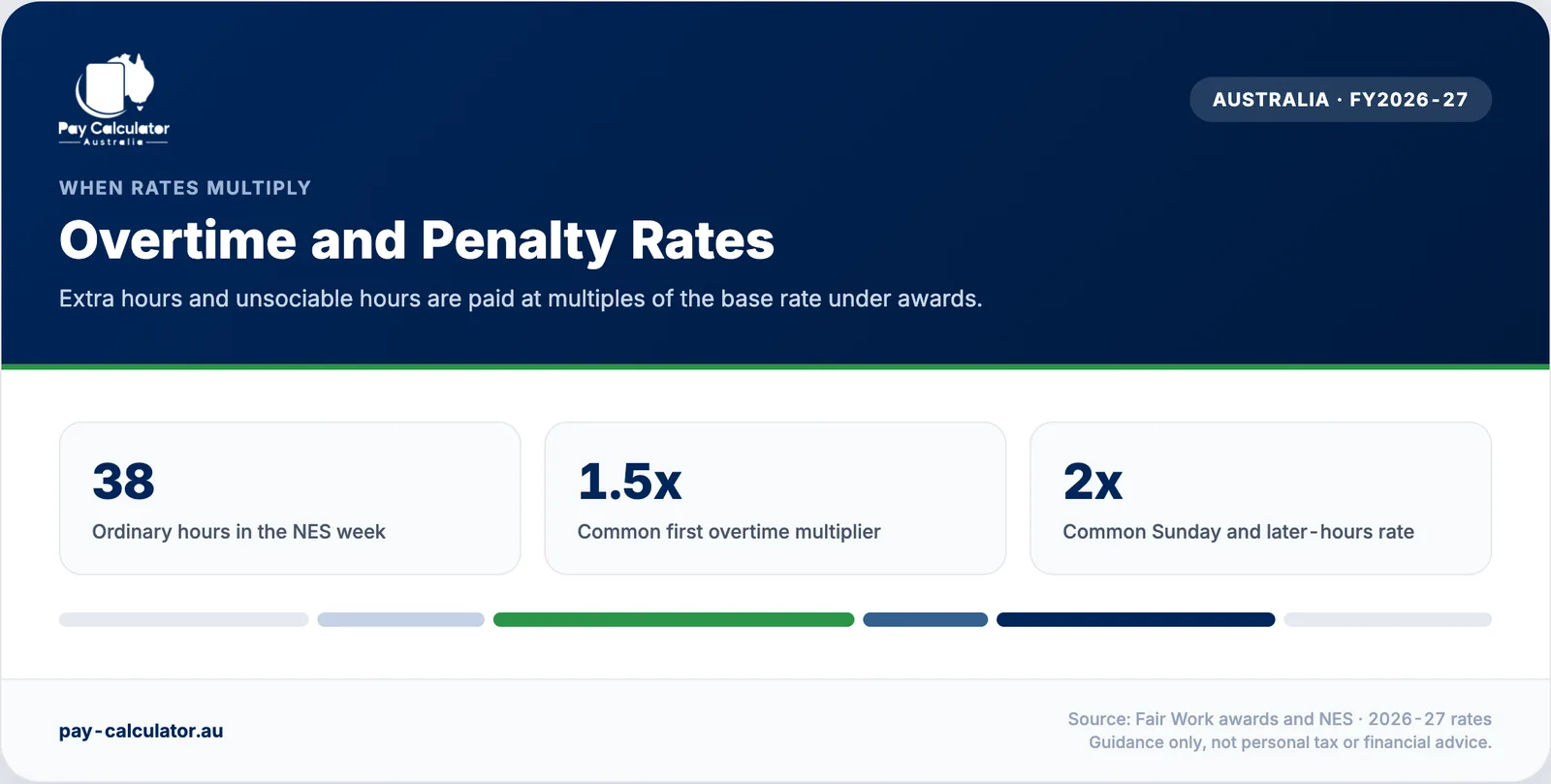
Overtime pays you more for extra hours. Penalty rates pay you more for unsociable hours. This guide covers the 38-hour week, how time-and-a-half and double-time are calculated, and what the common rates are worth in dollars.
What is the difference between overtime and penalty rates?
Overtime is a higher rate for working more hours than your ordinary hours, or outside them. Penalty rates are higher rates for working particular times: weekends, public holidays, late nights and early mornings. The distinction matters because they have different triggers, and because they can stack on the same shift.
| Overtime | Penalty rates | |
|---|---|---|
| What triggers it | Hours beyond or outside your ordinary hours | When the hours fall: weekends, public holidays, nights, early mornings |
| Where the rate is set | Your award or registered agreement | Your award or registered agreement |
| Common rates | 150% for the first 2 or 3 hours, then 200% | 150% Saturday, 200% Sunday, 250% public holidays (varies by award) |
| Alternative to being paid it | Time off in lieu (TOIL), where the award allows | Absorption into an annualised salary, subject to better-off-overall rules |
| Can both apply at once | Yes. Overtime on a Sunday or public holiday attracts the higher combined rate in many awards | |
Source: Fair Work Ombudsman, Penalty rates and Overtime pay (both updated 12 May 2026). Multipliers are common patterns, not universal rates.
What counts as ordinary hours in the 38-hour week?
A standard full-time week is 38 ordinary hours. Under Fair Work's National Employment Standards, an employer cannot require more than 38 hours in a week unless the additional hours are reasonable. Ordinary hours are the hours that are not overtime, and they are the hours your base rate applies to.
Your award or agreement then fills in the detail: the maximum ordinary hours per day, week, fortnight or month, the minimum per day, and the spread of hours, meaning the window of the day ordinary hours can be worked, such as 7am to 7pm. Work outside the spread can attract overtime rates even when your weekly total is under 38. That is why a 6am start can pay more than a 9am start on the same roster. To see what a 38-hour week is worth in take-home terms, try the weekly pay calculator.
When does overtime actually start?
Overtime starts where your award says it does, not at a single national threshold. Awards typically trigger overtime when you exceed the daily maximum of ordinary hours, exceed the weekly (or averaged) maximum, or work outside the spread of hours. The rate paid, and how quickly it escalates, is set by the same award. A common structure is time-and-a-half (150%) for the first 2 or 3 overtime hours and double-time (200%) after that, with higher rates on Sundays and public holidays.
Some awards and agreements allow time off in lieu, or TOIL, where you bank the extra hours as leave instead of pay. The rules on how TOIL accrues and when it must be paid out sit in the award, so check before agreeing to it. Casual employees can be entitled to overtime too, layered on their 25% loading; how the two combine is covered in our casual loading guide.
How much are time-and-a-half and double-time worth per hour?
The multiplier applies to your ordinary hourly rate. Computed at common 2026-27 base rates.
| Base rate | Time-and-a-half (150%) | Double-time (200%) | Double-time-and-a-half (250%) |
|---|---|---|---|
| $26.44 (NMW) | $39.66 | $52.88 | $66.10 |
| $30.00 | $45.00 | $60.00 | $75.00 |
| $35.00 | $52.50 | $70.00 | $87.50 |
| $40.00 | $60.00 | $80.00 | $100.00 |
NMW is the 2026-27 National Minimum Wage of $26.44 an hour (Fair Work Commission Annual Wage Review 2026, [2026] FWCFB 3500). Some awards also use triple-time (300%) for certain public holidays.
Two habits keep these numbers honest. First, confirm the base rate the multiplier applies to, because for casuals some awards apply penalties to the loaded rate and others to the unloaded base. Second, confirm whether your award compounds a penalty and an overtime rate or takes the higher of the two. The overtime calculatordoes the multiplication for you once you know your award's rule.
What does a week with overtime look like in dollars?
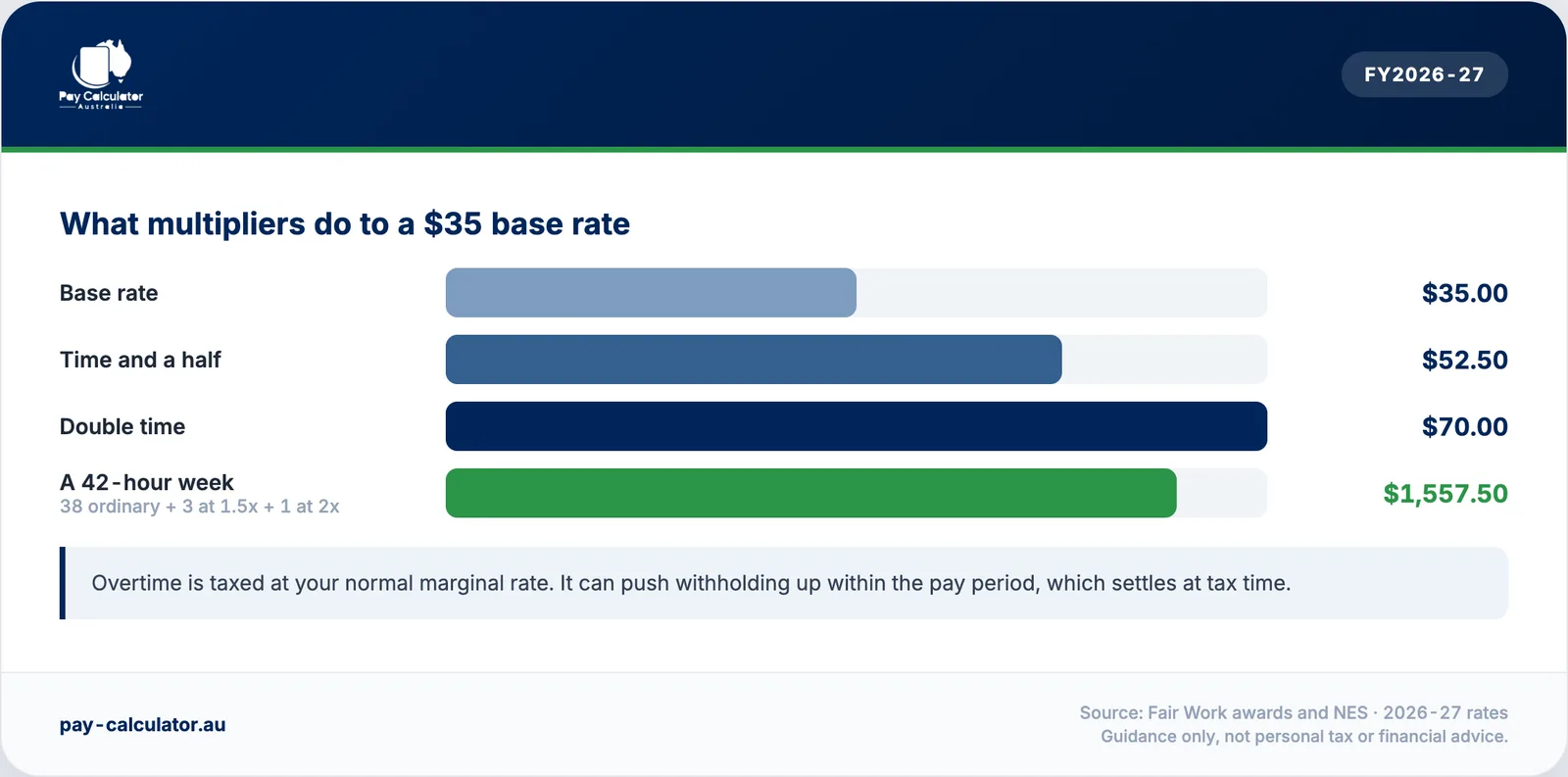
A $35.00 base rate, 38 ordinary hours, then 4 overtime hours under a common award structure.
| Component | Hours | Rate | Pay |
|---|---|---|---|
| Ordinary hours | 38 | $35.00 | $1,330.00 |
| Overtime at 150% (first 3 hours) | 3 | $52.50 | $157.50 |
| Overtime at 200% (after that) | 1 | $70.00 | $70.00 |
| Total for the 42-hour week | 42 | $1,557.50 |
Computed from the stated rates. The same 42 hours at a flat $35.00 would pay $1,470.00, so the overtime structure adds $87.50 for this week.
The gross number is only half the story on payday. A $1,557.50 week has more withheld than your usual week, because the weekly withholding table annualises whatever week it sees. That is withholding, not extra tax, and the difference between the two is worked out when you lodge. The PAYG withholding calculator shows the payday estimate on any gross amount.
What penalty rates apply on weekends and public holidays?
Common patterns across awards. Your own award is the only authoritative source for your rate.
| When you work | Common rate | Notes |
|---|---|---|
| Saturday | 150% | Often time-and-a-half |
| Sunday | 200% | Double-time in many awards; some retail and hospitality awards use lower Sunday rates |
| Public holiday | 250% | Commonly double-time-and-a-half; some arrangements pay 150% plus a day off in lieu instead |
| Late night or early morning shifts | Varies | Shift loadings are set by each award |
| Overtime on ordinary days | 150% then 200% | Commonly 150% for the first 2 or 3 hours, then 200% |
Source: Fair Work Ombudsman, Penalty rates (updated 12 May 2026). Enterprise agreement rates are set in the agreement itself.
Can overtime and penalty rates apply at the same time?
Yes, and awards say exactly how. Fair Work's library example from the Security Services Industry Award shows the layering: overtime worked on a Sunday is paid at 200% of the minimum hourly rate, and overtime worked on a public holiday is paid at 250%. The overtime rate absorbs the day-based penalty into a single, higher multiplier rather than paying both separately.
Other awards use different formulas, which is why two workers with identical rosters in different industries can be paid differently for the same Sunday. When the numbers matter, look up your award in Fair Work's Pay and Conditions Tool rather than reasoning from a general rule. If the extra hours are becoming permanent, it is worth comparing the annualised value against a salaried role on the hourly to salary calculator.
Is overtime taxed more than normal pay?
No. Overtime is ordinary income, taxed at the same 2026-27 rates as the rest of your wages. There is no overtime tax bracket and no penalty-rate levy.
The myth survives because of withholding. Your employer withholds from each pay using a table that assumes the week in front of it is typical, so one 50-hour week is withheld as if you work 50 hours every week of the year. More is taken that payday than your annual position justifies. Withheld is not owed. Your actual tax is assessed on your real annual income when you lodge, and the overshoot from lumpy weeks comes back as part of your refund. Our guide to how income tax works covers the marginal system behind this.
Is super paid on overtime hours?
Generally no. The 12% super guarantee (2026-27) is calculated on ordinary time earnings: broadly what you earn for ordinary hours, including many allowances but generally excluding overtime payments. A big overtime month lifts your take-home pay without lifting your super at the same rate.
One update for 2026-27: under the Payday Super rules starting 1 July 2026, employers must pay super each payday rather than quarterly, and the ATO frames the earnings base as qualifying earnings for the pay period, closely based on ordinary time earnings. Contributions must reach your fund within 7 business days of payday in most cases. The superannuation calculator shows the 12% on your ordinary earnings.
Can a salary absorb your penalty rates?
Yes, within limits. Annualised wage arrangements, individual flexibility arrangements and guarantees of annual earnings can roll penalty and overtime rates into one salary figure. The protection is the better-off-overall principle: the total you receive must be at least what the award or agreement would have paid you for the hours you actually worked.
If your roster is heavy with Sundays, nights or regular overtime, that comparison is worth running each year rather than assuming the salary still clears the bar. Keep your own record of hours worked, price them at the award rates above, and compare the total against your salary. If the award total is higher, raise it, because the shortfall is recoverable. For persistent shortfalls, the backpay calculator estimates what an underpayment claim is worth before and after tax.
Overtime and penalty rate questions
Where these figures come from
- Fair Work Ombudsman, Penalty rates, updated 12 May 2026.
- Fair Work Ombudsman, Overtime pay, updated 12 May 2026.
- Fair Work Ombudsman, Hours of work (ordinary hours, maximum weekly hours, spread of hours), updated 19 December 2025.
- Fair Work Commission, Annual Wage Review 2026 decision [2026] FWCFB 3500 (2026-27 National Minimum Wage of $26.44 an hour).
- Fair Work Ombudsman library, Overtime rates in the Security Award (K600564), for the layered Sunday and public holiday overtime example.
- ATO, Super guarantee and Paying super on payday: what payments are qualifying earnings (12% rate, Payday Super from 1 July 2026).
Last verified 23 July 2026. Dollar examples are computed live from the stated base rates.
Written by Marcus Kelleher, editor, pay and tax contentat pay-calculator.au. He works from ATO and Fair Work source documents and is not a registered tax agent. Award rates vary; confirm yours through Fair Work's Pay and Conditions Tool.