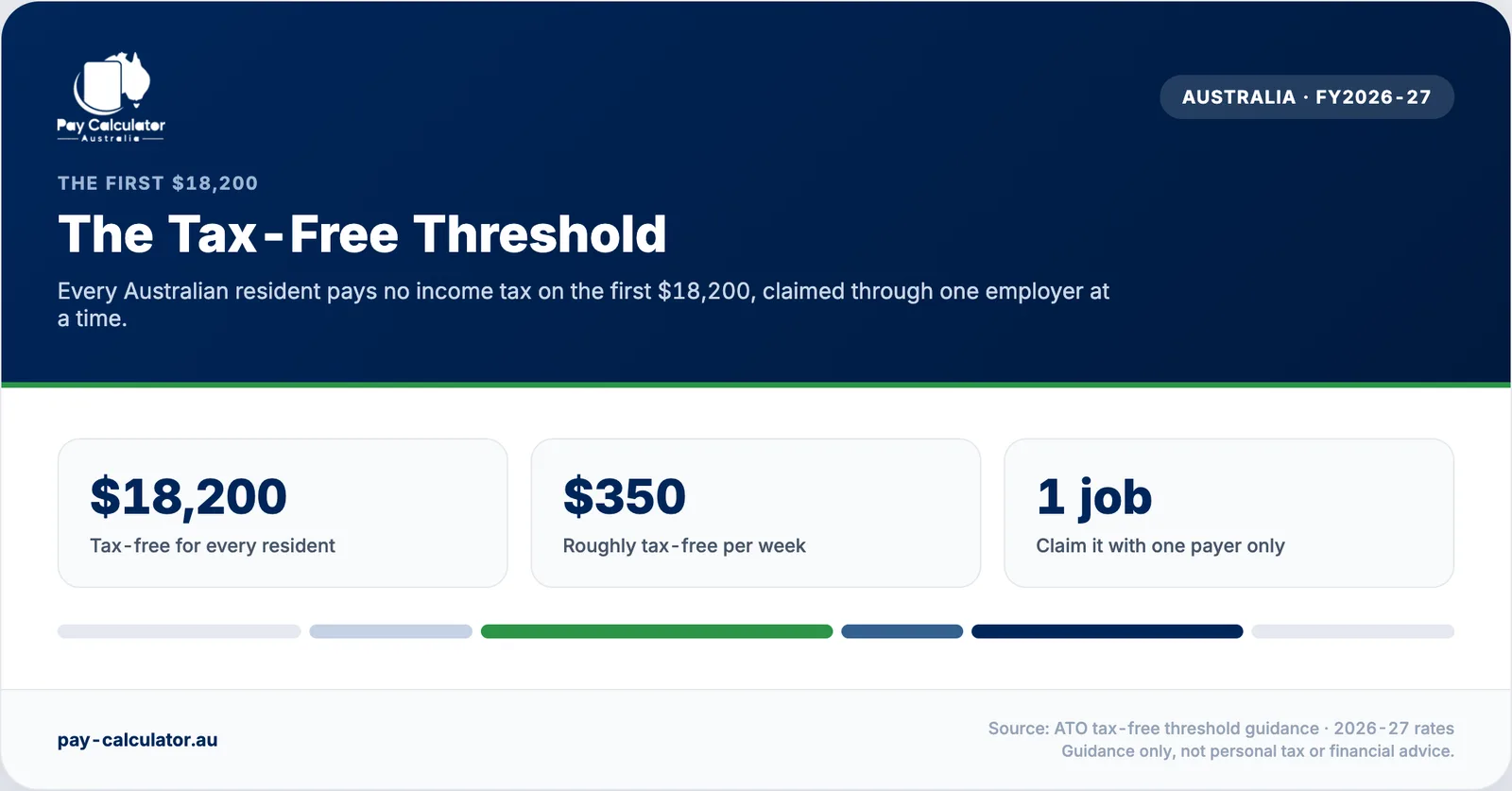
The tax-free threshold is $18,200 (2026-27): the first $18,200 an Australian resident earns each financial year carries no income tax at all. It sounds like the least complicated number in the tax system, and for one job it is. The complications start when you have two payers, arrive partway through the year, or wonder why a second job seems to be taxed so hard. This guide covers how to claim the threshold, the one-job-only rule, and what happens in the part-year and non-resident cases.
Key takeaways
- The first $18,200 of a resident taxable income is tax-free (2026-27), about $350 a week or $700 a fortnight.
- You claim it once, on the TFN declaration you give a payer, not every year.
- With two jobs at the same time, claim it from one payer only, usually the higher-paying one.
- Part-year residents get $13,464 plus up to $4,736, pro-rated by months of residency (2026-27).
- Claiming or not claiming changes withholding only. Your final tax for the year is the same either way.
What is the tax-free threshold?
It is the 0% band at the bottom of the resident tax scale: taxable income from $0 to $18,200 is taxed at nil for 2026-27. Every resident gets it, whatever they earn, which is why even a $190,000 earner pays nothing on their first $18,200. The threshold has not moved since it was set at $18,200, and the 1 July 2026 tax cut did not change it; that cut lowered the rate on the next band (from 16% to 15%), not the threshold itself. The full scale is in the guide to the 2026-27 tax brackets.
Two ideas get bundled into the phrase and it pays to keep them apart. The threshold is a feature of the annual tax calculation, applied automatically when you lodge. Claiming the threshold is a payday instruction to one employer about how much to withhold. The first is fixed. The second is a choice you make on a form.
How much is the threshold per week, fortnight and month?
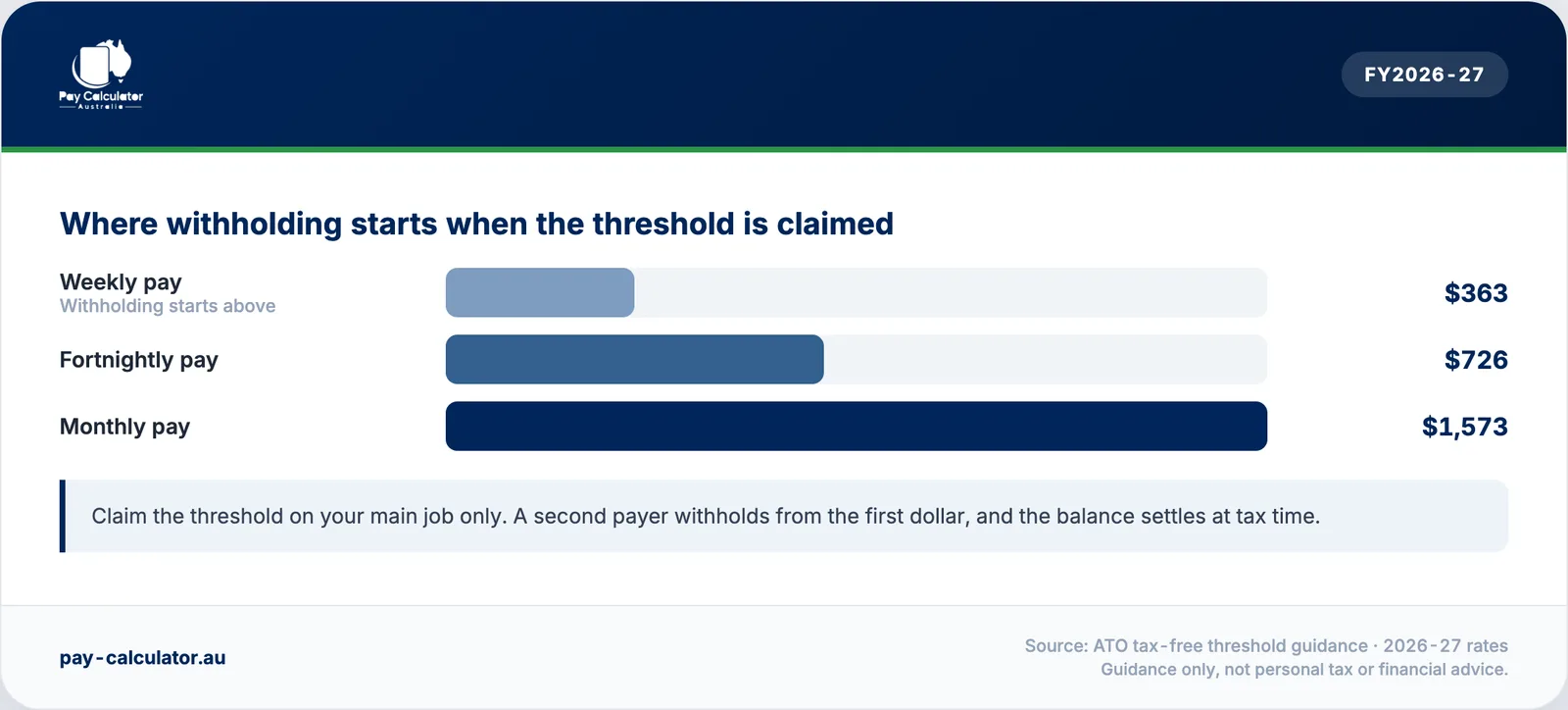
The ATO expresses the $18,200 threshold as roughly $350 a week, $700 a fortnight or $1,517 a month (2026-27). In practice a payer who has your threshold claim starts withholding slightly above those figures: from $363 a week, $726 a fortnight or $1,573 a month. The ATO notes these trigger points sit slightly higher than the flat $18,200 equivalents because of how the withholding schedules are built.
So if you earn under about $363 a week from the one job where you claimed the threshold, your payslip should show no tax withheld at all. If tax is coming out anyway, the usual cause is that the payer never received your TFN declaration, or the no-threshold box was ticked.
How do you claim the tax-free threshold?
You claim it by answering yes to the tax-free threshold question on the tax file number (TFN) declaration you complete when you start with a payer. A payer is anyone who pays you: an employer, or an agency such as Centrelink. There is no separate annual application. The answer you gave carries through until you change it by lodging a withholding declaration with that payer.
Claiming it tells that one payer to leave the first $18,200 of your annualised pay untaxed and to withhold on the rest using the standard scale. Not claiming it tells the payer to withhold from the first dollar. Either way, the truth is settled at tax time, when the ATO applies the real threshold to your actual total income. How that payday estimate works is covered in the guide to PAYG withholding.
What happens to your pay if you do not claim it?
Your employer withholds at the no-threshold rate, which takes tax from the first dollar. On the same wage your fortnightly pay is noticeably smaller than a colleague who claimed the threshold. Nothing is lost permanently. The extra amounts withheld become a credit on your return, and if they exceed your final tax the difference comes back as a refund. What you give up is cash flow during the year: you are lending the difference to the ATO until you lodge. You can estimate the size of that end-of-year credit with the tax refund calculator.
How much tax do you actually pay just above the threshold?
Very little, and less than the bracket rate suggests, because the Low Income Tax Offset wipes out the first $700 of tax and the Medicare levy does not start until income passes the low-income threshold. The table below is computed from the 2026-27 scale, LITO and the Medicare levy shade-in.
| Taxable income | Tax before LITO | LITO | Tax after LITO | Medicare levy | Total |
|---|---|---|---|---|---|
| $16,000 | $0 | $0 | $0 | $0 | $0 |
| $18,200 | $0 | $0 | $0 | $0 | $0 |
| $22,000 | $570 | $570 | $0 | $0 | $0 |
| $26,000 | $1,170 | $700 | $470 | $0 | $470 |
| $30,000 | $1,770 | $700 | $1,070 | $199 | $1,269 |
| $37,500 | $2,895 | $700 | $2,195 | $750 | $2,945 |
| $45,000 | $4,020 | $325 | $3,695 | $900 | $4,595 |
Read the $22,000 row: the brackets produce $570 of tax, LITO cancels all of it, and the Medicare levy is nil because income is under the $28,011 low-income threshold. In practice you pay nothing until income passes roughly $22,867 (2026-27, where 15c per dollar over $18,200 first exceeds the $700 offset). The Medicare levy low-income thresholds shown are the 2025-26 values; the ATO has not yet published the 2026-27 figures, and this page will be updated when it does.
Can you claim the threshold from two jobs at once?
No, not when the jobs run at the same time. The ATO rule is to claim the tax-free threshold from one payer only, usually the one paying the highest salary or wage. Every other payer should withhold at the higher no-threshold rate. The reason is mechanical: each employer withholds as if it were your only job. If two employers both treat your first $18,200 as tax-free, the threshold gets applied twice against pay that only earns it once, combined withholding comes in too low, and the shortfall lands as a bill when you lodge.
The ATO worked example (published on its multiple-jobs page, using 2025-26 rates) shows the system working as designed. Sue earns $16,000 in a retail job with the threshold claimed, so nothing is withheld, and $10,000 in a restaurant job at the no-threshold rate, which withholds $1,716 over the year. Her final tax on $26,000 comes to $548 after LITO, so she gets $1,168 back. The no-threshold rate on the second job over-collects slightly, and the excess returns as a refund. Claiming the threshold on both jobs would have flipped that refund into a bill. The second job tax calculator runs this arithmetic on your own two incomes.
One nuance: the rule is about simultaneous payers, not about how many jobs you hold in a year. If you change jobs, you claim the threshold from the new employer even though you claimed it from the old one earlier in the same year, because the two never overlap.
What if your total income across all jobs is under $18,200?
Then you can claim the threshold from every payer, because the double-counting problem cannot bite: even counted twice, your income never exceeds the tax-free amount, so no tax is owed and none needs withholding. The ATO allows this explicitly. The catch is that circumstances change. If your combined income later looks like passing $18,200 (2026-27), lodge a withholding declaration with one payer to stop claiming it there, or expect a small bill at assessment.
What is the part-year tax-free threshold?
If you were an Australian resident for tax purposes for only part of the year, you do not get the full $18,200. The 2026-27 part-year threshold is a flat $13,464 plus a share of a further $4,736, pro-rated by the number of months you were in Australia, counting the month you arrived. Arrive with one month of the year left and your threshold sits near the $13,464 floor; arrive in July and it approaches the full $18,200.
This catches new migrants and returning expats in their first tax return, because withholding during the year assumed a full threshold while the assessment applies the reduced one. If your residency changed partway through 2026-27, treat any calculator that assumes a full-year threshold, including the ones on this site, as an approximation for that year. The residency tests themselves are a separate topic, covered in the guide to resident vs non-resident tax.
Can foreign residents claim the tax-free threshold?
No. A foreign resident for tax purposes pays 30c on every dollar from the first (2026-27), with no threshold and no Medicare levy. The gap this creates at ordinary incomes is large, and the table below computes it from both 2026-27 scales.
| Taxable income | Resident total tax (after LITO, incl. levy) | Foreign resident tax | Extra paid by foreign resident |
|---|---|---|---|
| $30,000 | $1,269 | $9,000 | $7,731 |
| $45,000 | $4,595 | $13,500 | $8,905 |
| $70,000 | $12,920 | $21,000 | $8,080 |
| $90,000 | $19,320 | $27,000 | $7,680 |
| $135,000 | $33,720 | $40,500 | $6,780 |
On $45,000 a resident pays $4,595 all-in for 2026-27 while a foreign resident pays $13,500, almost entirely because of the missing threshold. Working holiday makers on 417 and 462 visas sit on a third scale again, taxed at 15% from the first dollar. Run the numbers on the non-resident tax calculator if this is your situation.
Does claiming the threshold change your final tax bill?
No, and this is the point the whole topic turns on. Claiming the threshold changes what is withheld on payday, which is an estimate. Your actual tax is calculated at assessment from your real annual income, and the $18,200 threshold is applied there automatically, exactly once, whatever boxes you ticked during the year. Claim it twice and you have under-withheld, so you owe the difference. Claim it nowhere and you have over-withheld, so you are refunded. The destination is identical; only the path differs.
That is why the practical advice is unglamorous: claim it once, from your main job, and let the system square up at tax time. If your situation involves residency changes plus multiple payers, or foreign income alongside Australian wages, the interactions get genuinely complicated and a registered tax agent is worth the money.
Frequently asked questions
Sources
All figures verified against the named documents. Last verified 23 July 2026.
- ATO, How to claim the tax-free threshold ($18,200; weekly, fortnightly and monthly equivalents; part-year threshold of $13,464 plus up to $4,736), last updated 5 June 2026.
- ATO, Multiple jobs or change of job (one-payer rule; withholding trigger points of $363 a week, $726 a fortnight, $1,573 a month; Sue worked example), last updated 5 June 2026.
- ATO, Tax rates: Australian residents, last updated 1 June 2026, with the 2026-27 15% first rate per the Income Tax Rates Amendment (Tax Reform No. 1) Act 2026.
- ATO, Tax rates: foreign residents, last updated 1 June 2026.
- ATO, Low income tax offset, last updated 8 June 2026.
- ATO, Medicare levy reduction for low-income earners, last updated 30 June 2026 (2025-26 thresholds, carried forward pending 2026-27 publication).