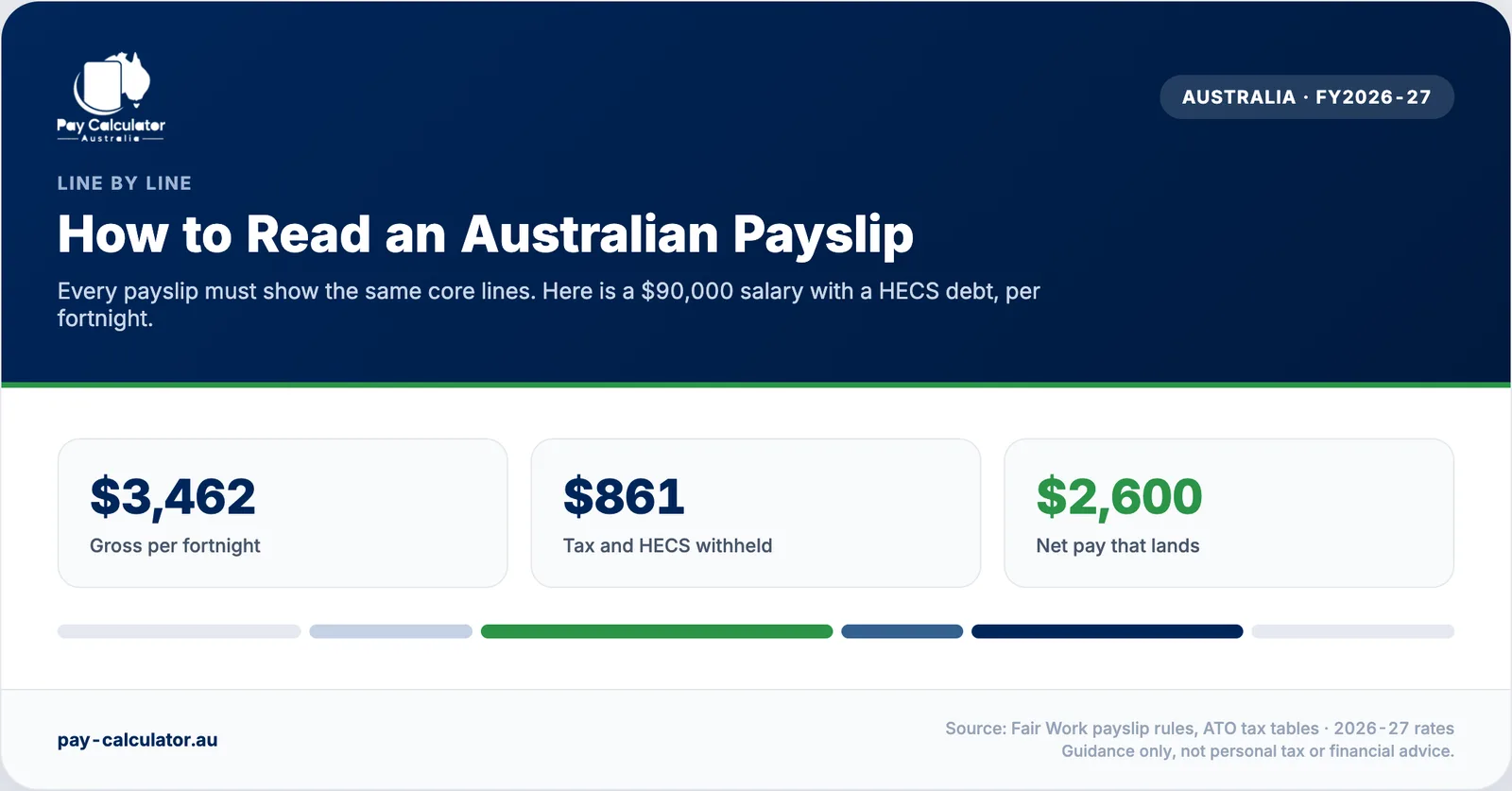
An Australian payslip is a legal document with a fixed list of required contents, set by the Fair Work Act 2009 and the Fair Work Regulations 2009. Once you know what each line is, most payslip surprises stop being surprises. This guide walks through every required line, decodes the STSL entry that puzzles anyone with a study loan, and explains why superannuation appears on the slip without ever touching your net pay.
Key takeaways
- Your employer must give you a payslip within one working day of payday.
- Ten categories of information are required, from gross and net pay to deductions and super.
- STSL means Study and Training Support Loans, the extra withholding for HECS-HELP and similar debts.
- The super line (12% in FY2026-27) is paid on top of your salary, not out of it.
- The tax line is withholding, a payday estimate. Your actual tax is settled when you lodge your return.
What must an Australian payslip show?
A payslip must show ten categories of information, listed in the Fair Work Regulations 2009 (regulations 3.45 to 3.48). If any required item is missing, the payslip is non-compliant and Fair Work Inspectors can fine the employer. The full list, from the Fair Work Ombudsman's payslip rules (updated 22 October 2025), is below.
| Required line | What it must show |
|---|---|
| Employer and employee names | Both names, so the slip identifies who paid whom |
| Employer's ABN | The Australian Business Number, if the employer has one |
| Pay period | The dates the payment covers |
| Date of payment | The day the money was paid |
| Gross pay and net pay | Pay before withholding, and the amount that reached your account |
| Hourly rate details | If paid hourly: the ordinary rate, hours worked at it, and the dollar total |
| Loadings and extras | Casual loading, allowances, bonuses, incentive payments and penalty rates, each separately identifiable |
| Final pay rate | The rate that applied on the last day of employment, where relevant |
| Deductions | The amount and details of each deduction, plus the name (or name and number) of the fund or account it went to |
| Superannuation | Contributions made or to be made for the period, and the name (or name and number) of the super fund |
A payslip can note that an hourly rate already incorporates the casual loading rather than splitting it out. Everything else on the list has to appear as its own entry.
When must you receive your payslip?
Within one working day of payday, even if you are on leave that day. The rule comes from the Fair Work Act 2009 (section 536) and applies to every pay run, not only the monthly summary some employers once favoured. Payslips can be electronic or hard copy. An electronic payslip must contain the same information as a paper one, and you must be able to access it and print it in private, which matters if your only workplace computer sits in a shared office.
What does a sample payslip look like?
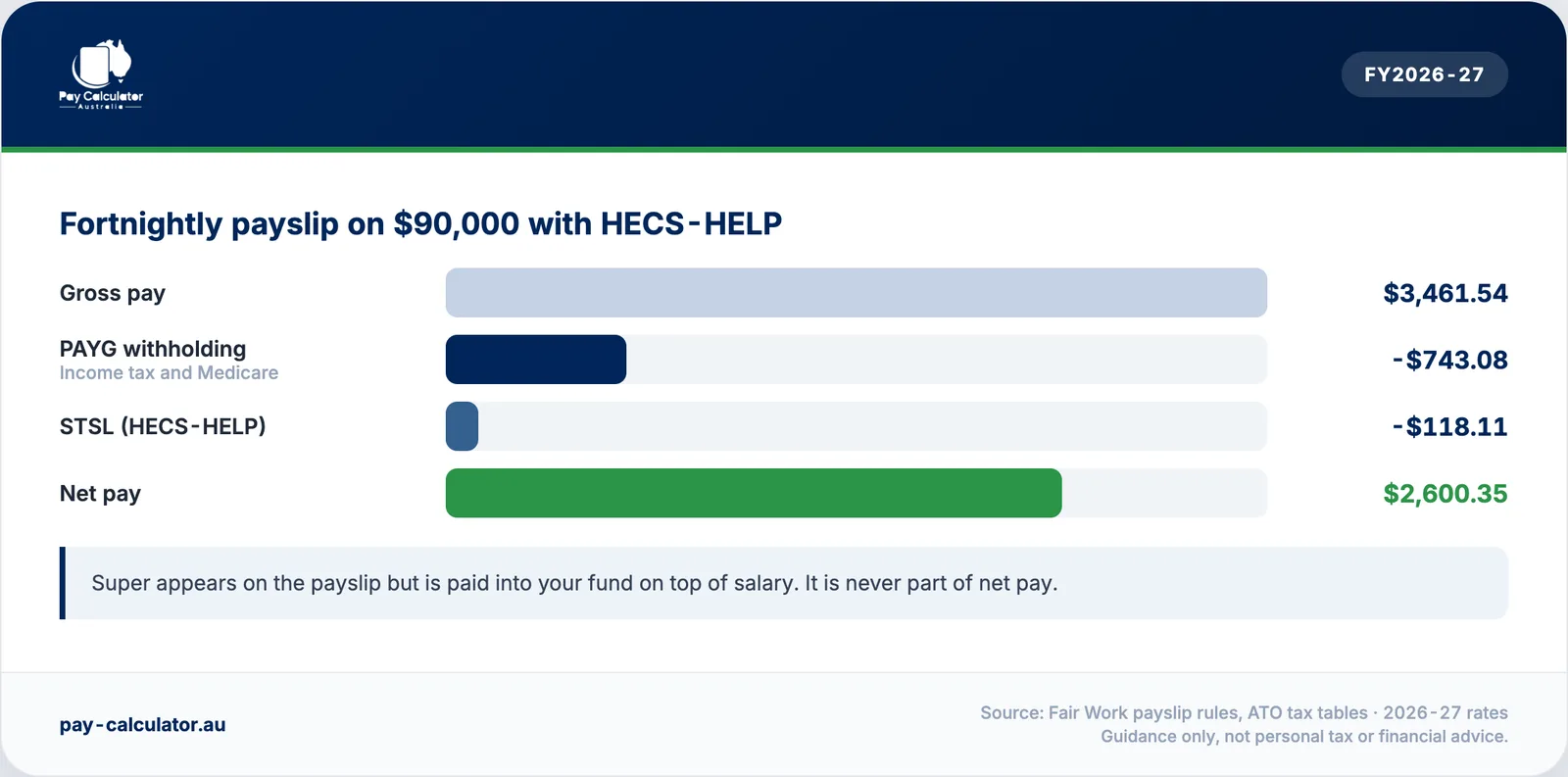
The table below shows the money lines of a fortnightly payslip for a $90,000 salary in FY2026-27, for a resident with a HECS-HELP debt who claims the tax-free threshold. The figures are the annual amounts from our tax engine divided by 26, shown to the cent because withholding amounts are quoted to the cent.
| Payslip line | Amount per fortnight | What it is |
|---|---|---|
| Gross pay | $3,461.54 | Salary for the period before anything comes out |
| PAYG withholding | $743.08 | Estimated income tax and Medicare levy, sent to the ATO |
| STSL | $118.11 | Extra withholding for the study loan repayment |
| Net pay | $2,600.35 | What lands in your bank account |
| Super guarantee | $415.38 | Paid by the employer to your fund, on top of gross |
One caution on precision. Your employer does not divide an annual figure by 26. Each pay is worked out from the ATO's fortnightly tax table (NAT 1006) or the Schedule 1 formulas (NAT 1004), so the withholding on a real payslip can differ from this table by a few dollars. Over the year the two approaches land in almost the same place. To see your own version of this breakdown, run your salary through the take-home pay calculator or the fortnightly pay calculator.
What is the difference between gross pay and net pay?
Gross pay is what you earned for the period. Net pay is what reached your account after withholding, and both must appear on the payslip. On the $90,000 example above, $3,461.54 gross becomes $2,600.35 net each fortnight once income tax, the Medicare levy and the STSL amount come out. The gap is not a mystery and it is not a fee. It is tax being collected as you earn, under the PAYG withholding system. The full anatomy of that gap has its own guide: why net pay differs from gross.
What does STSL mean on your payslip?
STSL stands for Study and Training Support Loans, the ATO's umbrella term for HECS-HELP, FEE-HELP, OS-HELP, SA-HELP, VET Student Loans, the Student Financial Supplement Scheme, Student Start-up Loans and Australian Apprenticeship Support Loans. If you ticked the study loan box on your Tax file number declaration (NAT 3092), or later on a Withholding declaration (NAT 3093), your employer withholds an extra amount from each pay using the ATO's study and training support loans tax tables.
Two things about this line catch people out. First, it only reflects an expected repayment. For 2026-27, compulsory repayments start once repayment income passes $69,528, at 15c per dollar above that threshold (ATO study and training support loans rates page, updated 30 June 2026). Second, the STSL amount withheld does not reduce your loan during the year. It is remitted to the ATO as ordinary withholding, and your loan is only credited when your return is assessed after 30 June. Your payslip is not a loan statement. To see the annual repayment behind the fortnightly line, use the HECS-HELP repayment calculator.
Why is super on your payslip but not taken out of your pay?
The super guarantee is 12% of ordinary time earnings for FY2026-27, and it is an amount your employer pays on top of your salary, directly to your super fund. It never passes through your bank account, which is why the payslip shows it but the net pay line ignores it. On the $90,000 example, that is $415.38 per fortnight going to the fund alongside your $2,600.35 of net pay.
The payslip must name the fund the contributions were or will be paid to. From 1 July 2026, new Payday Super rules require employers to pay super each payday rather than quarterly, with contributions generally reaching your fund within 7 business days of payday (Fair Work Ombudsman, Tax and superannuation, updated 6 July 2026). That makes the super line worth actually checking: the amount shown should now be turning up in your fund shortly after every payday, not months later. The exception is salary sacrifice. If you asked your employer to redirect part of your pre-tax salary into super, that sacrificed amount is a deduction from gross pay and appears as one. The employer's own 12% still sits on top. The mechanics are covered in the superannuation guarantee guide, and you can check the dollars with the superannuation calculator.
What counts as a deduction on a payslip?
A deduction is any amount taken out of your gross pay, and the payslip must show the amount, what it was for, and the name (or name and number) of the fund or account it was paid into. The common lines sort as follows.
| Line | Comes out of your gross pay? |
|---|---|
| PAYG withholding | Yes. Estimated income tax and Medicare levy, sent to the ATO |
| STSL | Yes. Extra withholding for a study loan, part of the same PAYG system |
| Salary sacrifice super | Yes, but only if you set it up. Pre-tax pay redirected to your fund |
| Other agreed deductions | Yes. Things like union fees or novated lease payments you authorised |
| Super guarantee (12%) | No. Employer money paid on top, shown for transparency |
Notice that the Medicare levy does not get its own payslip line. It is collected inside the PAYG withholding amount, because the ATO's withholding schedules build the levy into their formulas. You only see it broken out when your tax return is assessed.
What extra lines apply if you are paid hourly?
If you are paid an hourly rate, the payslip must show three extra things: the ordinary hourly rate, the number of hours worked at that rate, and the total dollars paid at that rate. This is the part of the payslip that lets you audit your own pay. Hours multiplied by rate should equal the line total, and the rate should be at or above your award or agreement minimum.
Casuals should look for the loading. The standard casual loading is 25% on top of the equivalent permanent hourly rate, and it must be separately identifiable on the payslip, although the slip may instead state that the hourly rate already incorporates it. Penalty rates, overtime, allowances and bonuses must each be shown as their own identifiable amounts too. If your weekend shifts pay the same rate as your Tuesday shifts and your award says otherwise, the payslip is where that shows up first. See the casual loading guide for how the 25% works and what it trades away.
What is not required on a payslip?
Leave balances are the big one. Annual leave, sick and carer's leave, and long service leave balances do not have to appear on a payslip. The Fair Work Ombudsman calls including them best practice, and most payroll software does, but an employer who leaves them off is not breaking the rules. They must tell you your balances if you ask.
One item is deliberately excluded rather than optional. Paid family and domestic violence leave must not be itemised on a payslip as such. Any amount paid for that leave has to be recorded as ordinary hours of work or another payment type, such as an allowance or overtime. The rule exists to protect the safety of employees whose payslips might be seen at home.
What can you do if your payslip is missing or wrong?
Start with payroll, because most payslip problems are clerical. If that fails, the enforcement framework is real: Fair Work Inspectors can issue an infringement notice (a fine) to an employer who does not give payslips, gives them late, or leaves out required information, under the Fair Work Act 2009 (sections 536 and 539) and the Fair Work Regulations 2009 (regulations 3.45 to 3.48 and 4.04). Giving a payslip the employer knows is false or misleading is unlawful, and courts can impose penalties.
Keep your payslips. They are your evidence for chasing underpaid wages or super, and your reference at tax time. If the numbers on the slip look right but the amount that reaches your account feels wrong, compare the slip against the take-home pay calculator before assuming the worst. The most common finding is that the payslip is correct and the surprise lives in how withholding works, which is covered in the PAYG withholding guide.
Payslip FAQ
Sources
- Fair Work Ombudsman, Pay slips (payslip contents and timing rules), updated 22 October 2025.
- Fair Work Act 2009, sections 536 and 539; Fair Work Regulations 2009, regulations 3.45 to 3.48 and 4.04.
- ATO, Study and training support loans rates and repayment thresholds, updated 30 June 2026.
- ATO, Compulsory repayments (employer notification via NAT 3092 and NAT 3093), updated 3 June 2026.
- ATO, Fortnightly tax table (NAT 1006) and Schedule 1 Statement of formulas (NAT 1004), 2026-27 editions applying from 1 July 2026.
- Fair Work Ombudsman, Tax and superannuation (12% super guarantee, Payday Super from 1 July 2026), updated 6 July 2026.
Last verified 23 July 2026. Worked example computed with this site's FY2026-27 tax engine.