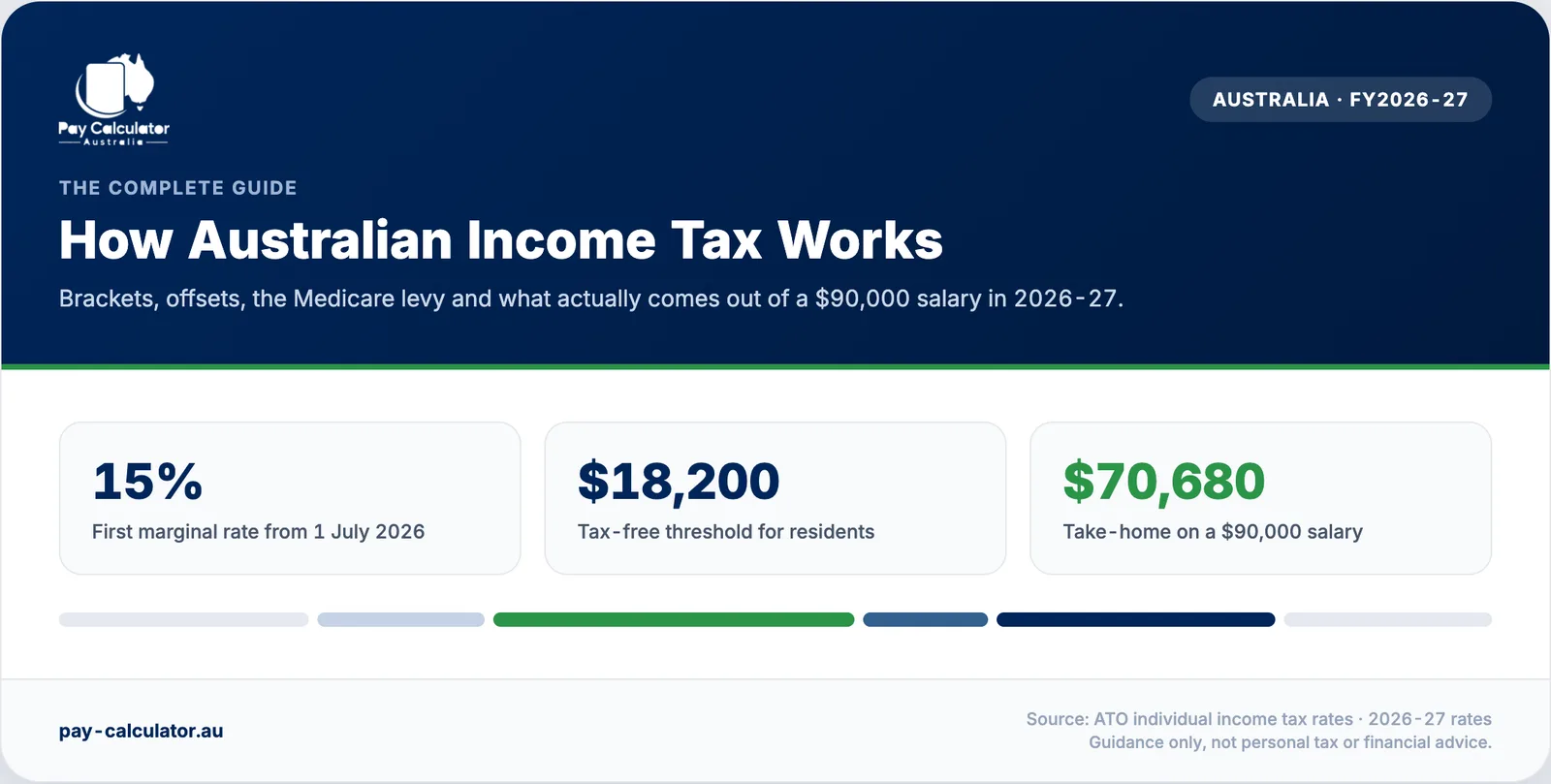
Australia uses a progressive income tax system, which means the rate you pay rises in steps as you earn more. You never pay a single flat rate on your whole salary. Instead, each slice of your income is taxed at the rate for its band. This guide explains the 2026-27 rates, the tax-free threshold, the Medicare levy and the offsets that lower your bill, and it shows you exactly how the sums work on a real salary.
Key takeaways
- The first $18,200 you earn each year is tax-free.
- From 1 July 2026 the first taxed band fell from 16% to 15%.
- The four resident rates for 2026-27 are 15%, 30%, 37% and 45%.
- A 2% Medicare levy applies on top for most residents.
- New for 2026-27: a $1,000 standard work deduction you can claim at tax time.
The tax-free threshold
Every Australian resident can earn $18,200 in a financial year before paying any income tax at all. This is the tax-free threshold, and it is the reason a part-time or lower-income worker can pay little or no tax. You claim it through your employer by answering yes to the tax-free threshold question on your tax file number declaration, which lowers the tax withheld from each pay.
If you hold more than one job at the same time, you normally claim the threshold from the job that pays you the most. Claiming it from every job would leave too little tax withheld across the year, which can lead to a bill when you lodge your return.
The 2026-27 income tax brackets
For the 2026-27 financial year, an Australian resident is taxed at the following marginal rates. The rate shown applies only to the income that falls inside each band, not to your whole salary.
| Taxable income | Rate on this band |
|---|---|
| $0 to $18,200 | Nil (tax-free threshold) |
| $18,201 to $45,000 | 15% |
| $45,001 to $135,000 | 30% |
| $135,001 to $190,000 | 37% |
| $190,001 and above | 45% |
The headline change this year is that the first taxed band was cut from 16% to 15% on 1 July 2026. Everyone who earns above the tax-free threshold benefits, because that lower rate applies to the same slice of income for all taxpayers. You can see the full band table and put your own salary in on our income tax calculator.
Marginal rate versus average rate
Two numbers describe your tax, and it helps to keep them apart. Your marginal rate is the rate you pay on your next dollar of income, so it is the rate of the band your top dollar sits in. Your average rate is the total tax you pay divided by your total income.
Your average rate is always lower than your marginal rate. That is because the first $18,200 is tax-free and the lower bands are taxed gently before the higher rates ever apply. Someone on a marginal rate of 30% might have an average income tax rate closer to 20%. This is why a pay rise is never taxed at your average rate: only the extra income is taxed, and it is taxed at your marginal rate.
Worked example: tax on a $90,000 salary
Take a resident earning a $90,000 salary in 2026-27. The tax is built up band by band:
- The first $18,200 is tax-free, so it adds nothing.
- The slice from $18,201 to $45,000 is $26,800, taxed at 15%, which is $4,020.
- The slice from $45,001 to $90,000 is $45,000, taxed at 30%, which is $13,500.
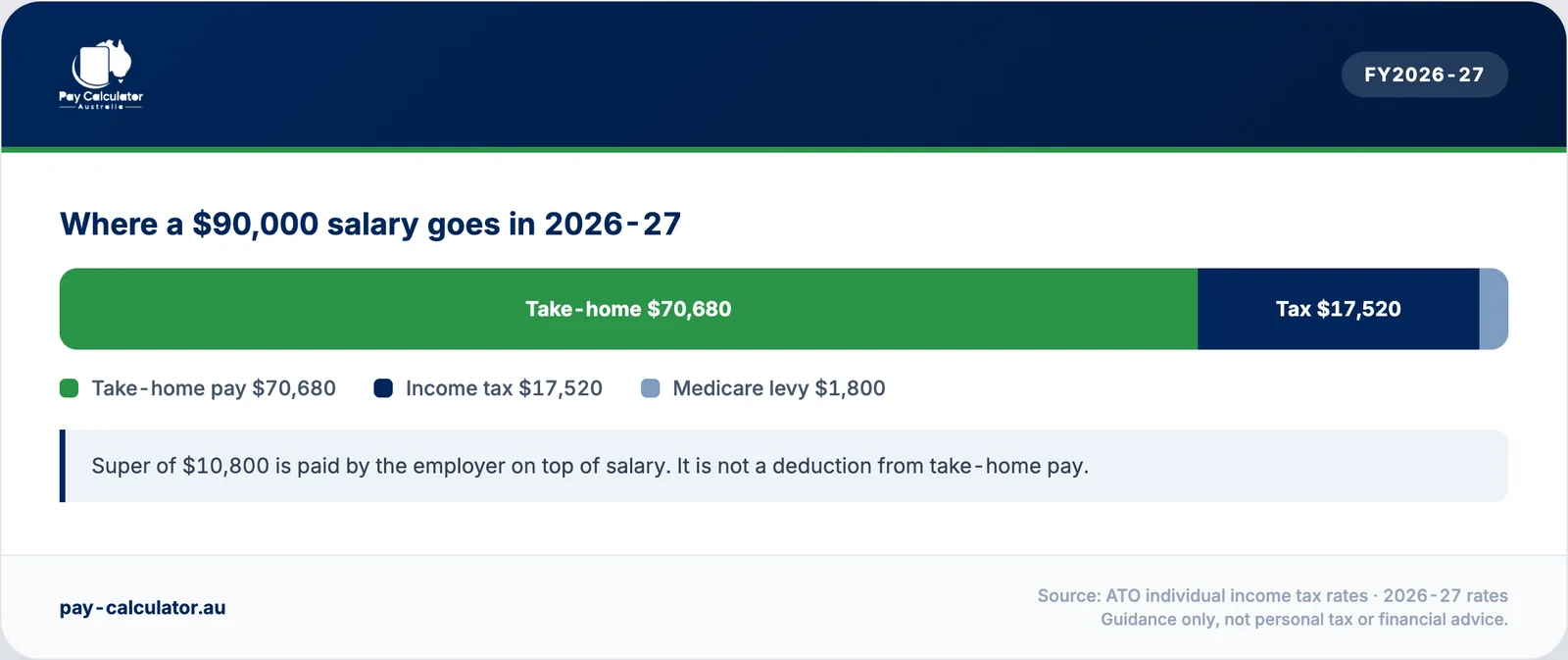
Adding those together gives $17,520 in income tax. On top of that, the 2% Medicare levy adds $1,800, so the total taken is $19,320. That leaves take-home pay of $70,680. Separately, the employer pays $10,800 of superannuation on top of the salary, because super is not part of your take-home pay.
On $90,000 the marginal rate is 30%, but the average rate including the Medicare levy is only about 21.5%, because the first $18,200 is tax-free and the next band is taxed at just 15%.
To break your own pay down the same way, use the take-home pay calculator on the home page.
The Medicare levy
Most Australian residents pay a Medicare levy of 2% of their taxable income to help fund the public health system. It sits on top of your income tax rather than inside the brackets, which is why the $90,000 example adds $1,800 separately. Lower-income earners pay a reduced levy or none at all, thanks to a low-income shade-in that phases the levy in gradually. You can check the levy on your own income with our Medicare levy calculator.
The Low Income Tax Offset
The Low Income Tax Offset, or LITO, reduces the income tax of lower earners. It is worth up to $700 for taxable incomes at or below $37,500, then it phases out as income rises and reaches nil around $66,667. An offset is not a cash payment or a deduction: it reduces the tax you would otherwise owe, and it cannot push your tax below zero. The Australian Taxation Office applies it automatically when you lodge your return, so you do not need to claim it.
The new $1,000 standard work deduction
New for 2026-27, you can claim a $1,000 standard deduction for your work expenses at tax time without keeping receipts. It reduces your taxable income by $1,000, so the tax you save depends on your marginal rate. For someone on the 30% band, a $1,000 deduction is worth about $300 back. If your genuine, receipted work expenses come to more than $1,000, you can still claim the higher amount the usual way instead. This standard deduction simply gives everyone a floor without the paperwork.
What income tax does not include
Two big items are often confused with income tax but are handled separately. The first is superannuation. Your employer pays super at 12% on top of your salary, and it is taxed inside the fund at a concessional rate rather than at your marginal rate, so it never appears in your take-home pay. The second is your study loan. If you have a HECS or HELP debt, your compulsory repayment is worked out from your income and collected through the tax system, but it is a repayment of your loan rather than tax. You can estimate it with our HECS/HELP repayment calculator.
How to work out your own tax
The quickest way to see your position is to let a calculator build the bands for you. Enter your salary on the income tax calculator to see the tax and Medicare levy alone, or use the take-home pay calculator to fold in super and any study loan and land on your final net pay. Every figure on this site is built on published ATO rates for the 2026-27 financial year, so the numbers you see match the way your employer and the tax office calculate them.