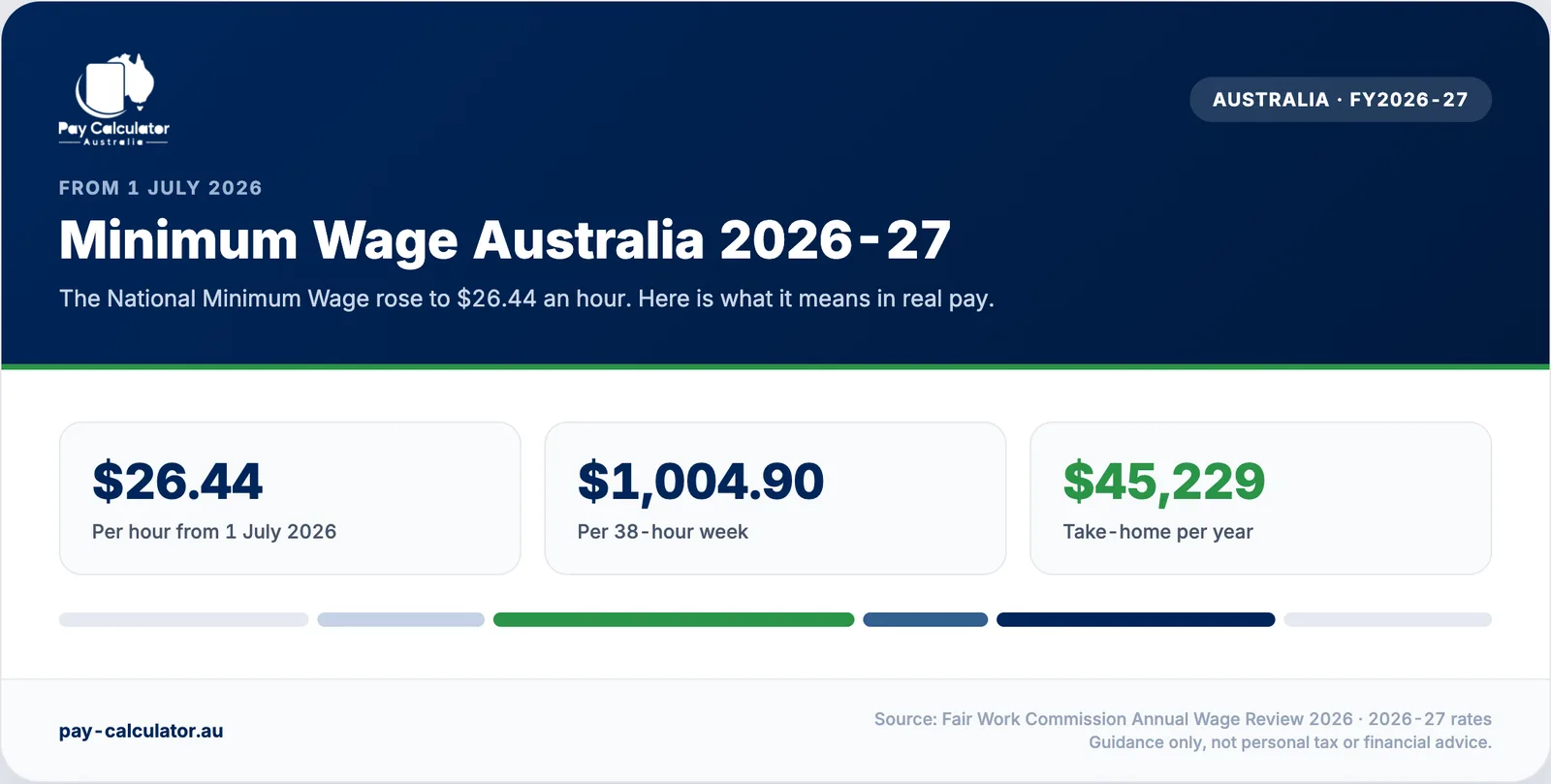
The National Minimum Wage is $26.44 per hour, or $1,004.90 per week for a full-time 38-hour week, from the first full pay period starting on or after 1 July 2026. That headline hides two traps: most Australian workers are not actually on the National Minimum Wage but on higher award minimums, and the percentage increase you read in the news depends on which of those two numbers is being quoted. This guide sorts the figures out, then follows the minimum wage all the way to a bank account: what a year on it earns, what tax comes out, and what is left.
Key takeaways
- The National Minimum Wage is $26.44 per hour, $1,004.90 per week, from 1 July 2026.
- Minimum award wages rose 4.75%; the NMW itself rose about 6.0% because of a structural adjustment.
- The NMW only applies to award-free employees. Most workers get an award minimum instead.
- Casuals on the NMW get a 25% loading, about $33.05 per hour.
- Full-time on the NMW is $52,255 a year, about $45,229 after tax (FY2026-27), with 12% super on top.
What is the minimum wage in Australia in 2026-27?
The National Minimum Wage is $1,004.90 per week or $26.44 per hour from the first full pay period on or after 1 July 2026, set by the Fair Work Commission's Annual Wage Review 2026 decision ([2026] FWCFB 3500, announced 2 June 2026). The weekly figure assumes a full-time 38-hour week, which is the standard set by the National Employment Standards.
Both numbers are gross figures, before tax. They are also a floor, not a default: an award, enterprise agreement or contract can pay more, and awards almost always set their own higher-than-NMW minimums for skilled classifications. What no instrument can do is pay an adult employee less for ordinary hours than the applicable minimum. To turn the hourly figure into a weekly, fortnightly or annual number for your own hours, use the hourly pay calculator.
How much did the minimum wage rise on 1 July 2026?
Two different percentages are in circulation and both are correct, for different things. Minimum award wages rose by 4.75%, which is the Commission's headline figure and the one that applies to most workers. The National Minimum Wage itself rose by about 6.0%, from $948.00 to $1,004.90 per week, because of an extra structural adjustment explained further down.
| Rate | 2025-26 | From 1 July 2026 | Increase |
|---|---|---|---|
| NMW per week (38 hours) | $948.00 | $1,004.90 | About 6.0% |
| NMW per hour | $24.95 | $26.44 | About 6.0% |
| Minimum award wages | Varied by award | Varied by award | 4.75% |
The prior-year figures ($948.00 and $24.95) and the 6 per cent characterisation come from ABC News reporting of the decision; the 4.75% award increase and the new dollar rates are stated directly by the Fair Work Ombudsman and the Commission. If you are on an award, the number that moved your pay is 4.75%, not 6%.
Who does the National Minimum Wage actually apply to?
Only employees who are not covered by an award or a registered agreement, which the Fair Work Commission notes is a very small share of the workforce. Around 21.1% of Australian employees, roughly 2.8 million people, are paid at a minimum award rate under a modern award, and for them the binding number is their award classification rate, not the NMW. Everyone else is on an agreement or an above-minimum contract.
The practical rule: if a modern award covers your industry and your role, your minimum is in that award, and it can be well above $26.44 per hour once classifications, penalty rates, overtime and allowances are counted. Those extras are covered in the overtime and penalty rates guide. The NMW is the floor under the entire system, which is exactly why it is the number the news reports every June.
When did the new rate actually start?
From the first full pay period starting on or after 1 July 2026, not necessarily on 1 July itself. Fair Work's own worked example: if a weekly pay period starts on a Monday and 1 July falls on a Wednesday, the new rates apply from Monday 6 July 2026, the start of the next full period. If your early-July payslip straddled the changeover and still showed the old rate for those first few days, that was correct, not an underpayment.
This timing rule applies to the award increases as well as the NMW. It is worth checking a mid-July payslip against your award rate; the payslip guide shows exactly which lines to look at.
Why did the NMW rise more than award wages?
Because of a structural change at the bottom of the award system. The NMW is aligned to the C13 classification wage rate, the lowest rate for ongoing employment in the award structure. In the 2026 decision the Commission began phasing out C13 over three stages so that C12 becomes the lowest ongoing rate. Stage one lifted the C13 rate by the general 4.75% increase plus one-third of the gap between C13 and C12. The NMW, pegged to C13, moved up with it, producing the roughly 6% effective rise.
| Lowest award rates from 1 July 2026 | Per week | Per hour |
|---|---|---|
| Lowest ongoing rate in any award (C13-aligned, matches NMW) | $1,004.90 | $26.44 |
| Entry-level rate, first 6 months or less (C14) | $978.10 | $25.74 |
The C14 rate is a genuine entry rate: awards can only pay it for the first six months of employment or less, after which the higher rate applies.
What is the minimum wage for a casual employee?
A casual on the National Minimum Wage gets the base rate plus a 25% casual loading, which is about $33.05 per hour from 1 July 2026. The loading exists because casuals miss out on entitlements permanent staff receive: paid annual leave, paid sick and carer's leave, notice of termination and redundancy pay. It is compensation, not a bonus.
The exact loading is set by the relevant award or agreement, and 25% is the standard figure and the one that applies to award-free casuals on the NMW. Casuals can also be entitled to overtime and penalty rates on top, with each award setting how the loading and penalties combine. The casual loading calculator does the arithmetic, and the casual loading guide explains what the 25% trades away.
What does the minimum wage leave after tax?
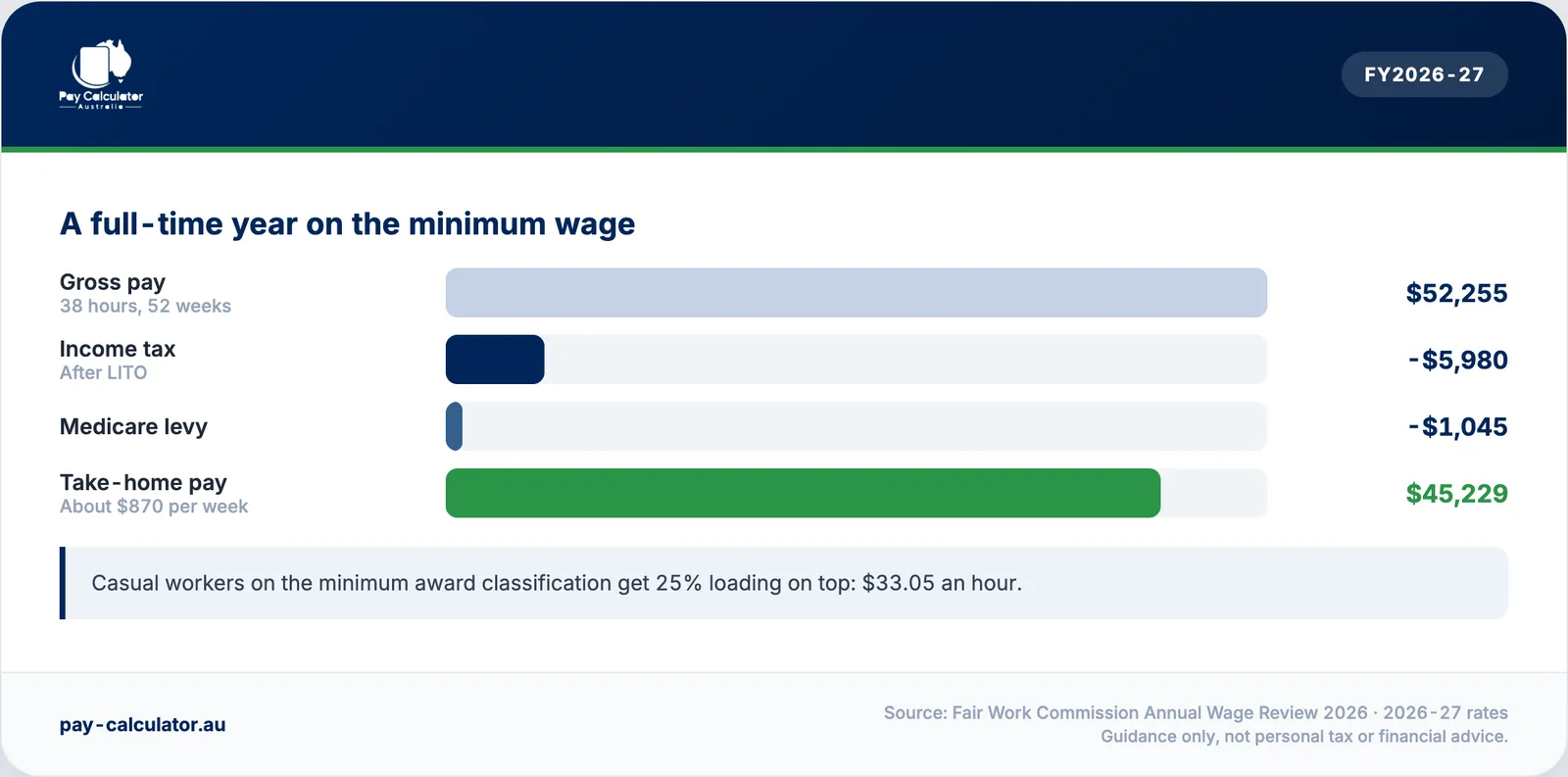
Full-time on the NMW is $52,255 a year ($1,004.90 for 52 weeks). On 2026-27 resident rates, claiming the tax-free threshold, income tax takes $5,980 (after the Low Income Tax Offset) and the Medicare levy takes $1,045, leaving $45,229 for the year, about $870 a week.
| Full-time on the NMW, FY2026-27 | Amount |
|---|---|
| Gross pay ($1,004.90 for 52 weeks) | $52,255 |
| Income tax (after Low Income Tax Offset) | $5,980 |
| Medicare levy | $1,045 |
| Net pay for the year | $45,229 |
| Net pay per week | $870 |
| Average tax rate | 13.4% |
| Super guarantee paid on top (12%) | $6,271 |
Three things soften the tax at this income. The first $18,200 is tax-free, the next band is taxed at only 15% for 2026-27, and the Low Income Tax Offset trims the bill further, so the average tax rate lands at 13.4% rather than anything near the headline bracket rates. There is no compulsory HECS-HELP repayment either, because $52,255 sits below the 2026-27 repayment threshold of $69,528. And the employer pays $6,271 of super on top of the wage, not out of it. For your own hours and rate, the weekly pay calculator gives the per-week version of this table.
What if an award covers your job?
Then your minimum is the award rate for your classification, which rose 4.75% on 1 July 2026 and is at least $1,004.90 per week for ongoing adult employment. Awards also set the parts of pay the NMW says nothing about: penalty rates for weekends and public holidays, overtime after ordinary hours, allowances, and minimum shift lengths.
The authoritative way to find your exact rate is Fair Work's Pay and Conditions Tool or the downloadable pay guides, both updated with the 1 July 2026 rates. Employees under an enterprise agreement should read the agreement, keeping in mind the better off overall principle: an agreement cannot leave you worse off overall than the award. If your pay is close to the minimum and involves weekend work, check the penalty rate interaction carefully; a correct base rate with missing penalties is one of the most common underpayment patterns.
What should your payslip show if you are on the minimum wage?
Because minimum wage jobs are usually paid hourly, your payslip must show the ordinary hourly rate, the number of hours worked at that rate, and the total dollars at that rate. Those three lines let you verify the minimum in seconds: the rate should be at least $26.44 from the first full pay period on or after 1 July 2026, and hours times rate should equal the line total.
Casuals should also see the 25% loading, either as its own line or with a note that the hourly rate incorporates it. Penalty rates, overtime and allowances must each appear as separately identifiable amounts. Payslips must arrive within one working day of payday under the Fair Work Act 2009. The full required list, and what STSL means if you have a study loan, is in the payslip guide.
What can you do if you are paid less than the minimum?
Minimum wages are enforceable, not advisory. Start by checking the correct rate for your situation in Fair Work's Pay and Conditions Tool, then raise the gap with your employer in writing; a surprising share of underpayments are payroll settings that nobody has looked at since the last increase. Keep your payslips, because they are the evidence.
If the conversation goes nowhere, the Fair Work Ombudsman handles underpayment complaints and can compel back-payment. Fair Work Inspectors can also fine employers over payslip failures, which often travel together with underpayment. To put a dollar figure on what you are owed across past pay periods, the backpay calculator will do the sums, including the tax treatment when the arrears are finally paid.
Minimum wage FAQ
Sources
- Fair Work Ombudsman, Minimum wages increase from 1 July 2026 (Annual Wage Review 2026), published 28 May 2026, updated 1 July 2026.
- Fair Work Ombudsman, Minimum wages, updated 1 July 2026.
- Fair Work Commission, Annual Wage Review 2026 decision [2026] FWCFB 3500, announced 2 June 2026 (4.75% award increase, C13 phase-out, C14 entry rate).
- ABC News, Fair Work Commission annual ruling lifts minimum wage by 6 per cent, 2 June 2026 (prior-year rates $948.00 and $24.95, about 6% NMW rise).
- Fair Work Ombudsman, Casual employees, updated 12 May 2026 (25% casual loading and what it compensates for).
- Fair Work Ombudsman, Pay slips, updated 22 October 2025 (hourly rate, hours and loading lines).
- ATO, 2026-27 resident tax rates and Study and training support loans thresholds (take-home calculation), updated 30 June 2026.
Last verified 23 July 2026. Take-home figures computed with this site's FY2026-27 tax engine.