Casual Loading Explained: The 25% and What It Trades Away
Casual loading adds 25% to your base hourly rate in place of paid leave, notice and redundancy pay. This guide shows what the loading covers, what casuals keep, and whether the extra 25% actually leaves you ahead over a year.
What is casual loading?
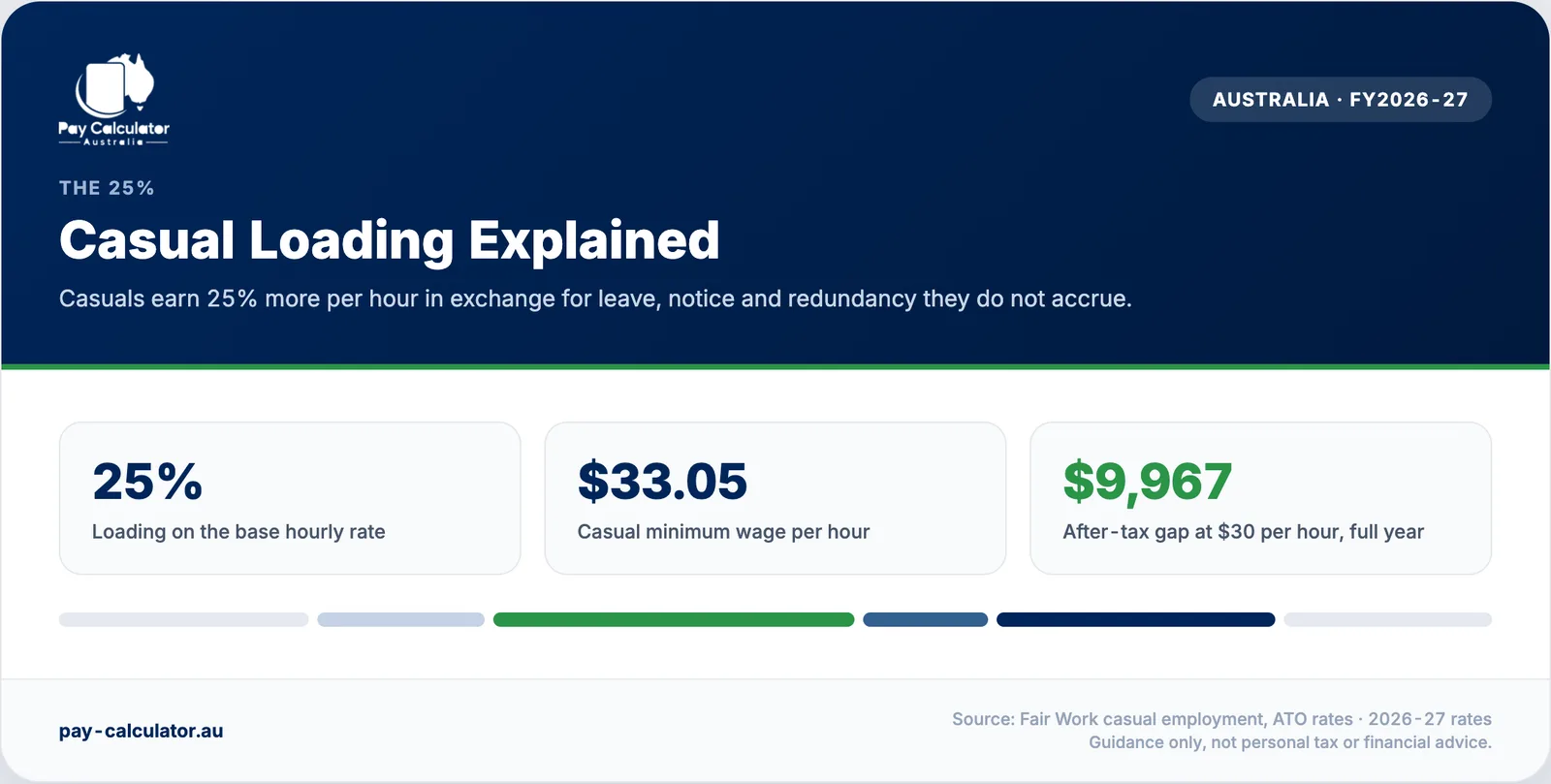
Casual loading is a higher hourly pay rate for casual employees, and the standard rate is 25% of the equivalent permanent base rate. A casual is paid either that loading on top of the base rate, or a specific casual rate set by an award, registered agreement or employment contract. Either way, the number comes from your award, not from a single national law.
The 25% figure is the common rate across modern awards, and it is the loading that applies to casual employees paid at the National Minimum Wage. From the first full pay period on or after 1 July 2026, that minimum is $26.44an hour for permanent staff, per the Fair Work Commission's Annual Wage Review 2026 decision [2026] FWCFB 3500. A casual doing the same minimum-wage job earns $33.05 an hour. You can test your own rate on the casual loading calculator.
What does the 25% loading compensate you for?
The loading is not a bonus. It is the price of the entitlements you give up.
The loading compensates casual employees for entitlements they do not receive under the National Employment Standards. A casual generally does not get paid annual leave, paid sick and carer's leave, notice of termination or redundancy pay. That holds even after years of regular shifts with the same employer. Fair Work's Casual employees guidance is blunt about it: regular long-term work does not, on its own, create those entitlements.
The practical effect shows up when life interrupts work. A permanent employee who catches the flu is paid while away. A casual is not. A permanent employee made redundant after five years receives redundancy pay worked out under the NES. A casual in the same restructure generally receives nothing beyond their final hours worked, which our final pay calculator can break down. The 25% is meant to fund those gaps yourself, week by week, whether or not you ever need to draw on it.
Which NES entitlements do casual employees keep?
Casual does not mean entitlement-free. These stay, per Fair Work's National Employment Standards.
| Entitlement | Permanent | Casual |
|---|---|---|
| Paid annual leave (4 weeks under the NES) | Yes | No |
| Paid sick and carer's leave | Yes | No |
| Notice of termination | Yes | No |
| Redundancy pay | Yes | Generally no |
| Paid family and domestic violence leave | 10 days a year | 10 days a year |
| Unpaid carer's leave | 2 days per occasion | 2 days per occasion |
| Unpaid compassionate leave | 2 days per occasion | 2 days per occasion |
| Unpaid community service leave | Yes | Yes |
| Superannuation guarantee (12% in 2026-27) | Yes | Yes |
| Pathway to permanent employment | Not applicable | Yes, in some circumstances |
Source: Fair Work Ombudsman, Casual employees (updated 12 May 2026). Casuals employed on a regular and systematic basis for at least 12 months can also request flexible working arrangements and take unpaid parental leave.
Superannuation deserves its own sentence, because casuals often assume they miss out. They do not. The 12% super guarantee (2026-27) applies to casual wages for anyone over 18, and for under-18s working more than 30 hours a week. See how that accrues on the superannuation calculator.
How much extra is the 25% loading per hour?
Computed from the base rate: casual rate, extra per hour, and extra across a 38-hour week.
| Permanent base rate | Casual rate (base + 25%) | Extra per hour | Extra per 38-hour week |
|---|---|---|---|
| $26.44 (NMW) | $33.05 | $6.61 | $251.18 |
| $30.00 | $37.50 | $7.50 | $285.00 |
| $35.00 | $43.75 | $8.75 | $332.50 |
| $40.00 | $50.00 | $10.00 | $380.00 |
| $45.00 | $56.25 | $11.25 | $427.50 |
NMW is the 2026-27 National Minimum Wage hourly rate. Rows below it are illustrative base rates. Your award may set a different loading or a specific casual rate.
The published weekly National Minimum Wage is $1,004.90 (2026-27) for a full-time 38-hour week. On the casual side there is no published weekly figure, because casual pay is built hour by hour from the loaded rate. To turn an hourly rate into weekly, fortnightly or annual take-home pay, use the hourly pay calculator.
Is a casual on 25% loading better paid over a full year?
Only if the year goes perfectly. Here is the honest comparison at a $30 base rate.
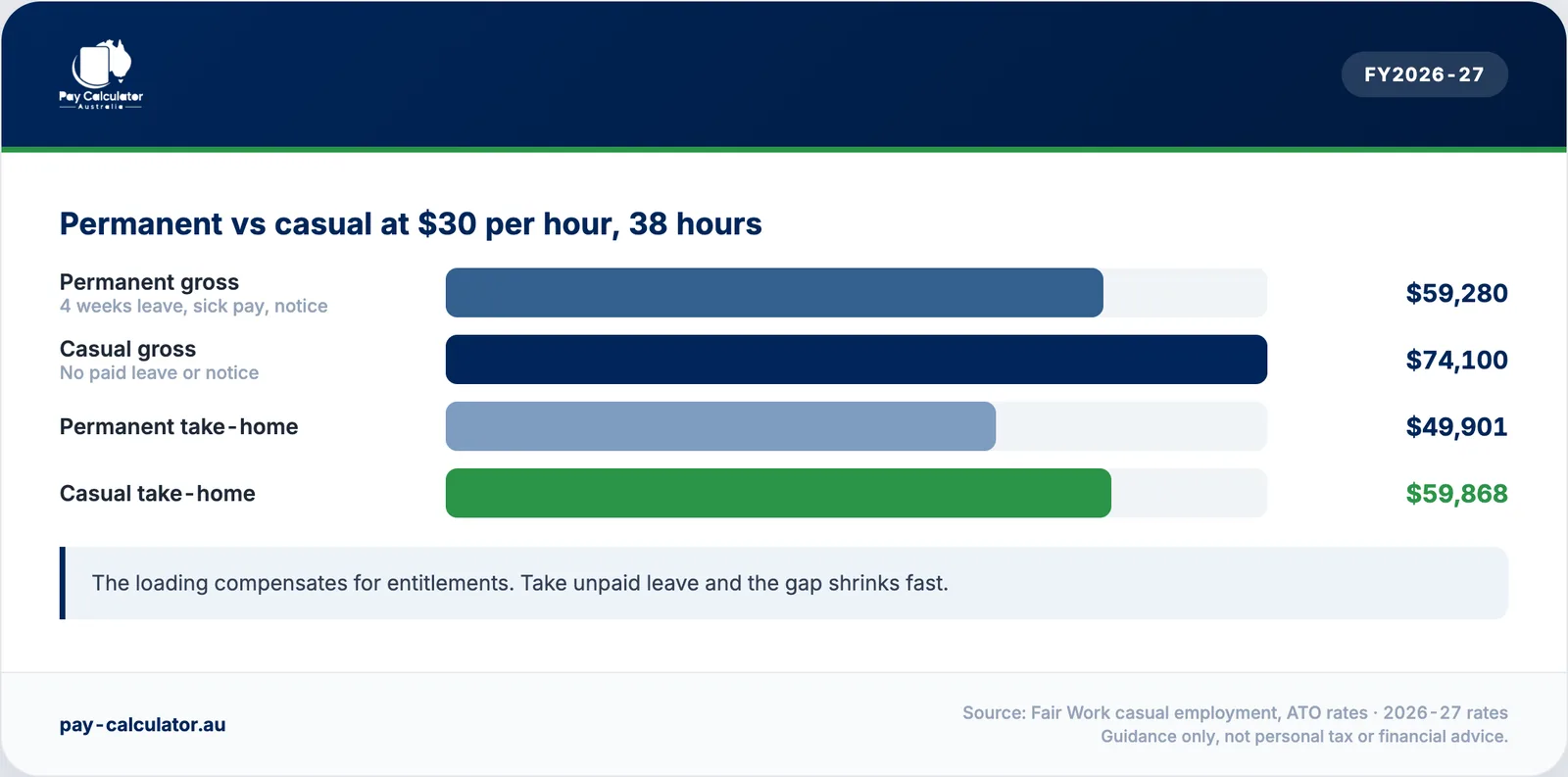
The fair comparison is not hour against hour, because a permanent employee is paid for 52 weeks while working 48, thanks to 4 weeks of paid annual leave under the NES. A casual who takes the same 4 weeks off takes them unpaid. The table compares a permanent employee and a casual doing the same job at a $30.00 base rate, 38 hours a week, both taking 4 weeks off, with 2026-27 resident tax settings and no HECS-HELP debt.
| Over one year | Permanent full-time | Casual (25% loading) |
|---|---|---|
| Hourly rate | $30.00 | $37.50 |
| Weekly pay (38 hours) | $1,140.00 | $1,425.00 |
| Weeks paid | 52 (includes 4 weeks paid leave) | 48 (4 weeks off are unpaid) |
| Annual gross | $59,280 | $68,400 |
| Estimated take-home (2026-27, resident) | $49,901 | $55,992 |
| Paid if sick for a week | Yes | No |
| Notice and redundancy pay if the job ends | Yes | Generally no |
Take-home computed with this site's 2026-27 tax engine (income tax after LITO, plus the 2% Medicare levy). Both roles also receive 12% super on top.
The casual finishes about $6,091 ahead in take-home pay across that year. But the margin assumes zero sick days, no quiet fortnights with reduced shifts, and no gap between jobs. Every unpaid sick day at this rate costs the casual $285.00 in lost gross pay, while the permanent employee loses nothing. The loading buys income now at the cost of income security. Run your own numbers side by side on the employment type calculator.
Who counts as a casual employee?
You are a casual if, when you start the job, there is no firm advance commitment to ongoing work, and you are entitled to a casual loading or a specific casual pay rate. The test looks at the real substance and practical reality of the relationship, not the label on the contract. Fair Work's guidance weighs several factors, including whether you can accept or reject shifts and whether ongoing work is genuinely on offer.
One point catches many people: a regular pattern of shifts does not, by itself, make you permanent. You can work every Tuesday to Saturday for two years and remain a casual, provided the no-firm-advance-commitment character of the arrangement holds. What that regularity does earn you is the conversion pathway covered below, and access to unpaid parental leave and flexible work requests after 12 months.
Does casual loading stack with overtime and penalty rates?
Often yes, but the method is set by your award. Casual employees can be entitled to overtime and penalty rates on top of their loaded rate. What varies is the arithmetic: some awards add the 25% loading and the penalty percentage to the base rate separately, while others compound the penalty on the already-loaded casual rate. The difference is real money on a Sunday shift, so check your specific award through Fair Work's Pay and Conditions Tool rather than assuming.
The mechanics of time-and-a-half (150%) and double-time (200%), and how they interact with weekends and public holidays, are covered in our guide to overtime and penalty rates. For a quick dollar answer, the overtime calculator handles loaded casual rates too.
How is casual loading taxed?
The loading is ordinary income. It goes into your gross wages and is taxed under the same 2026-27 PAYG withholding tables as everyone else's pay. There is no separate casual tax rate, higher or lower.
What surprises casuals is the withholding pattern, not the tax itself. Withholding tables annualise each pay period, so a huge week is withheld as if you earned that much every week, and a quiet week is withheld as if you earned little all year. Withholding is only your employer's payday estimate. Your actual tax is worked out on your real annual income when you lodge, and for casuals with lumpy hours the estimate frequently overshoots, which returns as a refund. The tax refund calculator shows where you are likely to land.
Can a casual convert to permanent employment?
The National Employment Standards give casual employees a pathway to become permanent full-time or part-time in some circumstances. Conversion swaps the 25% loading for the permanent entitlement set: paid annual leave, paid sick and carer's leave, notice of termination and redundancy pay.
Whether conversion pays depends on how much of the entitlement set you would actually use. The computed table above shows a casual who never gets sick finishing roughly $6,091 ahead at a $30 base rate. Someone who values certain income, takes real holidays and wants redundancy protection will usually weigh the permanent side more heavily. There is no universally right answer, only your own year.
Where does casual loading appear on your payslip?
Your payslip must show any loadings, including casual loading, as a separately identifiable amount, or state that your hourly rate already incorporates the loading. That is a Fair Work requirement under the payslip rules (Fair Work Act 2009 ss536 and 539, Fair Work Regulations 2009 rr3.45 to 3.48), and payslips must arrive within one working day of payday. If your rate looks like a flat number with no mention of loading anywhere, ask which of the two formats your employer is using. Our guide on how to read a payslip walks through every required line.
Casual loading questions
Where these figures come from
- Fair Work Ombudsman, Casual employees, updated 12 May 2026.
- Fair Work Ombudsman, Minimum wages, updated 1 July 2026 (2026-27 National Minimum Wage of $26.44 an hour, $1,004.90 a week).
- Fair Work Commission, Annual Wage Review 2026 decision [2026] FWCFB 3500, announced 2 June 2026.
- Fair Work Ombudsman, Pay slips, updated 22 October 2025 (Fair Work Act 2009 ss536, 539; Fair Work Regulations 2009 rr3.45 to 3.48).
- Fair Work Ombudsman, Tax and superannuation, updated 6 July 2026 (12% super guarantee, Payday Super from 1 July 2026).
Last verified 23 July 2026. Take-home figures are computed live from this site's 2026-27 tax engine.
Written by Marcus Kelleher, editor, pay and tax content at pay-calculator.au. He works from ATO and Fair Work source documents and is not a registered tax agent. This page is general information, not advice about your employment arrangement.