Resident vs Non-Resident Tax: The Tests and What They Cost
Your tax residency is decided by four ATO tests, not your visa. The answer controls whether you get the $18,200 tax-free threshold or pay a flat 30% from the first dollar. This guide covers the tests, the 2026-27 rates, and the dollar difference.
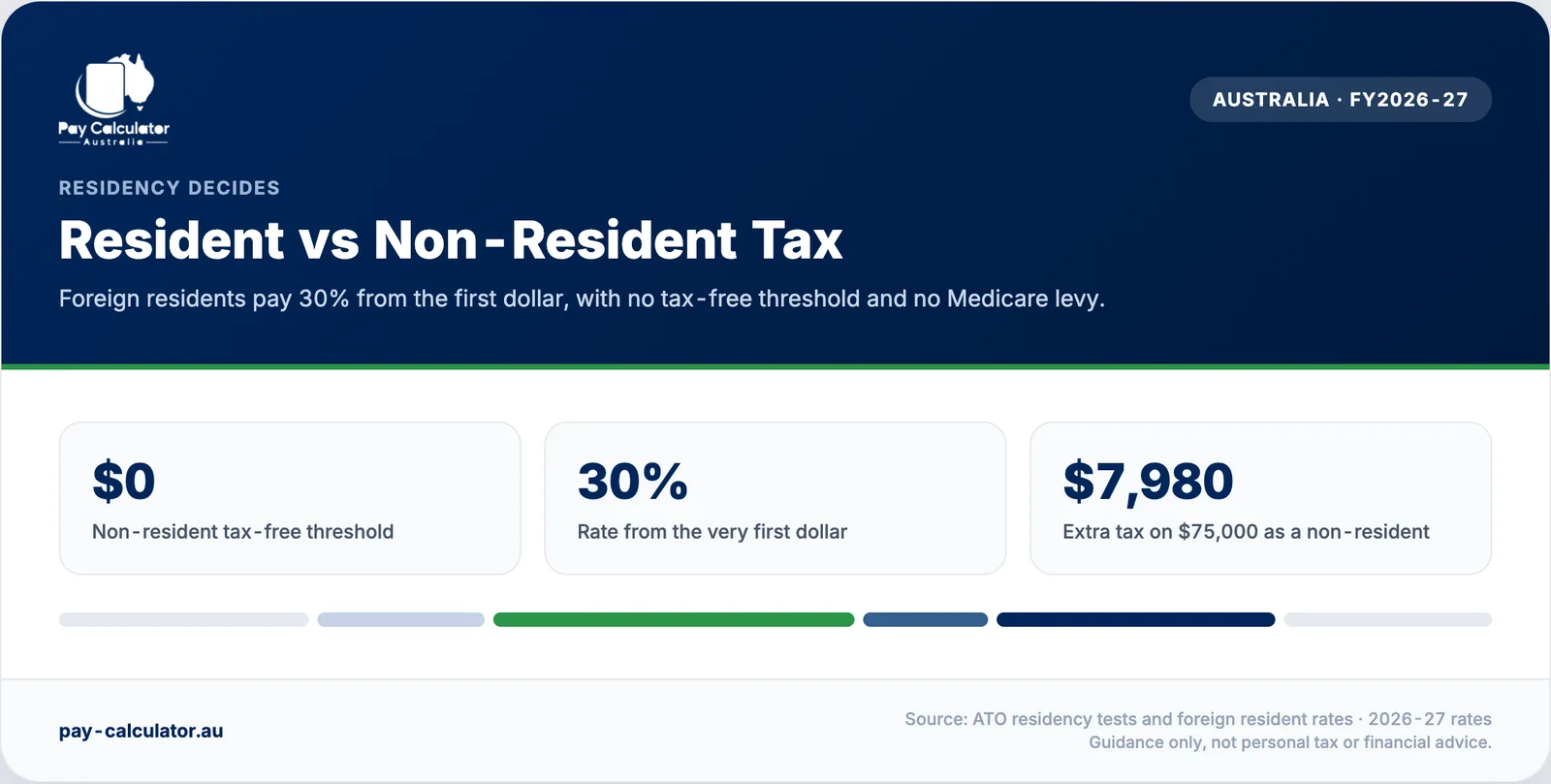
What decides whether you are a resident for tax purposes?
Four statutory tests, applied by the ATO, decide your tax residency. Your visa does not. The ATO does not use the same rules as the Department of Home Affairs, so you can be an Australian resident for tax purposes without being a citizen or permanent resident, and you can hold a visa yet still be a foreign resident for tax.
The structure is a primary test with three backstops. Satisfy the resides test and you are a resident, full stop. Fail it, and you are still a resident if any one of the domicile test, the 183-day test or the Commonwealth superannuation test applies to you. Fail all four and you are a foreign resident, taxed on the scale below. The ATO's residency pages (updated 3 and 7 June 2026) set out all four, and its online tool applies them to your answers.
How do the four residency tests work?
One primary test, three statutory backstops. Passing any one makes you a resident.
The resides test
The primary test asks whether you reside in Australia in the ordinary sense of the word. The ATO weighs physical presence, intention and purpose, family, business or employment ties, the maintenance and location of your assets, and your social and living arrangements. No single factor decides it. Someone who lives here, works here and keeps their life here resides here, whatever their passport says.
The domicile test
You are a resident if your domicile, your permanent home by law, is in Australia, unless the ATO is satisfied your permanent place of abode is outside Australia. Domicile comes from origin, where you were born, or by choice, where you have made a new permanent home. This is the test that keeps many Australians working overseas within the resident net.
The 183-day test
Present in Australia for 183 days or more of the income year, continuously or in stints, and you are a resident under this test, unless your usual place of abode is outside Australia and you have no intention of taking up residence here. Counting days is the start of this test, not the end of it.
The Commonwealth superannuation test
A narrow test for Australian Government employees posted overseas who are contributing members of the CSS or PSS schemes. It does not apply to PSSAP members. Where it applies, the employee, their spouse and children under 16 are residents regardless of every other factor.
How do resident and non-resident tax rates differ in 2026-27?
Residency changes almost every line of the calculation, in both directions.
| Feature | Australian resident | Foreign resident |
|---|---|---|
| Tax-free threshold | Yes, $18,200 | No, taxed from the first dollar |
| Lowest marginal rate | 15% (from 1 July 2026) on $18,201 to $45,000 | 30% flat on $0 to $135,000 |
| Medicare levy (2%) | Yes, with a low-income reduction | No, exempt |
| Medicare levy surcharge | Can apply without private cover | Generally not applicable |
| Low Income Tax Offset (up to $700) | Yes, if eligible | No |
| $1,000 standard work deduction (new for 2026-27) | Yes, with work income | No |
| Income that is taxed | Worldwide income | Generally Australian-sourced income only |
| HELP and study loan repayments | Yes | Yes, on worldwide income |
Source: ATO, Your tax residency (updated 3 June 2026) and Tax rates for foreign residents (updated 1 June 2026).
The summary version: a foreign resident loses the $18,200 threshold and the 15% starter rate but escapes the 2% Medicare levy. On low and middle incomes the resident keeps far more, because the flat 30% first bracket is what makes non-resident tax expensive on modest earnings. Our guide to the tax-free threshold covers what that $18,200 is worth on its own.
What are the foreign resident tax rates for 2026-27?
No tax-free threshold, no Medicare levy. Unchanged from 2025-26.
| Taxable income | Rate | Tax on this income |
|---|---|---|
| $0 to $135,000 | 30% | 30c for each $1 |
| $135,001 to $190,000 | 37% | $40,500 plus 37c for each $1 over $135,000 |
| $190,001 and over | 45% | $60,850 plus 45c for each $1 over $190,000 |
Source: ATO, Tax rates for foreign residents (2026-27). The resident 16%-to-15% cut on 1 July 2026 did not touch this scale, because the lowest foreign resident rate is already 30% and no thresholds moved.
The resident scale for the same year runs nil to $18,200, then 15%, 30%, 37% and 45%, with the full band table on our income tax calculator. The two scales converge at the top: above $190,000 both pay 45 cents on the next dollar, and the whole difference lives in how the first $135,000 is treated.
How much more tax does a non-resident pay on the same income?
Total 2026-27 tax at the same income under each status, computed with this site's tax engine.
| Taxable income | Resident (tax + Medicare levy) | Foreign resident (tax, no levy) | Extra paid as a non-resident |
|---|---|---|---|
| $45,000 | $4,595 | $13,500 | $8,905 |
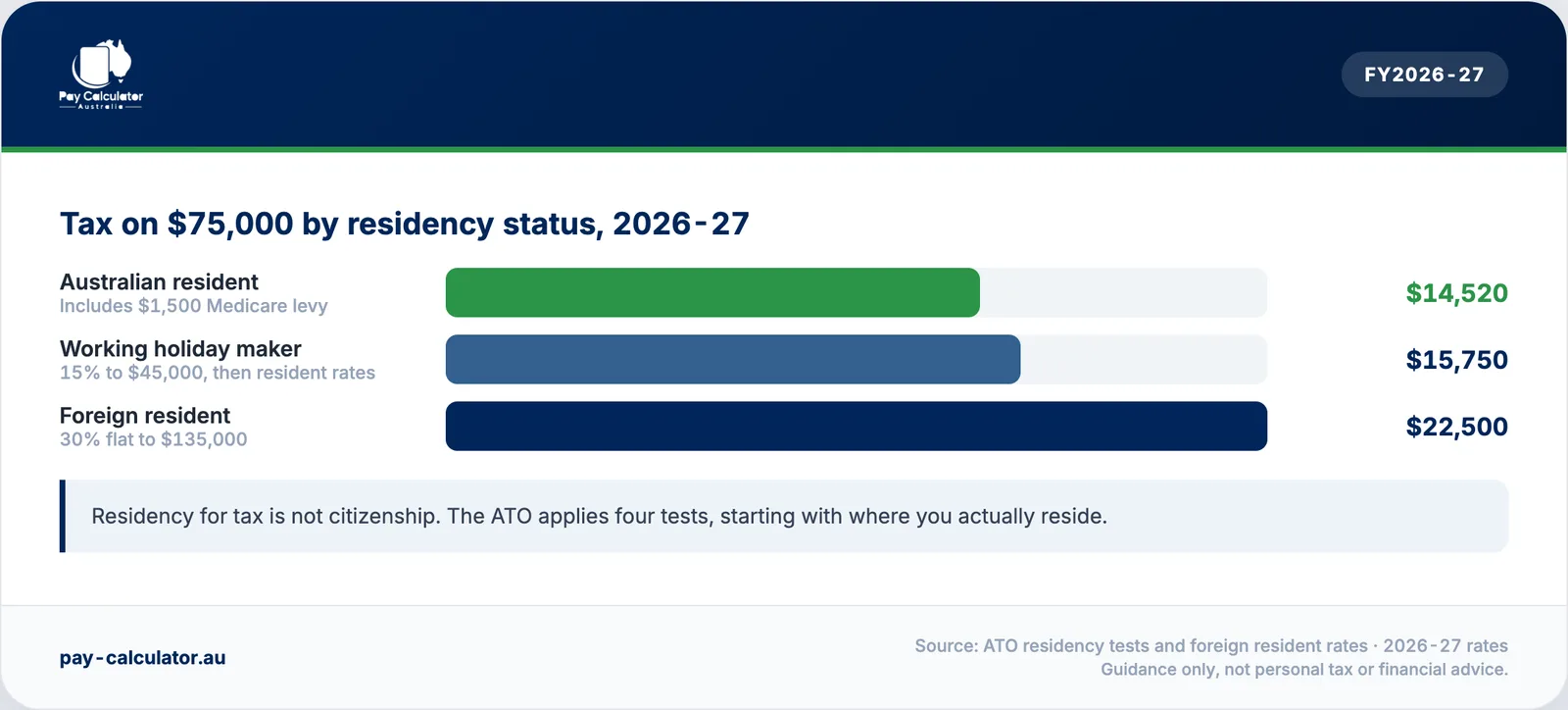
| $75,000 | $14,520 | $22,500 | $7,980 |
| $100,000 | $22,520 | $30,000 | $7,480 |
| $135,000 | $33,720 | $40,500 | $6,780 |
| $190,000 | $55,170 | $60,850 | $5,680 |
Resident figures include the 2% Medicare levy and the Low Income Tax Offset where it applies. Foreign resident figures have no levy, no LITO and no tax-free threshold. Computed for 2026-27.
The gap is widest at the bottom of the table. At $45,000 the non-resident pays $8,905 more, almost triple the resident's bill, because the resident's first $18,200 is tax-free and the next slice is taxed at 15%. By $190,000 the gap narrows to $5,680: the threshold matters less when most of your income sits in the upper brackets, and the resident is paying a levy the non-resident never sees. Run your own income through the non-resident tax calculator for the exact split.
Do non-residents pay the Medicare levy?
No. Foreign residents are exempt from the 2% Medicare levy, because they are generally not entitled to Medicare. The Medicare levy surcharge, which targets higher earners without private hospital cover, also generally does not apply to them. On $100,000 the exemption is worth $2,000 a year (2026-27), which is real money, though the computed table above shows it never comes close to offsetting the lost threshold at that income.
Residents pay the levy subject to a low-income reduction, and part-year residents can claim their foreign-resident days as exempt days. The Medicare levy calculator handles the resident side, including the shade-in for lower incomes.
What rates do working holiday makers pay?
Working holiday makers on 417 and 462 visas sit on their own scale, separate from both columns above: 15% on the first $45,000, then 30% to $135,000, 37% to $190,000 and 45% beyond, with no Medicare levy and no tax-free threshold. These rates are unchanged for 2026-27 under ATO Schedule 15 (published 17 June 2026).
The trap for WHMs is withholding, not the rates. A registered employer withholds 15% on the first $45,000; an unregistered employer must withhold 30% from the first dollar. On $75,000 that means $22,500 withheld instead of $15,750, with the $6,750 difference recoverable only by lodging a return. Withheld is not owed; the assessed tax is the same either way. The full picture, including the NDA-country exception, is on the working holiday tax calculator.
What happens if your residency changes during the year?
You are taxed as both, in sequence. Arrive permanently in January, or leave permanently in January, and the year splits: resident rates apply to the resident portion, and you receive a pro-rata tax-free threshold for the months you were an Australian resident rather than the full $18,200. On your return you answer yes to the resident question, and you claim your foreign-resident days as exempt days for the Medicare levy.
Part-year years produce more wrong returns than full years of either status, because payroll withholding rarely matches a mid-year change. Whatever was withheld, your assessment trues it up. If your part-year also involves foreign income, tax treaties or a departing super claim, that is genuinely beyond a calculator, and a registered tax agent is worth the money.
Do you still repay HELP if you live overseas?
Yes. A HELP, VSL or AASL debt is not wiped by leaving Australia or becoming a foreign resident. The ATO's overseas repayment rules (updated 30 June 2026) are explicit: live overseas 183 days or more in any 12-month period and you must lodge an overseas travel notification within 7 days of leaving, keep your contact details current, and report your worldwide income to the ATO each year by 31 October.
Worldwide income means your Australian repayment income plus your non-resident foreign-sourced earnings. Pass the 2026-27 minimum repayment threshold of $69,528 and a compulsory repayment or overseas levy applies, using the same bands as onshore repayments. Below the reporting floor, you lodge a non-lodgment advice instead: that floor is 25% of the minimum threshold, which computes to $17,382 for 2026-27. The ATO page still shows the 2025-26 figure of $16,750, so treat $17,382 as derived until the ATO prints it. The bands themselves are on the HECS-HELP repayment calculator.
Which tax breaks do non-residents miss out on?
Three headline items are residents-only in 2026-27. The $18,200 tax-free threshold is the big one, worth thousands a year on any full-time income. The Low Income Tax Offset, up to $700 for incomes at or below $37,500, phasing out by $66,667, is second. Third is the new $1,000 standard work-expense deduction, introduced for 2026-27, which lets residents claim $1,000 of work expenses with no receipts.
Foreign residents get none of the three, and pay no Medicare levy as the lone structural consolation. That asymmetry is why the computed comparison above never favours the non-resident at any income level. If your status is genuinely unclear, resolve it before you lodge, because the two calculations do not meet in the middle. Start with the ATO's residency tool, then put your income through our take-home pay calculator under each status to see your own gap.
Residency tax questions
Where these figures come from
- ATO, Your tax residency, updated 3 June 2026, and Residency tests, updated 7 June 2026 (including the resides, domicile, 183-day and superannuation test pages).
- ATO, Tax rates for foreign residents, updated 1 June 2026.
- ATO, Schedule 15 tax table for working holiday makers, published 17 June 2026, and Tax rates for working holiday makers, updated 1 June 2026.
- ATO, Overseas repayments for study and training support loans, updated 30 June 2026.
- ATO, Study and training support loans rates and repayment thresholds, updated 30 June 2026 (2026-27 minimum threshold $69,528).
Last verified 23 July 2026. Comparison figures are computed live from this site's 2026-27 tax engine. The 2026-27 overseas non-lodgment floor of $17,382 is derived (25% of $69,528); the ATO page still prints the 2025-26 figure.
Written by Marcus Kelleher, editor, pay and tax content at pay-calculator.au. He works from ATO and Fair Work source documents and is not a registered tax agent. Residency with foreign income or treaty questions is a case for a registered tax agent, not a web page.