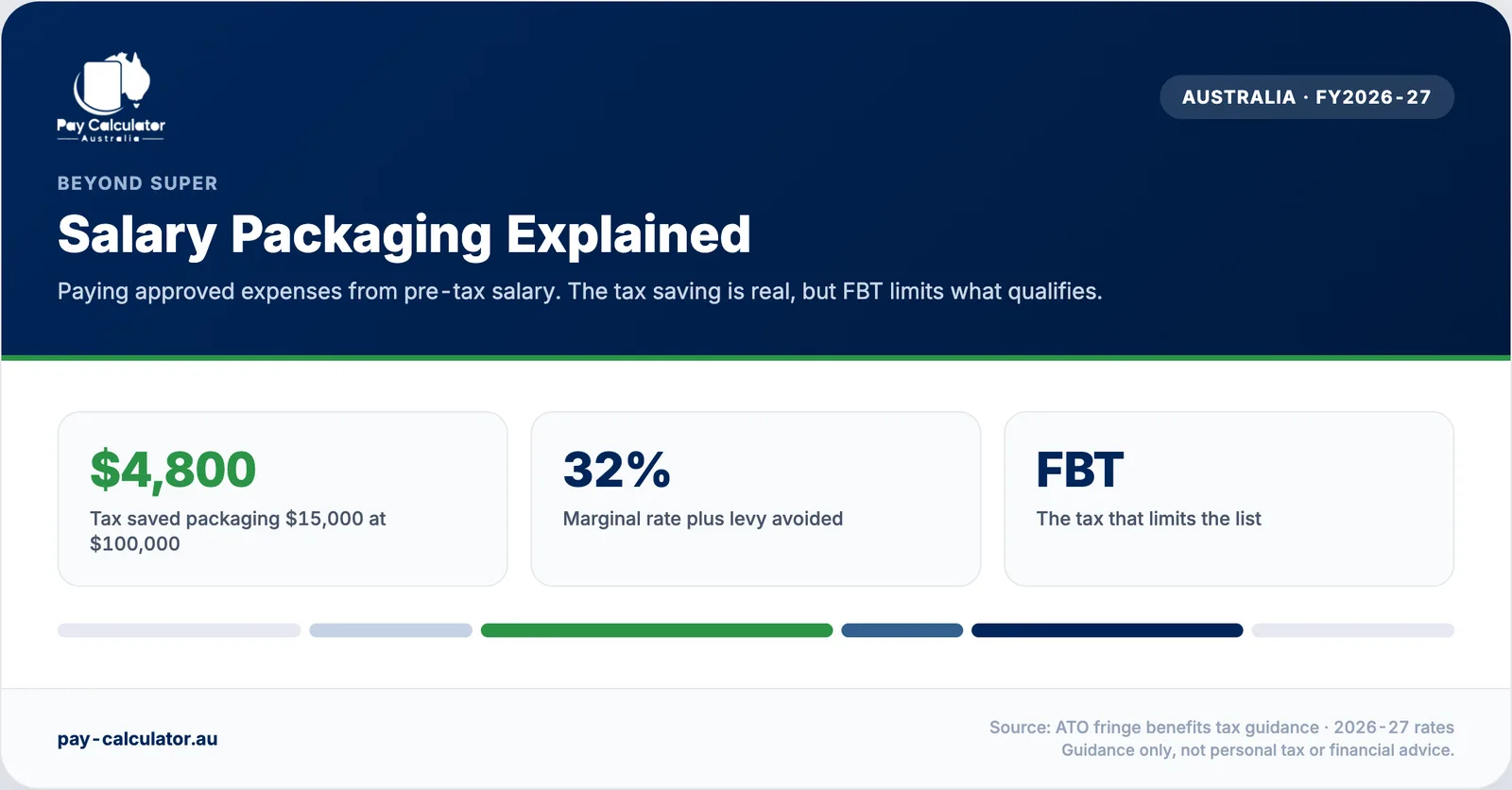
Salary packaging swaps part of your after-tax income for benefits your employer pays from your pre-tax salary, which lowers your taxable income. Packaging $15,000 of a $100,000 salary cuts your 2026-27 income tax and Medicare levy by $4,800, before fringe benefits tax enters the picture. Whether you keep that saving depends almost entirely on which benefit you package. This guide explains the three benefit categories, why FBT erases the gain on most of them, and where packaging genuinely works.
Key takeaways
- Packaging reduces your taxable income: a $100,000 salary packaged as $85,000 plus $15,000 of benefits is taxed on $85,000 (2026-27).
- Fringe benefits tax (FBT) applies to most non-super benefits and can wipe out the income tax saving.
- Exempt items (devices, software, protective clothing, tools of trade), super, and eligible electric cars avoid FBT.
- Not-for-profit and some health and charity employers have FBT concessions, so packaging goes further for their staff.
- Super salary sacrifice is the most widely offered packaging option and is taxed at 15% in the fund.
What is salary packaging?
Salary packaging is an arrangement where you agree to receive less after-tax income, and in return your employer pays for benefits out of your pre-tax salary. Moneysmart's salary packaging page (last updated 14 July 2026) uses this example: a $100,000 salary packaged as $85,000 of income plus $15,000 of car expenses paid as a benefit. Your taxable income falls to $85,000, so you may pay less income tax.
The terms salary packaging and salary sacrifice describe the same mechanism. In practice, "salary sacrifice" usually refers to super contributions and "salary packaging" to everything else, cars, devices and other benefits, often run through a specialist packaging provider. Like super sacrifice, packaging must be set up in advance: you cannot package salary you have already earned.
How does salary packaging reduce your tax?
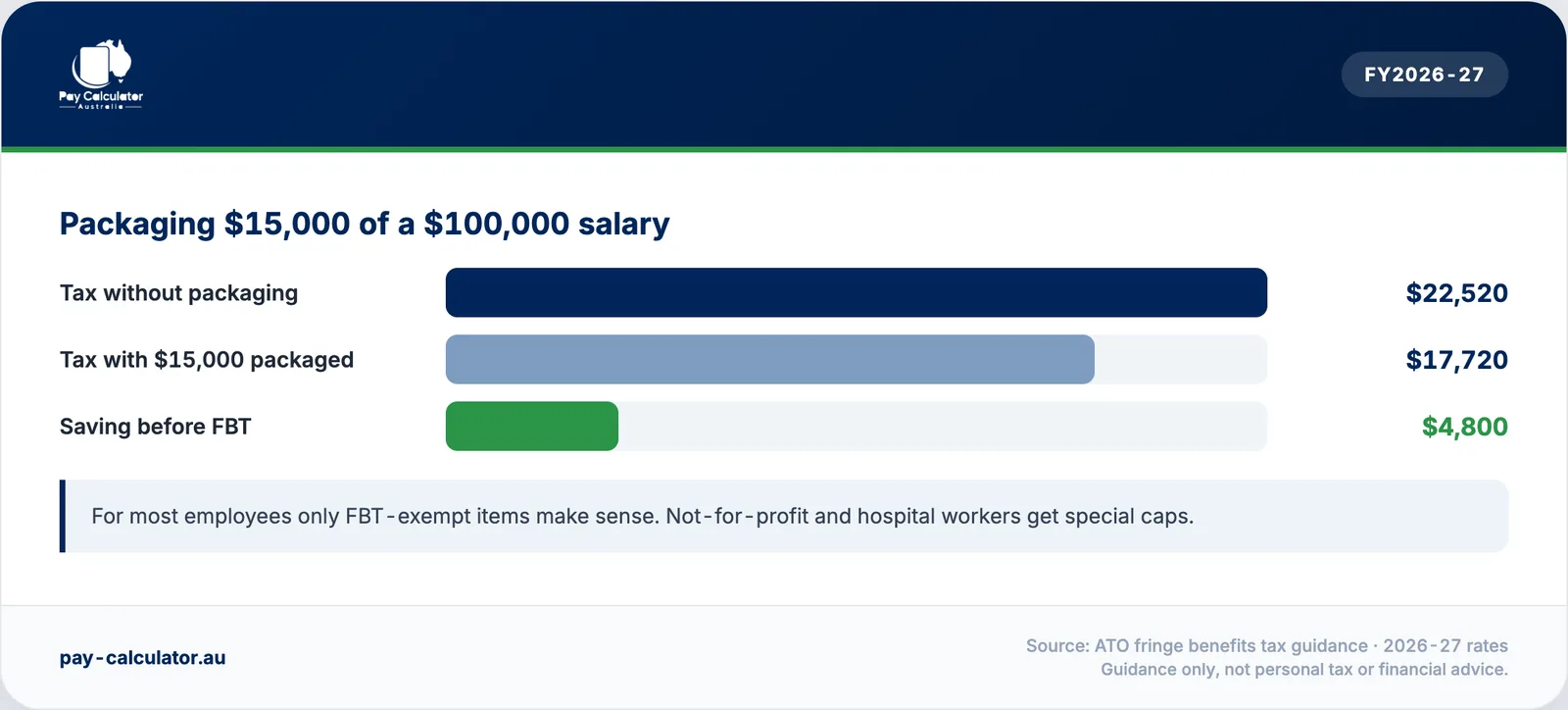
Packaging works because the packaged amount leaves your taxable income, so income tax and the Medicare levy are no longer charged on it. Take the Moneysmart example on 2026-27 rates. On the full $100,000, income tax plus Medicare levy is $22,520. On $85,000 it is $17,720. Packaging the $15,000 saves $4,800 of income tax and Medicare levy for the year.
That is the gross saving, and it is only half the story. The benefit your employer pays for may attract fringe benefits tax, which is charged to the employer and priced into what they offer you. For many benefits the FBT bill cancels most or all of the income tax saving, which is why the benefit category matters more than the arithmetic. You can check the income tax side of any packaging offer by comparing two salaries on the income tax calculator.
What can you package?
Moneysmart groups packaged benefits into three categories, and the FBT treatment differs sharply across them.
| Category | Examples | FBT position |
|---|---|---|
| Fringe benefits | A car, health insurance, school fees, childcare, loans | Employer pays FBT on most of these, which limits what is offered |
| Exempt benefits | Portable electronic devices, computer software, protective clothing, tools of trade | No FBT for the employer |
| Super | Salary sacrifice into your super fund | No FBT; taxed at 15% in the fund instead |
The pattern to remember: packaging generally works best for super, for exempt items, for employees of FBT-concession employers, and for FBT-exempt electric cars. For everything else, run the numbers before you sign.
What is fringe benefits tax and why does it matter?
Fringe benefits tax is a tax your employer pays on most non-cash benefits provided to you. It is levied at a high rate, designed to match the top marginal income tax rate, and it is charged on the grossed-up value of the benefit rather than its sticker price. Per Moneysmart, that combination can wipe out the income-tax saving for ordinary, non-exempt benefits.
The design logic is deliberate. Without FBT, a top-rate taxpayer could take most of their pay as benefits and skip income tax entirely. FBT closes that door, which means the interesting packaging opportunities live in the exceptions: benefits Parliament chose to exempt, and employers Parliament chose to concede.
Which benefits are FBT-exempt?
Moneysmart's list of exempt benefits covers work tools: portable electronic devices, computer software, protective clothing, and tools of trade. Your employer pays no FBT on these, so packaging one from pre-tax salary delivers the full income tax saving at your marginal rate.
The other headline exemption is the electric car exemption. An eligible battery electric or hydrogen fuel cell car provided through a salary packaging or novated lease arrangement is exempt from FBT under conditions the ATO sets out on its electric cars exemption page (last updated 1 April 2026). The conditions, and what the exemption covers, are detailed in our novated lease guide.
Why does packaging suit not-for-profit employees?
Not-for-profit and some health and charity employers have FBT concessions or exemptions, so they can pay for benefits that would generate an FBT bill anywhere else. That makes packaging more valuable for their staff, and it is why hospital and charity workers are often offered packaging arrangements that private-sector employees never see, covering items like everyday living expenses.
If you work for a not-for-profit, the practical step is to ask your employer what they actually offer and at what cap, because the concession belongs to the employer type, not to you. The offer varies between a public hospital, a charity and a rebatable employer, and the packaging provider's statement will show the capped amount that applies.
Is super the best thing to package?
For most employees, yes. Super salary sacrifice attracts no FBT, is taxed at a flat 15% inside the fund, and is offered by most employers to all staff even where other benefits are restricted. Against a marginal rate of 30% to 47% including the 2% Medicare levy, the 15% rate is the largest reliable packaging discount available in 2026-27.
The limits are the $32,500 concessional cap for 2026-27, which includes your employer's 12% super guarantee, and preservation, since the money stays in super until retirement. The mechanics, worked savings at common salaries and the cap arithmetic are covered in our salary sacrifice guide, and how the 12% itself accrues is in the superannuation guarantee guide. To see the effect on your own pay, run the salary sacrifice calculator.
How does a novated lease fit in?
A novated lease is the most common way to package a car. It is a three-way arrangement between you, your employer and a finance company: the employer takes on the lease and pays the lease and running costs from your salary, usually through a packaging provider. Ordinarily the car is a fringe benefit and FBT applies, which shrinks the gain. The exception is an eligible electric car, where the FBT exemption lets the whole lease effectively run from pre-tax salary.
If you leave your job, the novation ends and the lease obligation transfers back to you personally. That single sentence carries most of the risk in the product, and it deserves more weight than the brochure gives it.
What is the income tax saving at your salary?
Packaging $15,000 saves between $4,800 and $5,850 of income tax and Medicare levy a year across common salaries in 2026-27. The table below is computed from the 2026-27 resident scales, including the Low Income Tax Offset and the 2% Medicare levy.
| Salary | Tax + Medicare on full salary | Tax + Medicare after packaging $15,000 | Gross saving |
|---|---|---|---|
| $70,000 | $12,920 | $7,945 | $4,975 |
| $85,000 | $17,720 | $12,920 | $4,800 |
| $100,000 | $22,520 | $17,720 | $4,800 |
| $120,000 | $28,920 | $24,120 | $4,800 |
| $150,000 | $39,570 | $33,720 | $5,850 |
Read the last column as a ceiling, not a promise. It is the most you can save if the packaged benefit carries no FBT, as with exempt items, super or an eligible electric car. For an ordinary fringe benefit, FBT claws back some or all of it, and the packaging provider's quote is where the real number lives.
When is salary packaging not worth it?
Packaging an FBT-attracting benefit at a middle income is the classic losing trade, because FBT is pitched at the top marginal rate while your saving accrues at yours. It is also weak below $45,000 of income, where the 2026-27 marginal rate is 15% and there is little tax to save. And every packaged dollar reduces your cash take-home pay, which you can sanity-check on the take-home pay calculator before committing to a year of deductions.
Packaging arrangements sit at the complex end of pay. FBT rules, employer concessions, reportable fringe benefits and lease contracts interact in ways a general guide cannot settle for your case. Before signing anything beyond super sacrifice or an exempt work tool, get advice from a registered tax agent and confirm exactly what your employer offers. That costs less than a year inside the wrong arrangement.