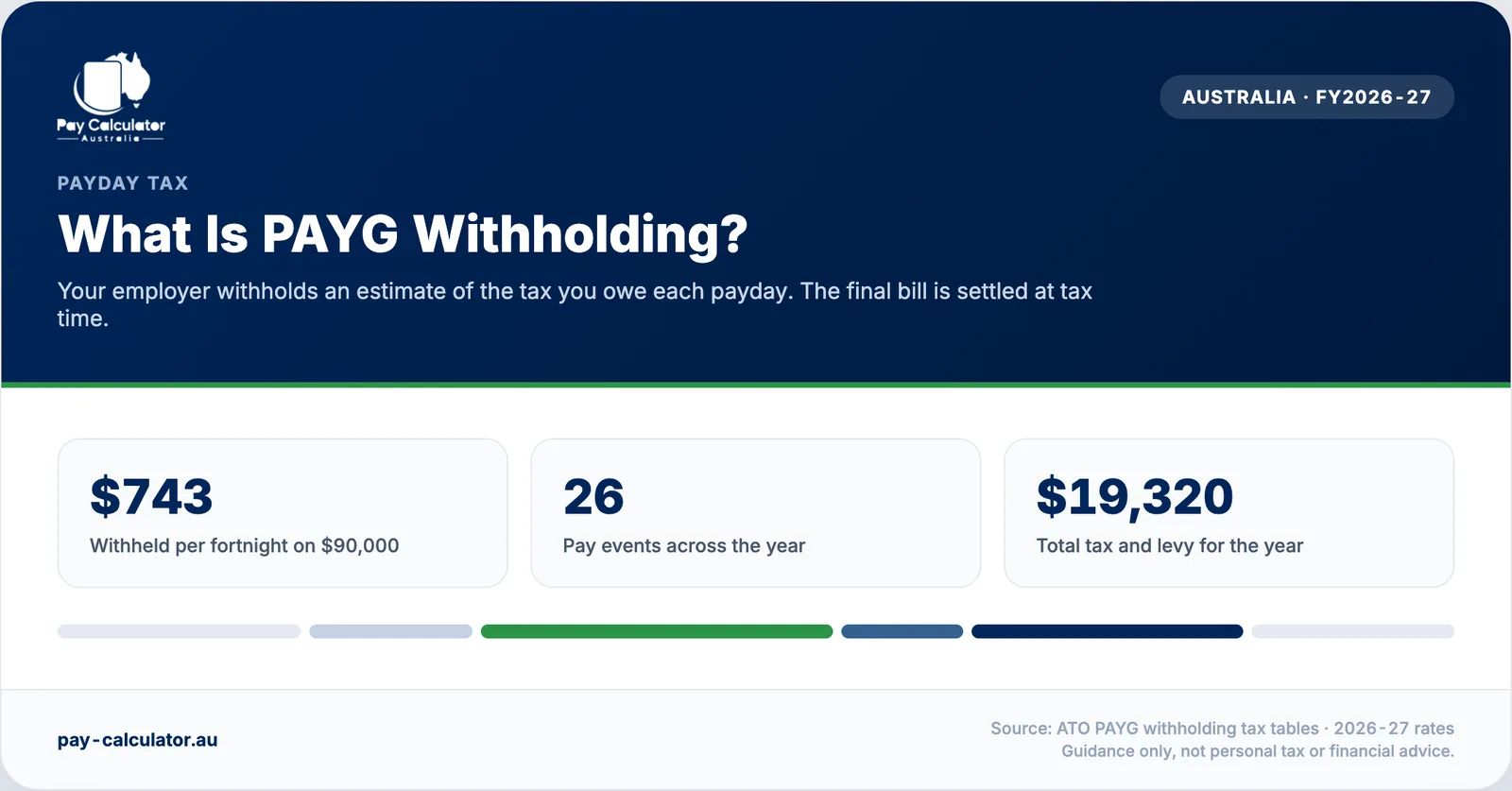
Pay as you go (PAYG) withholding is the tax your employer holds back from each pay and sends to the ATO on your behalf. It is not a separate tax. It is a pre-payment of the income tax you will owe for 2026-27, collected gradually across the year instead of in one lump at the end. Nearly every question people have about payday tax, from surprise refunds to over-taxed bonuses, comes down to one distinction: what is withheld is an estimate, and what you owe is settled later. This guide explains both halves and the gap between them.
Key takeaways
- PAYG withholding is a pre-payment of your income tax, not a tax in its own right.
- Employers read the amount from ATO withholding schedules; all were updated from 1 July 2026.
- Withheld tax almost never equals final tax, because deductions and offsets apply only at assessment.
- More withheld than owed means a refund; less means a bill. The 2026-27 reconciliation happens when you lodge from July 2027.
- Second jobs and bonuses are the two places the estimate diverges hardest from the truth.
What is PAYG withholding?
When your employer pays you $2,000 gross for a fortnight, they do not hand all of it over. They hold back an amount of tax, pay you the rest, and send the withheld amount to the ATO under your tax file number. Across a year those amounts accumulate into a credit that sits against your name, and when you lodge your return the credit is applied to the tax you actually owe.
The system exists because most people find one large annual tax bill much harder to manage than a deduction from every pay. As the ATO puts it, most employees have tax payments made on their behalf throughout the income year through PAYG withholding, and these amounts help meet the annual tax obligation. Employers must withhold, must report each pay day through Single Touch Payroll (STP), and must pass the money to the ATO. From your side, the whole system shows up as one line on your payslip.
How does your employer calculate the amount withheld?
They look it up. The ATO publishes withholding schedules and tax tables that specify the amount to withhold for every pay level, pay frequency and declaration combination: the weekly table (NAT 1005), fortnightly table (NAT 1006), monthly table (NAT 1007) and the daily and casual table (NAT 1024). The underlying maths sits in Schedule 1, the statement of formulas (NAT 1004), which payroll software implements directly. For 2026-27, all 15 withholding schedules and 12 tax tables were updated from 1 July 2026 to carry the legislated rate cut, updated Medicare levy parameters and the indexed study loan thresholds.
What you declared on your tax file number declaration steers the lookup: whether you claimed the tax-free threshold from this payer, and whether you have a HECS-HELP or other study loan. A threshold claim shifts you to a gentler column; a study loan adds a component on top. The PAYG withholding calculator estimates the per-pay amount for your own combination.
Why is the tax withheld not your final tax?
Because the schedules can only see one pay at a time, while your real tax is a whole-year calculation. The schedule assumes the pay in front of it repeats all year, then withholds a proportionate slice. Your assessment, done after 30 June, works from what actually happened: assessable income minus deductions gives taxable income, tax is calculated on the 2026-27 brackets, the Medicare levy is added, offsets are subtracted, and only then is the withholding credit applied.
The two figures diverge for predictable reasons:
- Deductions are claimed at return time, so withholding is computed on gross pay before them.
- Offsets like the Low Income Tax Offset are applied at assessment, not on payday.
- Income that varies (overtime, a rise, starting or leaving a job mid-year) breaks the repeats-all-year assumption.
- Second payers withhold as if they were your only income source.
- Investment, capital gains or side income arrives with no withholding at all.
None of this is an error. The schedules are deliberately built as a reasonable whole-population estimate, and the return is where your individual truth is settled.
What does your annual tax look like per pay?
A useful sanity check for any payslip is to spread your expected annual tax across the year. The table computes the 2026-27 assessed liability (income tax after LITO, plus the 2% Medicare levy) for a resident with no study loan, and divides it per pay period. If your payslip deduction sits near the matching cell, your withholding is roughly on track.
| Taxable income | Annual tax (incl. levy) | Per week | Per fortnight | Per month |
|---|---|---|---|---|
| $50,000 | $6,270 | $121 | $241 | $523 |
| $65,000 | $11,295 | $217 | $434 | $941 |
| $80,000 | $16,120 | $310 | $620 | $1,343 |
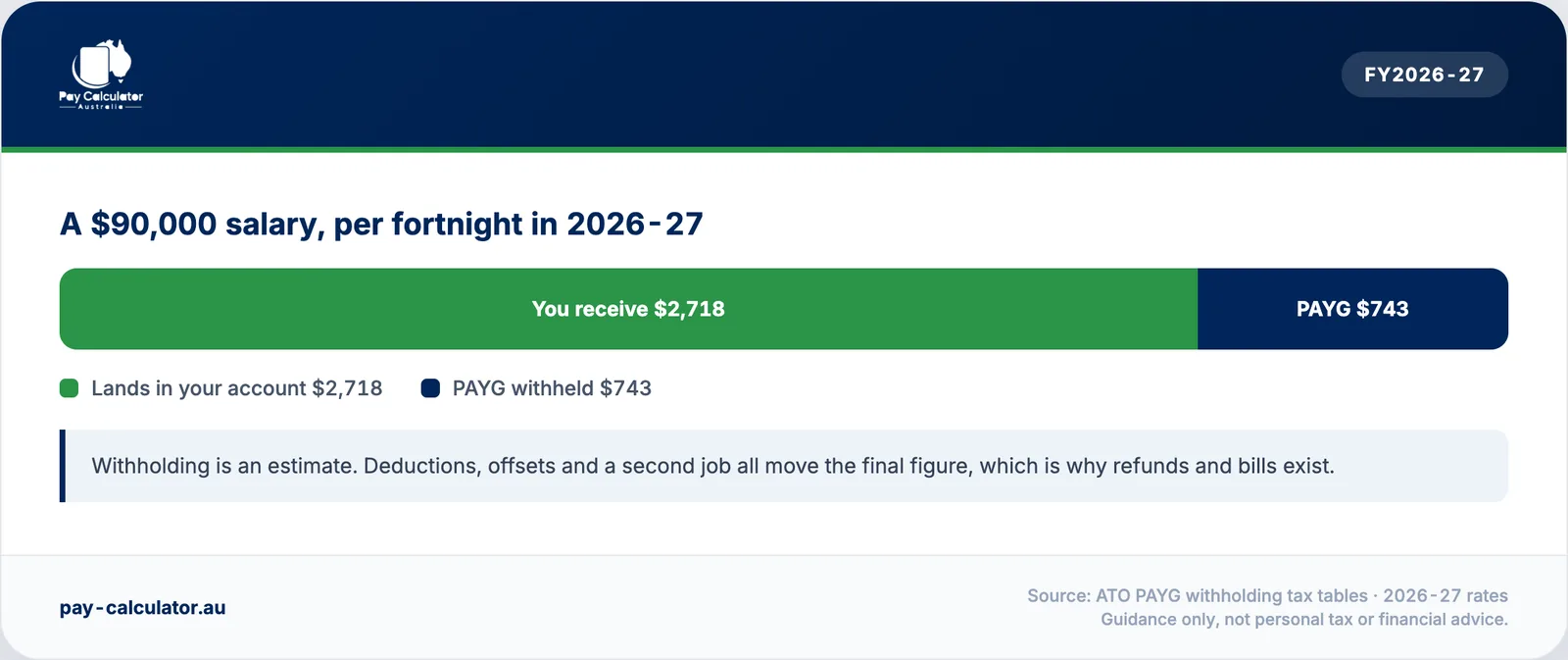
| $90,000 | $19,320 | $372 | $743 | $1,610 |
| $100,000 | $22,520 | $433 | $866 | $1,877 |
| $120,000 | $28,920 | $556 | $1,112 | $2,410 |
| $150,000 | $39,570 | $761 | $1,522 | $3,298 |
Treat this as the destination, not the payslip figure. The actual schedule amount will differ a little, because the schedules round to whole dollars, cannot see your deductions, and handle LITO differently from the assessment. A payslip within a few dollars of the table is normal; a payslip hundreds of dollars away per fortnight deserves a question to payroll.
How does a tax refund arise?
A refund arises when the year of withholding adds up to more than your assessed tax. The ATO worked example on its multiple-jobs page (2025-26 rates) shows the mechanics. Sue holds two jobs: retail paying $16,000 with the tax-free threshold claimed, so nothing is withheld, and a restaurant job paying $10,000 at the no-threshold rate, which withholds $1,716 across the year.
| Item (ATO example, 2025-26 rates) | Amount |
|---|---|
| Taxable income | $26,000 |
| Income tax on $26,000 | $1,248 |
| Less Low Income Tax Offset | $700 |
| Plus Medicare levy | $0 |
| Total tax payable | $548 |
| Credit for tax withheld | $1,716 |
| Refund | $1,168 |
The no-threshold rate on the second job over-collected, LITO cut the assessed tax to $548, and the excess $1,168 came back. A refund is not a windfall. It is your own money, returned after an estimate ran high. Estimate yours with the tax refund calculator.
How does a tax bill arise?
A bill is the same reconciliation running the other way: the year of withholding fell short of assessed tax. The companion ATO example (2025-26 rates) is Pierre, who draws a $30,000 pension with the threshold applied and earns $30,000 from part-time work without it, with $8,320 withheld in total.
| Item (ATO example, 2025-26 rates) | Amount |
|---|---|
| Taxable income | $60,000 |
| Income tax on $60,000 | $8,788 |
| Less Low Income Tax Offset | $100 |
| Plus Medicare levy (2%) | $1,200 |
| Total tax payable | $9,888 |
| Credit for tax withheld | $8,320 |
| Tax bill | $1,568 |
The ATO lists the usual suspects behind bills: the tax-free threshold claimed from more than one payer, a second income source, investment or capital gains income with nothing withheld, a study loan the employer did not know about, or an offset that no longer applies. Almost all of them reduce to the same cause, an estimate that could not see the whole year.
Why do second jobs cause tax bills?
Because each payer withholds as if it were your only job, and tax on two half-incomes is less than tax on one whole income. The table computes the 2026-27 assessed tax on a $60,000 total, first as two separate incomes of $40,000 and $20,000, then combined. The figures are annual liabilities from the resident scale with LITO and the Medicare levy, which is the cleanest way to see the gap the withholding system has to bridge.
| Scenario (2026-27) | Taxable income | Tax if this were your only income |
|---|---|---|
| Job A alone | $40,000 | $3,495 |
| Job B alone | $20,000 | $0 |
| Sum of the two, treated separately | $60,000 | $3,495 |
| Actual tax on the combined income | $60,000 | $9,620 |
Treated separately, the two jobs look like $3,495 of tax. Combined, the real liability is $9,620, a gap of $6,125 (2026-27). The tax-free threshold and the cheap 15% band can only be used once, but two naive estimates would use them twice. This is exactly why the ATO tells you to claim the threshold from one payer and let the second job withhold at the no-threshold rate. The second job tax calculator works through your own split.
What happens when you lodge your tax return?
Lodgment is where estimate meets truth. Your 2026-27 return, lodged from July 2027, assembles your actual income from STP data, banks and other pre-fill sources, subtracts your deductions (including, for the first time in 2026-27, the standard work deduction of up to $1,000, claimable without receipts), applies the brackets, levy and offsets, then credits everything withheld. The result arrives as a notice of assessment showing a refund or an amount payable.
Timing matters if you want it to go smoothly. Employers have until 14 July to finalise STP data and mark income statements as tax ready, and pre-fill completes by late July, which is why the ATO advises lodging from late July rather than 1 July. Self-lodgers have until 31 October; registered agents have extended programs, but you must be on their books before 31 October to use them. Most online returns process within 2 weeks.
Can you change how much tax is withheld?
Yes, in both directions. If a bill is building (a second job, investment income, a study loan your employer does not know about), you can ask a payer to withhold extra through an upward variation, or update your withholding declaration so the correct loading applies. If too much is being withheld and a large refund is simply accumulating, a PAYG withholding variation application to the ATO can reduce the rate during the year rather than waiting for the money at assessment.
A withholding declaration is also how you tell a payer things changed: you gained or lost a study loan, or you want to stop claiming the tax-free threshold from them because a second job started. Small paperwork, but it is the difference between a boring assessment and a surprising one.
How is a bonus withheld differently?
A bonus or back payment that covers more than one pay period is withheld under ATO Schedule 5 (NAT 3348), which spreads the payment over the year, works out the extra withholding at your annualised rate, and takes it all from the single pay. The result looks brutal on the payslip, often near your top marginal rate on the whole bonus, and it is the single most common reason people believe in a special bonus tax. There is no such tax. If the withholding overshoots your real 2026-27 liability, the excess comes back at assessment like any other over-withholding. A bonus tied to a single pay period skips Schedule 5 entirely and is taxed with your ordinary earnings. The bonus tax calculator shows the withholding on your own numbers, and the income tax calculator shows the year-end truth beneath it.
Frequently asked questions
Sources
All figures verified against the named documents. Last verified 23 July 2026.
- ATO, PAYG withholding (overview for employers), ato.gov.au.
- ATO, Tax tables overview (2026-27: 15 withholding schedules and 12 tax tables updated from 1 July 2026).
- ATO, Schedule 1: statement of formulas for calculating amounts to be withheld (NAT 1004); weekly (NAT 1005), fortnightly (NAT 1006), monthly (NAT 1007) tax tables.
- ATO, Multiple jobs or change of job (Sue and Pierre worked examples, 2025-26 rates; one-payer threshold rule), last updated 5 June 2026.
- ATO, Why you may receive a tax bill; Your notice of assessment (processing within 2 weeks online).
- ATO, Access your income statement (14 July STP finalisation); ATO media release, Do not lodge yet (pre-fill completes late July).
- ATO, Lodge your tax return online with myTax (31 October self-lodger deadline).
- ATO, Schedule 5: tax table for back payments, commissions, bonuses and similar payments (NAT 3348).
- ATO, Standard deduction for work-related expenses (new-legislation), last updated 26 June 2026.