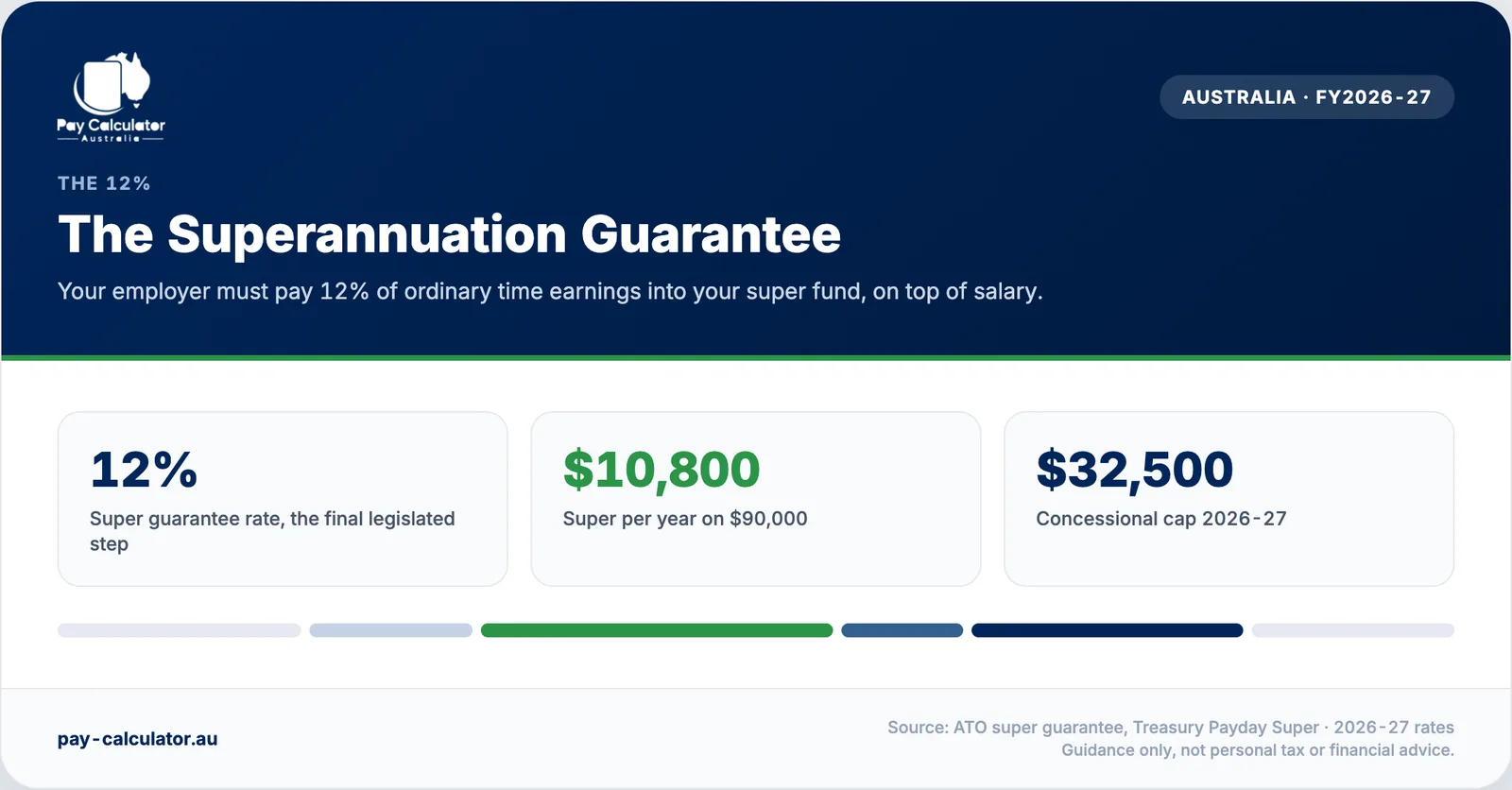
Your employer must pay 12% of your earnings into your super fund in 2026-27, on top of your wage. That 12% is the superannuation guarantee, or SG. On a $90,000 salary it is $10,800 a year, and from 1 July 2026 it must arrive in your fund within 7 business days of every payday. This guide covers what the SG is paid on, who gets it, the new Payday Super rules, and how to work out the super on your own salary.
Key takeaways
- The super guarantee rate is 12% for 2026-27, unchanged since 1 July 2025 and the final legislated step.
- On a $90,000 salary, SG is $10,800 a year, about $415 a fortnight (2026-27).
- From 1 July 2026, Payday Super requires the contribution to reach your fund within 7 business days of each payday.
- Super is paid on ordinary-hours earnings, loadings, most allowances and bonuses, but not on overtime.
- Compulsory SG stops once your earnings pass the $270,830 maximum contribution base for 2026-27.
What is the superannuation guarantee?
The superannuation guarantee is the minimum 12% of your earnings that your employer must pay into your super fund in 2026-27. It is money paid on top of your wage, not taken out of it, and it never appears in your take-home pay. The obligation comes from the Superannuation Guarantee (Administration) Act 1992, and the current rate is published on the ATO's key superannuation rates and thresholds page (last updated 17 April 2026).
Compulsory super started on 1 July 1992 at 3% to 4% for most employers and has climbed in steps to 12% today. The 12% rate took effect on 1 July 2025 and is the final legislated step. It stays at 12% for 2026-27 and for every year currently scheduled after that.
From 1 July 2026 the SG is calculated on your "qualifying earnings" for each pay period. Before that date it was calculated on ordinary time earnings (OTE). For almost everyone the amounts are the same, because qualifying earnings is built directly on OTE. The difference is covered below.
How much super do you get on your salary?
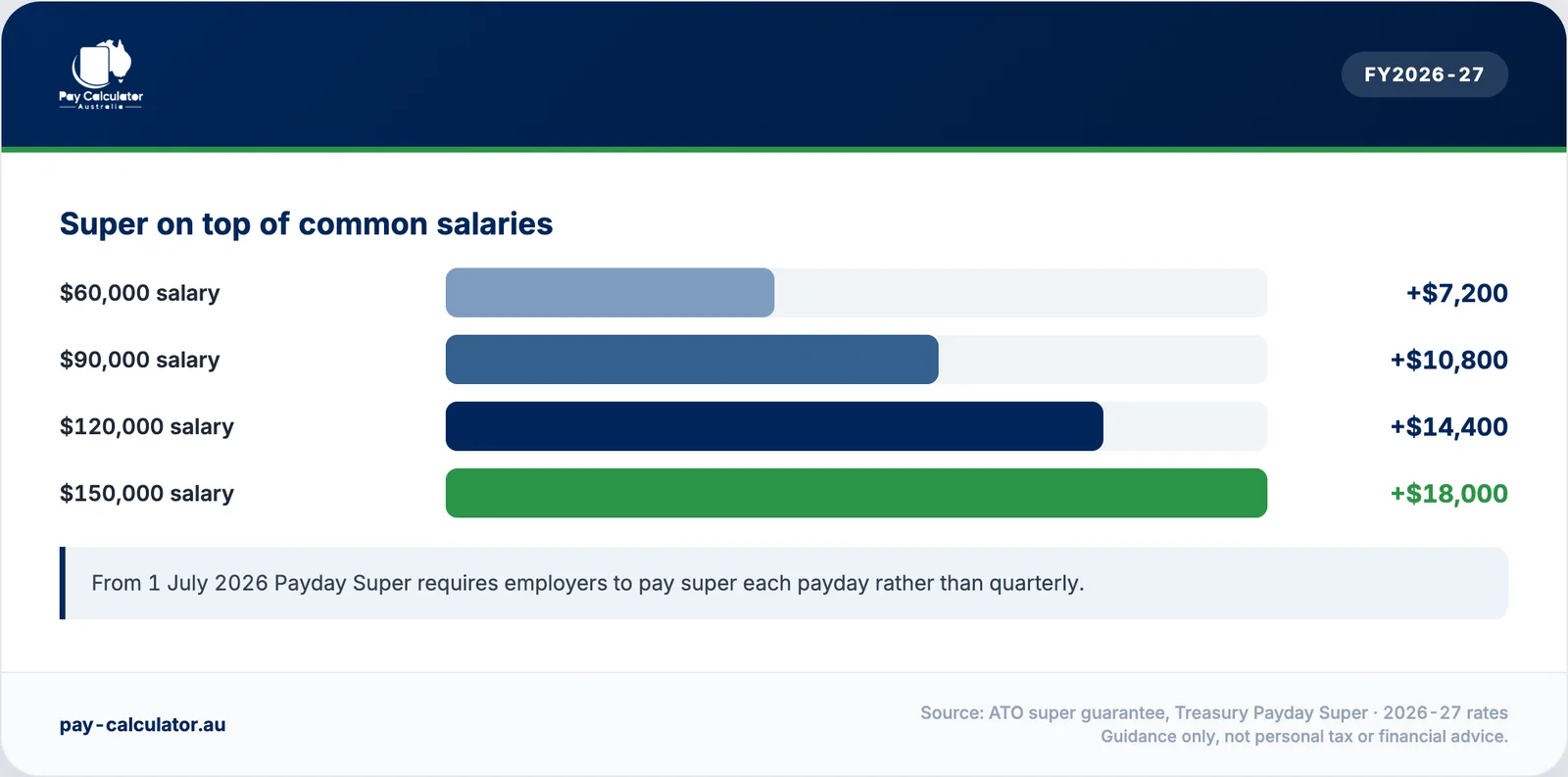
On a $90,000 salary with super paid on top, you get $10,800 of super in 2026-27, which is $900 a month or about $415 a fortnight. The table below shows the 12% SG at common salaries, computed on the 2026-27 rate, along with the total package each salary represents.
| Salary (cash wage) | Super at 12% | Per month | Per fortnight | Total package |
|---|---|---|---|---|
| $50,000 | $6,000 | $500 | $231 | $56,000 |
| $60,000 | $7,200 | $600 | $277 | $67,200 |
| $70,000 | $8,400 | $700 | $323 | $78,400 |
| $80,000 | $9,600 | $800 | $369 | $89,600 |
| $90,000 | $10,800 | $900 | $415 | $100,800 |
| $100,000 | $12,000 | $1,000 | $462 | $112,000 |
| $120,000 | $14,400 | $1,200 | $554 | $134,400 |
| $150,000 | $18,000 | $1,500 | $692 | $168,000 |
Per-pay amounts are the annual figure divided by 12 or 26 and rounded to the dollar. Because super now arrives every payday, the per-fortnight column is the number worth memorising. To see the super on your exact salary alongside your take-home pay, use the superannuation calculator.
How has the super guarantee rate changed over time?
The SG rate has risen from 9% in 2002 to 12% from 1 July 2025, with a six-year pause at 9.5% between 2014 and 2020. The full history below is from the ATO's super guarantee page (last updated 17 April 2026).
| Period | SG rate |
|---|---|
| 1 July 2027 onwards | 12.00% |
| 1 July 2026 to 30 June 2027 (current) | 12.00% |
| 1 July 2025 to 30 June 2026 | 12.00% |
| 1 July 2024 to 30 June 2025 | 11.50% |
| 1 July 2023 to 30 June 2024 | 11.00% |
| 1 July 2022 to 30 June 2023 | 10.50% |
| 1 July 2021 to 30 June 2022 | 10.00% |
| 1 July 2020 to 30 June 2021 | 9.50% |
| 1 July 2014 to 30 June 2020 | 9.50% (held flat for 6 years) |
| 1 July 2013 to 30 June 2014 | 9.25% |
| 1 July 2002 to 30 June 2013 | 9.00% |
The practical effect of each step was a rise in the total cost of employing you, not a cut to your cash wage, at least where super is paid on top. For packaged salaries the split moved instead, which is one more reason to read a job offer carefully.
What earnings is super paid on?
Super is paid on your qualifying earnings, which for 2026-27 means your ordinary time earnings plus a small number of extras. Ordinary time earnings is what you earn for your ordinary hours of work. The ATO's qualifying earnings page (last updated 21 June 2026) sets out both lists, summarised below.
| Payment type | Super payable? |
|---|---|
| Ordinary hours, casual loading, shift and public holiday penalties | Yes |
| Most allowances that reward work (higher duties, first aid, leading hand) | Yes |
| Annual leave, sick and carer's leave, long service leave taken as leave | Yes |
| Bonuses and commissions for ordinary-hours work, back pay, payment in lieu of notice | Yes |
| Directors' fees | Yes |
| Overtime (where ordinary hours are clearly identified) | No |
| Unused leave paid out on termination | No |
| Redundancy, severance and other genuine termination payments | No |
| Expense reimbursements and allowances expected to be fully spent | No |
| Fringe benefits and paid parental leave | No |
Two changes arrived with qualifying earnings on 1 July 2026, and both are minor. All commissions are now included, even commission earned entirely outside ordinary hours, which previously could fall outside OTE. A bonus paid solely for work done entirely outside ordinary hours remains excluded. One more rule matters if you salary sacrifice: sacrificed amounts are added back into your qualifying earnings, so sacrificing can never shrink the 12% your employer owes. That interaction is covered in our guide to salary sacrificing into super.
Is super paid on top of your salary, or included in it?
A "$100,000 plus super" job and a "$112,000 package" job pay you the same $100,000 in cash for 2026-27. The first framing quotes your wage and adds $12,000 of super on top. The second folds the super into the headline number. To split a package, divide it by 1.12. The gap between the two framings is about 10.7% of the headline figure (0.12 divided by 1.12), which is a large amount to misread in a job offer.
| Cash wage ("plus super") | Super at 12% | Package ("including super") |
|---|---|---|
| $60,000 | $7,200 | $67,200 |
| $75,000 | $9,000 | $84,000 |
| $90,000 | $10,800 | $100,800 |
| $100,000 | $12,000 | $112,000 |
| $120,000 | $14,400 | $134,400 |
Reading the table right to left splits a package back out. A $100,800 package is a $90,000 wage with $10,800 of super. If you are weighing up whether extra super or extra cash serves you better, our super vs take-home comparison runs both sides of that trade.
Who is eligible for the super guarantee?
Nearly every employee is eligible for the 12% SG in 2026-27, regardless of earnings. The ATO's eligibility page (last updated 15 July 2026) confirms there is no minimum amount you must earn before super is owed; the old $450-a-month threshold was removed from 1 July 2022. Eligibility covers full-time, part-time and casual employees, temporary residents including working holiday makers, company directors, family members working in a business, and employees already drawing a super pension.
The exceptions are narrow. Employees under 18 get super only in a week where they work more than 30 hours. The same 30-hour test applies to private or domestic workers, such as a nanny working in someone's home. Independent contractors paid mainly for their labour are treated as employees for SG purposes, even when they quote an ABN, with super calculated on the labour component of the invoice. The genuinely self-employed, sole traders and partners, do not have to pay SG for themselves, though they can contribute voluntarily.
What changed on 1 July 2026 with Payday Super?
From 1 July 2026, your employer must pay your super for every payday, and the contribution is on time only if it is received by your fund within 7 business days of the day you are paid. Before Payday Super, employers could hold your super and pay it quarterly, up to 28 days after each quarter ended. The rules are on the ATO's Payday Super payment deadlines page (last updated 21 June 2026).
The day you are paid qualifying earnings is called the QE day, and best practice is for the employer to send the super on payday itself. A business day excludes weekends and any public holiday that applies across a whole state or territory. Three edge cases stretch the window. A first contribution for a new employee, or to a newly nominated fund, gets 20 business days. An out-of-cycle payment such as a one-off bonus has its super fall due with the next regular payday's contribution. And in exceptional circumstances, such as a natural disaster or a major systems outage, the ATO can extend the window to 20 business days.
What Payday Super does not change matters as much as what it does. The rate stays 12%, eligibility is untouched, and for most employers the annual amount of super is identical. A contribution that misses the deadline makes the employer liable for the super guarantee charge (SGC), which gives the deadline teeth.
Is there a cap on how much super your employer must pay?
Yes. Compulsory SG stops once your qualifying earnings reach the maximum contribution base of $270,830 for 2026-27. Past that point, the employer can stop paying SG for the rest of the financial year. The maximum compulsory SG for 2026-27 is therefore 12% of $270,830, which is $32,499.60, and that lands fractionally under the $32,500 concessional contributions cap by design (the base is the cap times 100 divided by 12, rounded down to the nearest $10).
Payday Super restructured this cap. Up to 30 June 2026 the base was quarterly, $62,500 per quarter in 2025-26 with a maximum of $7,500 SG per quarter. From 1 July 2026 it is a single annual figure. High earners with multiple employers can apply for an employer shortfall exemption certificate to opt out of SG from some employers, which avoids breaching the concessional cap. If your income is anywhere near these numbers across more than one job, that is a conversation for a registered tax agent rather than a calculator.
How is your super taxed?
Employer SG contributions are taxed at 15% when they arrive in your fund, not at your marginal income tax rate. That 15% concessional rate is what makes super tax-effective for most workers, whose marginal rates run from 30% to 47% including the 2% Medicare levy. Investment earnings inside an accumulation account are taxed at up to 15%, and withdrawals from a taxed fund are generally tax-free from age 60. These rates are set out on Moneysmart's tax and super page (last updated 18 June 2026).
Two adjustments sit at the edges. If you earn $37,000 or less, the low income super tax offset (LISTO) effectively refunds the 15% contributions tax, up to $500, back into your fund. If your income plus concessional contributions exceed $250,000, Division 293 tax adds another 15% on some or all of those contributions, taking them to an effective 30%. The same 15% treatment applies to salary sacrifice, which is why adding your own pre-tax contributions on top of the SG can cut your tax bill. The mechanics and the 2026-27 caps are in our salary sacrifice guide, and the broader set of packaged benefits is covered in salary packaging explained.
How do you check your super is being paid?
Multiply your ordinary-hours pay for the period by 12% and compare it with what lands in your fund. The ATO's own worked example uses a $3,000 fortnightly wage for ordinary hours, which produces $360 of super per fortnight in 2026-27. On a $90,000 salary you should see about $415 arrive each fortnight, allowing for the 7-business-day delivery window.
Payday Super makes this check far more useful than it used to be. Under quarterly payment, a missing contribution could hide for months. From 1 July 2026 each payday should produce a matching deposit within days, so an underpayment shows up while the payslip is still fresh. Remember that super is never part of your net pay, so a correct payslip shows it as a separate employer contribution. You can see the full picture, wage, tax, Medicare levy and super side by side, on the take-home pay calculator.