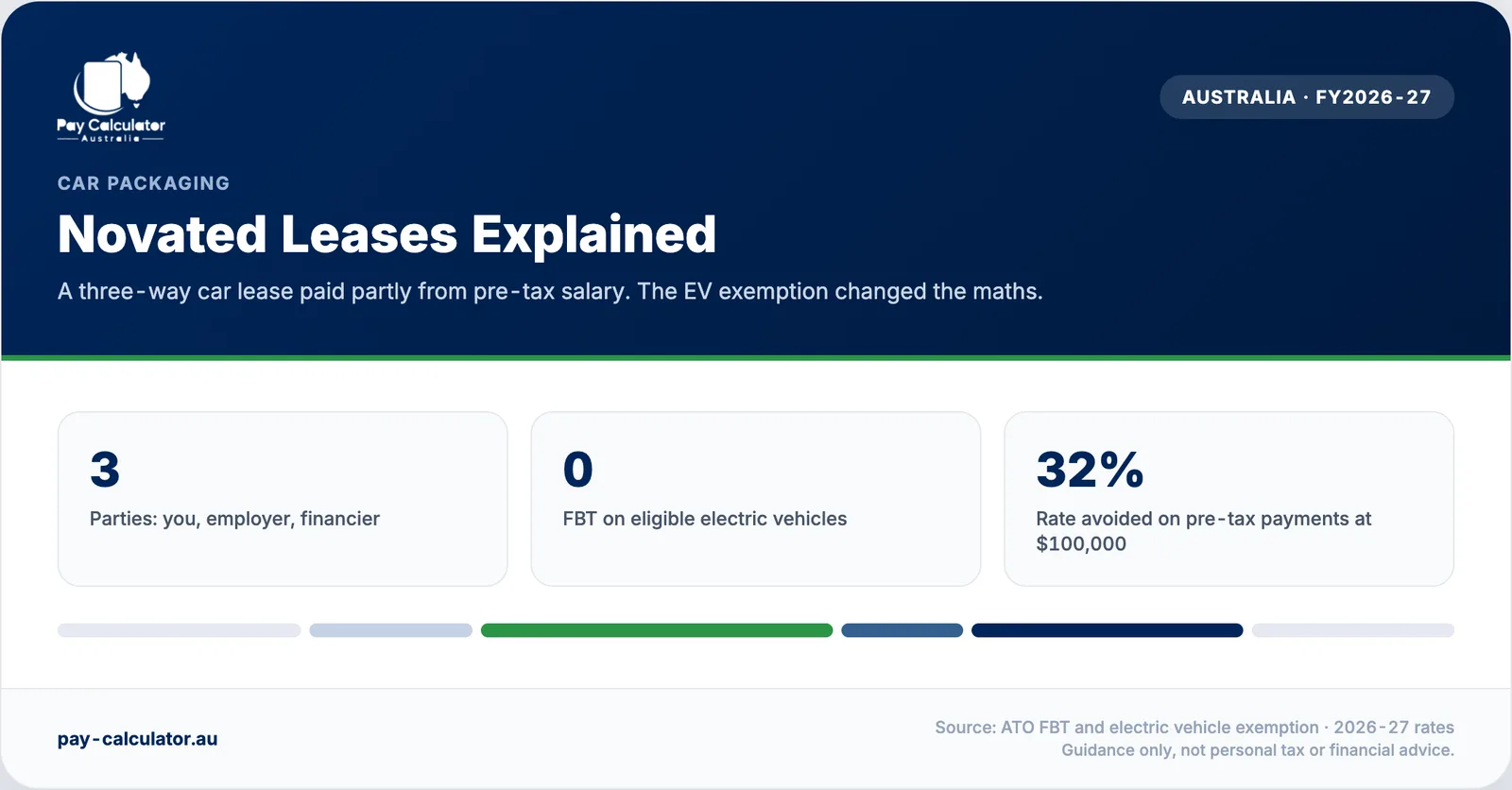
A novated lease is a three-way car finance arrangement where your employer pays the lease and running costs out of your salary. For most cars, fringe benefits tax applies and shrinks the benefit. For an eligible electric car, an FBT exemption lets the whole lease effectively run from pre-tax salary, which is what makes EV novated leases the packaging story of 2026-27. This guide explains the structure, the exemption conditions, and the traps, without pretending a general guide can price your specific lease.
Key takeaways
- A novated lease is a three-way arrangement: you, your employer, and a finance company.
- A packaged car is ordinarily a fringe benefit, so FBT applies and reduces the gain.
- Eligible battery electric and hydrogen fuel cell cars are FBT-exempt, including their running costs (ATO, electric cars exemption).
- Plug-in hybrids stopped qualifying for the exemption from 1 April 2025.
- An exempt car is still a reportable fringe benefit and can affect income-tested items such as the Medicare levy surcharge and HELP repayments.
What is a novated lease?
A novated lease is the most common way to salary package a car, and it involves three parties: you, your employer, and a finance company. Under the novation, your employer takes on the lease obligation and pays the lease payments and the car's running costs from your salary, usually through a specialist packaging provider. Moneysmart's salary packaging page (last updated 14 July 2026) is the plain-language source for the structure.
The word novated matters. The lease is yours, novated (transferred) to your employer while you work there. If you leave the job, the novation ends and the obligation transfers back to you personally. The car and the debt follow you, not the employer, which makes a multi-year lease a bet on your own job plans as much as on the car.
How does a novated lease run through your pay?
The lease and running costs are deducted from your salary each pay, as a mix of pre-tax and, for non-exempt cars, post-tax salary. Pre-tax deductions lower your taxable income, which is where the saving comes from. Post-tax deductions are commonly used on non-exempt cars to offset the fringe benefit's value, and the packaging provider sets the split.
The mechanism is the same salary packaging machinery covered in our salary packaging guide: you accept less cash salary, your employer pays a benefit, and your taxable income falls. What is different about a car is the size of the commitment and the fringe benefits tax that normally attaches to it. A packaged laptop is a few hundred dollars once. A packaged car is a multi-year deduction from every single pay.
Why does FBT matter for a novated lease?
A car provided through a novated lease is ordinarily a car fringe benefit, so your employer pays fringe benefits tax on it, and that cost is priced into the arrangement. FBT is levied at a high rate, designed to match the top marginal income tax rate, on the grossed-up value of the benefit. Per Moneysmart, that can cancel much of the income tax you saved by paying from pre-tax salary.
This is why a petrol or diesel novated lease is rarely the tax bonanza the marketing suggests. The pre-tax saving accrues at your marginal rate, while FBT is pitched at the top rate. The arrangement only turns clearly tax-positive when the FBT disappears, which is exactly what the electric car exemption does.
Which electric cars are exempt from FBT?
An electric car provided to you, including under a salary packaging or novated lease arrangement, is exempt from FBT if all three conditions below are met. The conditions come from the ATO's electric cars exemption page (last updated 1 April 2026).
| Condition | Detail |
|---|---|
| Vehicle type | A zero or low emissions vehicle: battery electric or hydrogen fuel cell, under 1 tonne carrying capacity and fewer than 9 seats. Motorcycles and scooters do not qualify. |
| Timing | First held and used on or after 1 July 2022. |
| Value | Luxury car tax has never been payable on the car, meaning its value was below the LCT threshold for fuel-efficient vehicles when first sold and in any later sale. |
The value test trips people up because it is historical, not current. A used EV that once sold above the fuel-efficient LCT threshold never becomes eligible, no matter what you pay for it today. The threshold is indexed each year and published on the ATO's luxury car tax rates and thresholds page, which is the place to check a specific car's eligibility year.
What does the EV exemption actually cover?
The exemption covers the private use of the eligible car and its associated running costs: registration, insurance, repairs, maintenance, and the electricity or fuel to charge it. In other words, the entire package of car plus running costs can sit inside the exemption, which is what lets the whole lease effectively run from pre-tax salary without FBT clawing the saving back.
That breadth is the point. On a non-exempt car, each running cost the employer pays is more fringe benefit value to tax. On an exempt EV, the same costs ride along tax-free, so the gap between an exempt and non-exempt lease is wider than the lease payment alone suggests.
Are plug-in hybrids still eligible?
No. Plug-in hybrid electric vehicles (PHEVs) stopped being eligible for the exemption from 1 April 2025. Only battery electric and hydrogen fuel cell cars now qualify. There is limited transitional continuation for PHEV arrangements that were already in place before that date, so an existing PHEV lease may keep its exemption while the arrangement continues unchanged.
If you are being quoted a PHEV novated lease in 2026-27, the FBT exemption is not part of the deal, and the quote should be read the same way as a petrol car's: pre-tax savings at your marginal rate, FBT priced against them.
Does an FBT-exempt car affect your other taxes?
Yes, and this is the most under-explained line in the EV lease pitch. An exempt electric car is still a reportable fringe benefit. Its grossed-up value appears on your income statement, and it can affect income-tested items even though no FBT is paid: the Medicare levy surcharge, the private health insurance rebate, some family payments, and your HELP repayment income.
The practical consequences are real money. A reportable benefit can lift your income for surcharge purposes past a Medicare levy surcharge tier, which you can test on the Medicare levy surcharge calculator. It can also raise your HELP repayment income and with it your compulsory repayment, which the HECS-HELP repayment calculator can show you at any income level. Neither effect appears in a quote that only shows income tax.
How much tax does pre-tax packaging avoid at your salary?
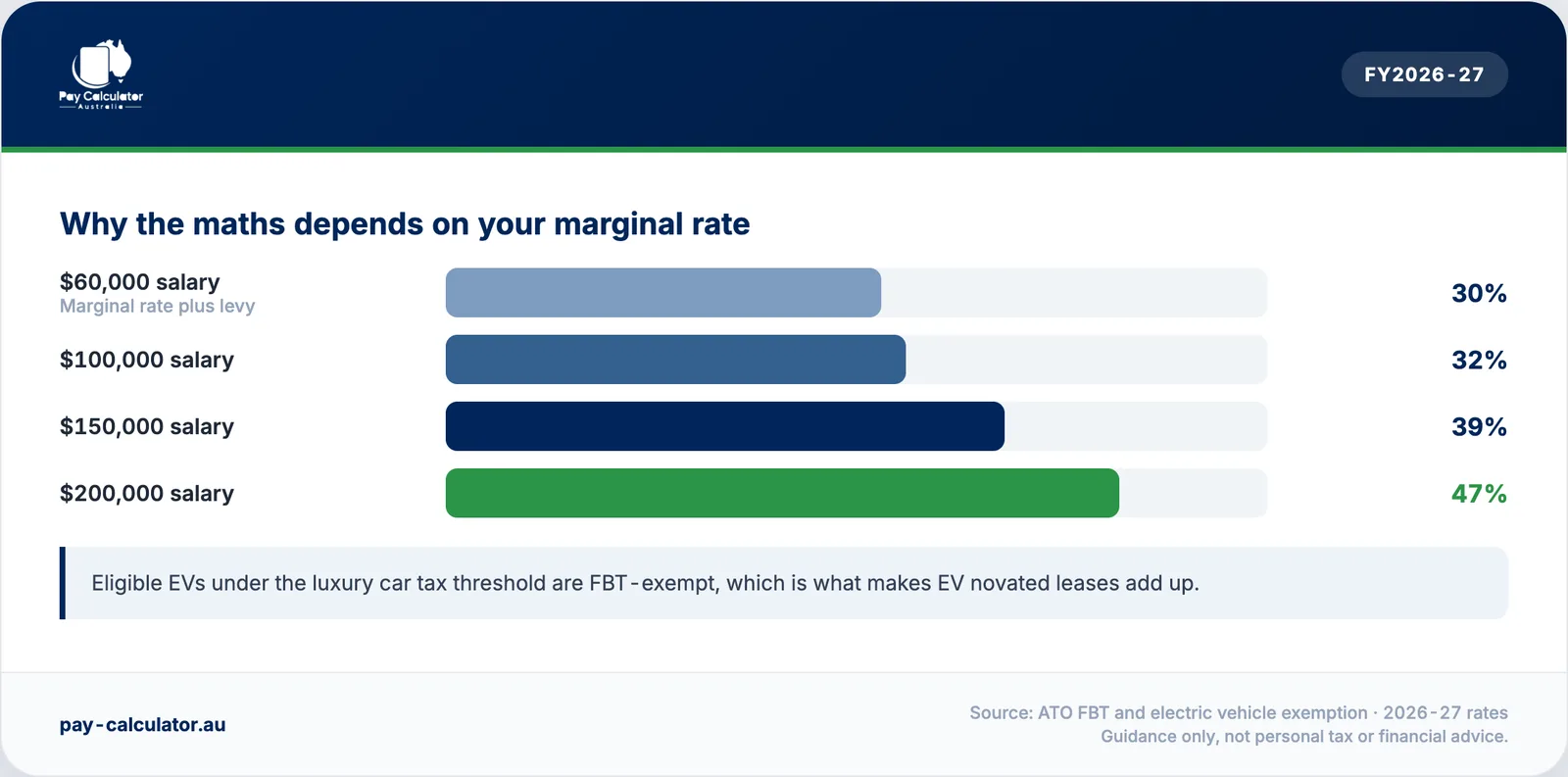
Each dollar of salary that moves from cash to an FBT-exempt package escapes tax at your marginal rate plus the 2% Medicare levy, which in 2026-27 runs from 17% to 47% depending on your income. The table below computes the 2026-27 resident marginal rates at salaries inside each bracket. It is the honest version of the number lease brochures print in large type.
| Salary | Marginal tax rate (2026-27) | With 2% Medicare levy |
|---|---|---|
| $40,000 | 15% | 17% |
| $60,000 | 30% | 32% |
| $100,000 | 30% | 32% |
| $140,000 | 37% | 39% |
| $200,000 | 45% | 47% |
Two honest caveats. This is the rate avoided on packaged dollars, not a projection of your lease saving, because the lease cost, fees and residual value belong to the provider's quote, not to a tax table. And the rate only survives intact when no FBT applies, which for cars means an eligible EV. For a sense of what pre-tax deductions do to your actual pay packet, the salary sacrifice calculator models the same mechanism with super.
How long will the EV exemption last?
The government will review the electric car exemption by mid-2027, per the ATO's electric cars exemption page (last updated 1 April 2026). No end date is legislated for battery electric and hydrogen fuel cell cars, but the PHEV removal on 1 April 2025 shows the boundary can move.
A novated lease commonly runs for several years, so a lease signed in 2026-27 may outlive the review. What that means for existing leases if the rules change is not something the current ATO page answers, and it is a fair question to put in writing to any packaging provider before you sign.
When do you need professional advice?
Before signing, not after. A novated lease stacks a finance contract, an FBT position, a reportable fringe benefit, and your employment plans into one document, and the FBT rules are more complex than anything else on this site. Moneysmart's own guidance is to get advice from a registered tax agent and to confirm exactly what your employer offers, and that is the advice this page repeats.
A calculator can show you the tax rate a packaged dollar avoids, and this site's tools do that for the 2026-27 year. What no general tool can do is weigh a specific car, lease term, residual, fee schedule and your job security against each other. A registered tax agent, or a licensed financial adviser for the bigger picture, is worth the fee on a commitment this size. For the simpler end of packaging, start with our guides to salary sacrificing into super and the superannuation guarantee.