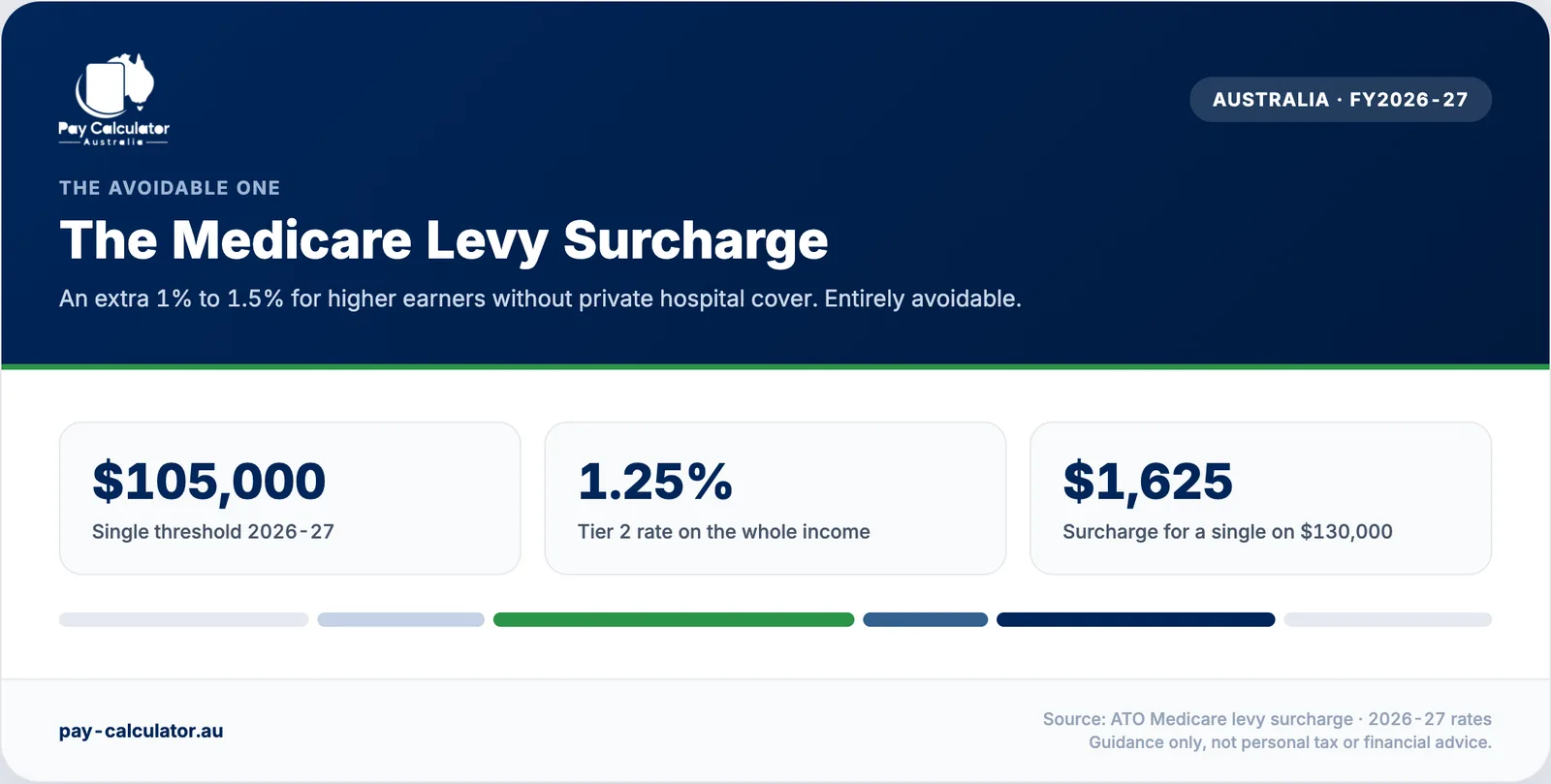
The Medicare levy surcharge is an extra 1% to 1.5% of income charged in 2026-27 to singles earning over $105,000 and families over $210,000 who do not hold private hospital cover. It sits on top of the 2% Medicare levy, and it is calculated on your whole income at the tier rate, not only the part above the threshold. This guide sets out the verified 2026-27 tiers, the broader income definition the surcharge uses, what you would pay at common incomes, and exactly what hospital cover avoids it.
Key takeaways
- MLS applies only above $105,000 single or $210,000 family income for MLS purposes (FY2026-27, verified).
- Rates are 1%, 1.25% and 1.5%, charged on your whole income for MLS purposes.
- A single on $130,000 with no hospital cover pays $1,625 in 2026-27, on top of the $2,600 levy.
- Approved hospital cover held for the full year, with an excess of $750 or less for singles ($1,500 families), avoids the surcharge.
- Hospital cover does not reduce the 2% Medicare levy. The two charges are separate.
What is the Medicare levy surcharge?
The Medicare levy surcharge, or MLS, is a charge of 1% to 1.5% of income for MLS purposes, applied to higher earners who do not hold an appropriate level of private patient hospital cover. In 2026-27 it starts above $105,000 for singles and $210,000 for families. Its stated purpose is to encourage people who can afford it to take out private hospital cover and reduce demand on the public system.
Two conditions must both be true before any surcharge applies: your income for MLS purposes is above the base threshold, and you (and everyone in your family, if you have one) did not hold adequate hospital cover for the full year. Fail either condition and the MLS is nil. You can test both on the Medicare levy surcharge calculator.
How is the surcharge different from the Medicare levy?
The levy is the broad 2% most residents pay. The surcharge is a targeted extra charge on higher earners without hospital cover. You can pay one, both, or neither, and they are worked out independently:
| Feature | Medicare levy | Medicare levy surcharge |
|---|---|---|
| Who pays | Most Australian resident taxpayers | Higher earners without adequate hospital cover |
| Rate (2026-27) | 2% of taxable income | 1% to 1.5% of income for MLS purposes |
| Income base | Taxable income | Broader income for MLS purposes |
| Avoided by hospital cover | No | Yes, if held for the full year |
The row that surprises people is the last one. Private hospital cover does nothing to the 2% levy. It only switches off the surcharge. How the levy itself works, including the low-income reduction, is covered in our Medicare levy guide.
What are the MLS income thresholds for 2026-27?
The base threshold is $105,000 for singles and $210,000 for families in 2026-27, with three tiers above it. These figures are verified: the ATO page (last updated 22 June 2026) and privatehealth.gov.au (modified 21 April 2026) publish identical numbers.
| Threshold (2026-27) | Base tier | Tier 1 | Tier 2 | Tier 3 |
|---|---|---|---|---|
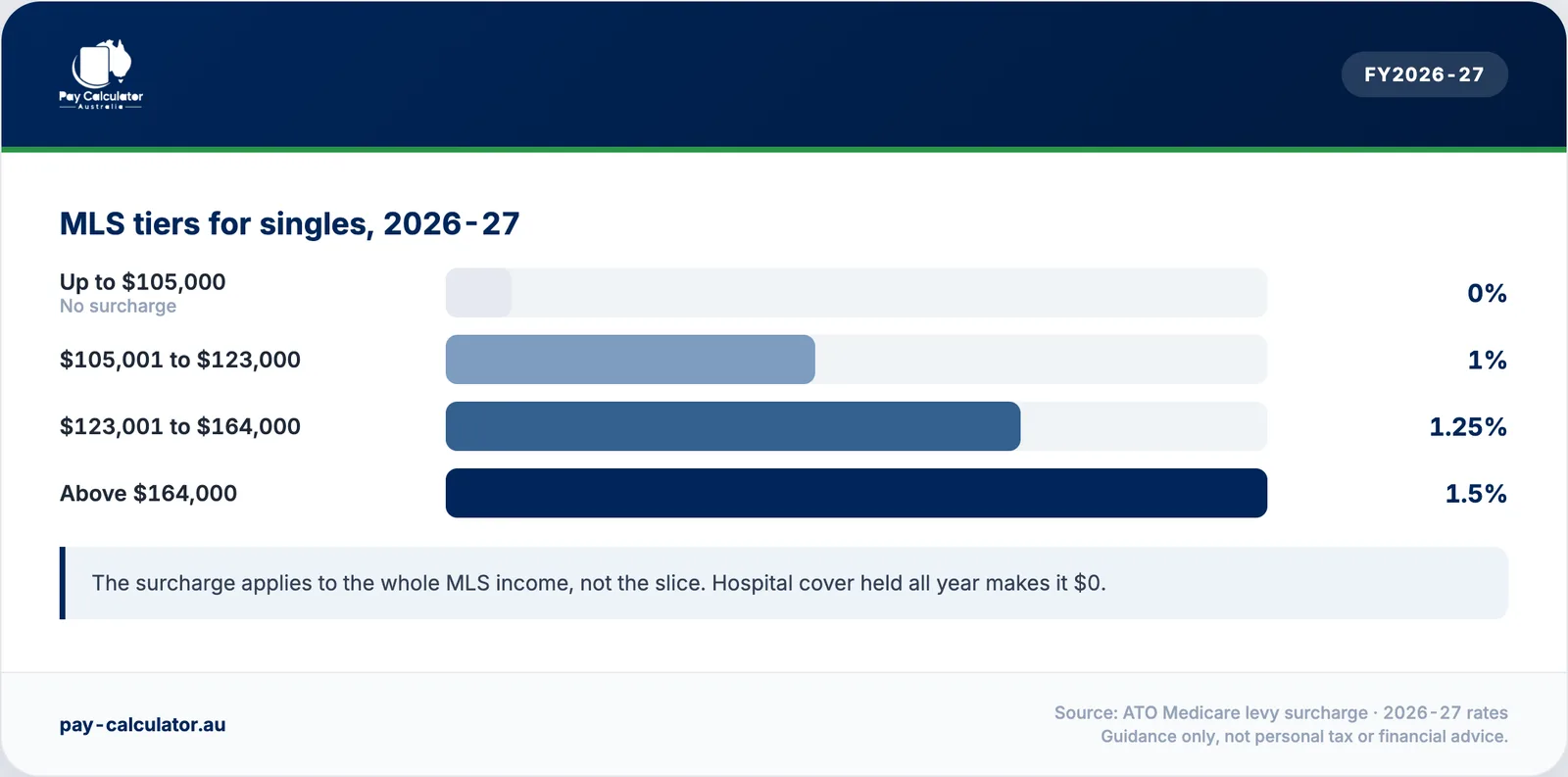
| Single | $105,000 or less | $105,001 to $123,000 | $123,001 to $164,000 | $164,001 or more |
| Family | $210,000 or less | $210,001 to $246,000 | $246,001 to $328,000 | $328,001 or more |
| MLS rate | 0% | 1.0% | 1.25% | 1.5% |
The family threshold rises by $1,500 for each MLS dependent child after the first. Single parents and couples, including de facto couples, use the family tiers. For context, the 2025-26 single base was $101,000 and the family base $202,000, so the 2026-27 thresholds are indexed up while the rates stay unchanged.
How much surcharge would you pay?
A single on $130,000 with no hospital cover pays $1,625 of surcharge in 2026-27, 1.25% of the whole $130,000. The surcharge is flat within each tier, not marginal, which makes the base threshold a genuine cliff: at $105,000 the surcharge is $0, and at $105,001 it is $1,050, because the 1% rate applies to every dollar, not the one dollar over.
| Income for MLS purposes (single) | Tier rate | Surcharge (2026-27, no cover) |
|---|---|---|
| $100,000 | 0% | $0 |
| $105,000 | 0% | $0 |
| $110,000 | 1% | $1,100 |
| $117,000 | 1% | $1,170 |
| $123,000 | 1% | $1,230 |
| $128,000 | 1.25% | $1,600 |
| $140,000 | 1.25% | $1,750 |
| $150,000 | 1.25% | $1,875 |
| $164,000 | 1.25% | $2,050 |
| $170,000 | 1.5% | $2,550 |
| $200,000 | 1.5% | $3,000 |
Every figure is computed from the verified 2026-27 single tiers, assuming no hospital cover for the whole year. Family incomes follow the same pattern against the doubled thresholds. Remember these amounts come on top of the 2% levy and your income tax, which you can see together on the take-home pay calculator.
What income does the MLS use?
Income for MLS purposes is broader than taxable income, which is how people earning a $95,000 salary can still cross the $105,000 single threshold. It is the sum, for you plus your spouse if you have one, of:
- Taxable income, including any net family-trust-distribution-tax amount and excluding assessable First Home Super Saver released amounts.
- Reportable fringe benefits.
- Total net investment losses, both financial investment and rental property losses.
- Reportable super contributions, which covers salary-sacrificed super and deductible personal contributions.
- A spouse share of certain trust income taxed to the trustee, and exempt foreign employment income where taxable income is $1 or more.
The ATO worked example for 2026-27 is Tom, 35 and single with no hospital cover. His taxable income is $90,000, but $27,000 of reportable fringe benefits lift his income for MLS purposes to $117,000. That lands in Tier 1, and his surcharge is 1% of the full $117,000, which is $1,170. Salary sacrificing into super has the same add-back effect, which you can see modelled on the salary sacrifice calculator: it lowers income tax, but it does not lower income for MLS purposes.
How do you avoid the surcharge?
Hold an appropriate level of private patient hospital cover for the full income year. The requirements, from privatehealth.gov.au, are specific:
- The policy must be hospital cover with a registered Australian health insurer, covering some or all of the fees for a hospital stay.
- The total yearly front-end deductible or excess can be no greater than $750 for singles or $1,500 for couples and families, a rule in place since 1 April 2019. A policy with a higher excess does not provide an MLS exemption.
- On a family policy, everyone must be covered: you, your partner and all dependants. If one person is not covered, you pay the surcharge.
Whether the premium costs less than the surcharge you would otherwise pay depends on your tier and the policies available to you, and premium prices are outside what this site tracks. The arithmetic is worth doing before 1 July rather than after, because cover only avoids the surcharge for the days it is held.
What cover does not count?
Three common products provide no MLS exemption at all. Extras cover, also called general treatment cover, does not count without hospital cover attached, no matter how comprehensive it is. Overseas Visitors Cover and Overseas Student Health Cover do not count, which regularly surprises visa holders who are paying for health insurance. And policies with insurers not registered in Australia do not count either.
Add the excess rule from the previous section and the checklist becomes: hospital cover, registered Australian insurer, excess within $750 single or $1,500 family, everyone in the family on the policy, held for the full year. Anything short of all five and the surcharge applies for the shortfall period.
What happens with part-year cover?
You pay the surcharge for the days you were not covered and get a partial exemption for the days you were. Taking out hospital cover in March does not erase the surcharge for July to February; it stops the meter from March. Suspending your policy, for example while travelling overseas, counts as not covered for those days.
The same day-count logic applies when your income changes. The tier is set by your full-year income for MLS purposes, and the surcharge is then applied for the uncovered days. This is one reason the ATO works the MLS out at assessment rather than through payday withholding: neither your final tier nor your covered days are known until the year ends. Withholding during the year does not include the surcharge, so an MLS bill commonly arrives as a surprise at tax time.
Who counts as a dependant for MLS purposes?
A person over 21 who is not a full-time student is not an MLS dependant. That matters twice over. For the family threshold, only genuine MLS dependants add the $1,500 per child after the first. And for cover, an adult child kept on the family policy as an insurer-defined dependant is not protected from the surcharge by that policy: if they earn over the single threshold, they are liable unless they hold their own hospital cover.
Couples, including de facto couples, are assessed on combined income against the family tiers. A spouse with cover does not shield a spouse without it; the whole family must be covered for either to avoid the surcharge. Where family structures get complicated, separated parents, shared care, adult student dependants, the ATO rules run long, and a registered tax agent is worth the money for a definitive answer.
Frequently asked questions
Singles: no surcharge at $105,000 or less, 1% from $105,001 to $123,000, 1.25% from $123,001 to $164,000, and 1.5% at $164,001 or more. Families: no surcharge at $210,000 or less, 1% to $246,000, 1.25% to $328,000, and 1.5% above. The family threshold rises by $1,500 for each dependent child after the first. Verified for 2026-27 against the ATO and privatehealth.gov.au.
As a flat percentage of your whole income for MLS purposes at your tier rate, not just the income above the threshold. A single on $130,000 with no hospital cover is in Tier 2 and pays 1.25% of the full $130,000, which is $1,625 for 2026-27.
Approved hospital cover with a registered Australian health insurer, held for the full income year, with a policy excess no greater than $750 for singles or $1,500 for couples and families. Extras-only cover, overseas visitor or student cover, and policies with non-registered insurers do not qualify.
Yes. The surcharge is charged in addition to the 2% levy, not instead of it. A single on $130,000 with no cover pays the $2,600 levy plus the $1,625 surcharge in 2026-27. Hospital cover removes only the surcharge; the 2% levy stays either way.
You get a partial exemption and pay the surcharge for the days you were not covered. Days on suspended cover, for example while travelling overseas, count as not covered. Only a policy held for the full income year avoids the surcharge completely.
Not only. Income for MLS purposes adds reportable fringe benefits, total net investment losses, reportable super contributions and certain other amounts to taxable income, and combines your income with your spouse if you have one. Salary packaging or sacrificed super can push you over a threshold even when your taxable income sits below it.
Sources
- ATO, Medicare levy surcharge income, thresholds and rates (2026-27 tiers, income for MLS purposes, the Tom example), last updated 22 June 2026.
- privatehealth.gov.au, Medicare Levy Surcharge (hospital cover requirements, excess caps, part-year rules, dependants), modified 21 April 2026.
- ATO, What is the Medicare levy? (the separate 2% levy), last updated 30 April 2026.
All sources accessed 19 July 2026. Page last reviewed 23 July 2026. The 2026-27 tier thresholds and rates are verified against both the ATO and privatehealth.gov.au, which publish identical figures. Surcharge amounts in the table are computed from those tiers.