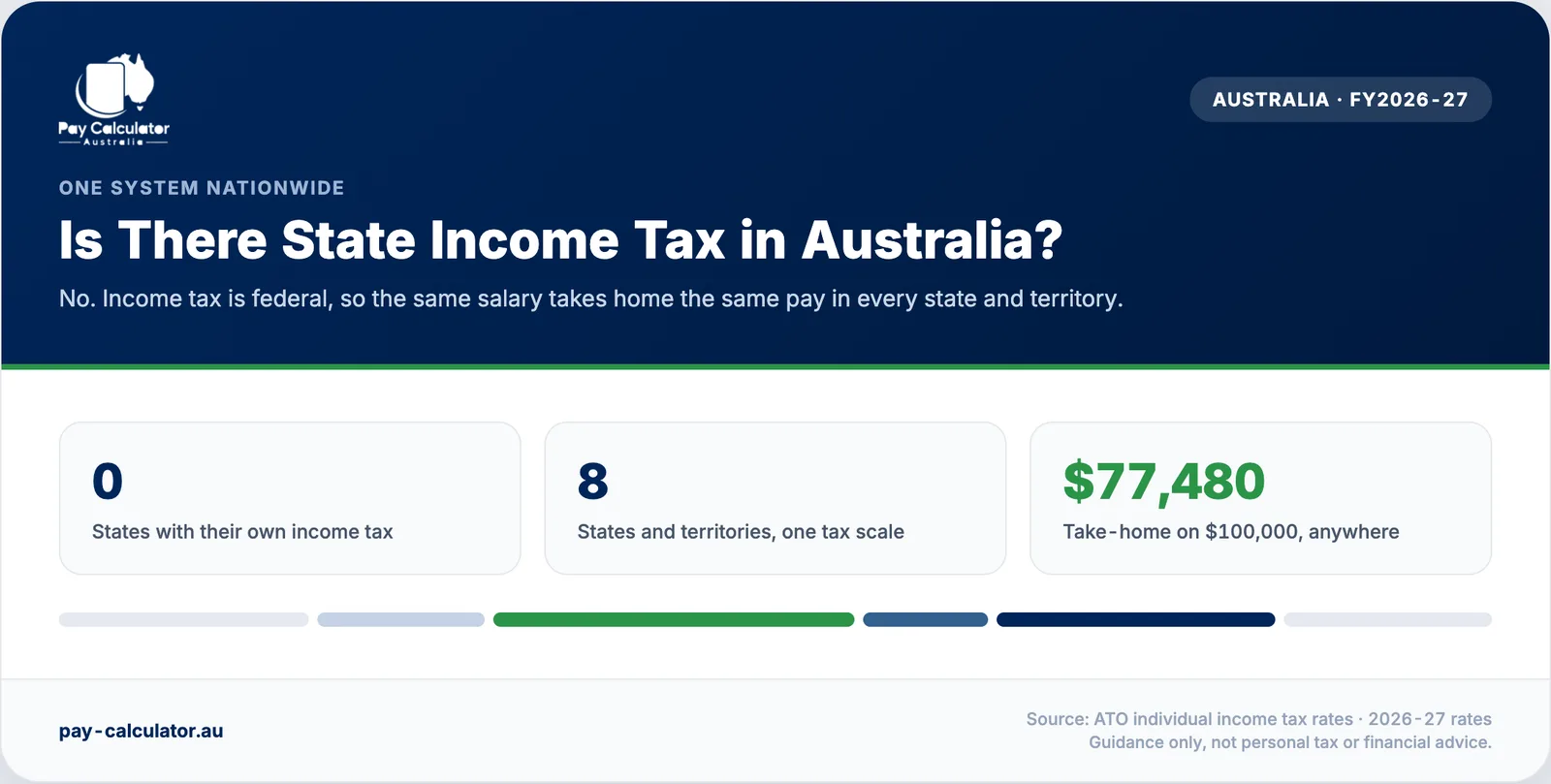
No. Australia has no state income tax. The tax taken from your pay is federal, administered by the Australian Taxation Office, and identical whether you work in Sydney, Melbourne, Brisbane, Perth, Adelaide, Hobart, Darwin or Canberra. If you searched for a NSW, Victorian or Queensland pay calculator, the honest answer is that they are all the same calculator. This guide explains why, covers the state tax that does exist (payroll tax, which your employer pays, not you), and lists the few things that genuinely do differ between states.
Key takeaways
- Income tax on wages is levied only by the federal government. No state or territory taxes your salary.
- A $90,000 salary leaves $70,680 after tax in FY2026-27, in every state and territory.
- Payroll tax is real but it is charged to employers on large wage bills, never deducted from your pay.
- The Medicare levy, HECS-HELP, super guarantee and minimum wage are all set nationally.
- Any accurate Australian pay calculator is automatically a NSW, VIC, QLD, WA, SA, TAS, NT and ACT calculator.
Is there state income tax in Australia?
There is none. Income tax on individuals is levied under federal law and collected by the ATO, and the 2026-27 rate scale applies uniformly across the country: the $18,200 tax-free threshold, the 15% first marginal rate, and every bracket above it. No state or territory adds its own percentage on top, and none offers a discount. This makes Australia different from countries like the United States, where a state income tax can sit on top of the federal one and moving states changes your tax bill.
The same is true of everything else withheld from your pay. The 2% Medicare levy is federal. HECS-HELP repayment thresholds are federal. The 12% super guarantee is federal. Your payslip would look exactly the same, line for line, in any state, which is why the payslip guide on this site never needs to ask where you live.
Why is take-home pay the same in every state?
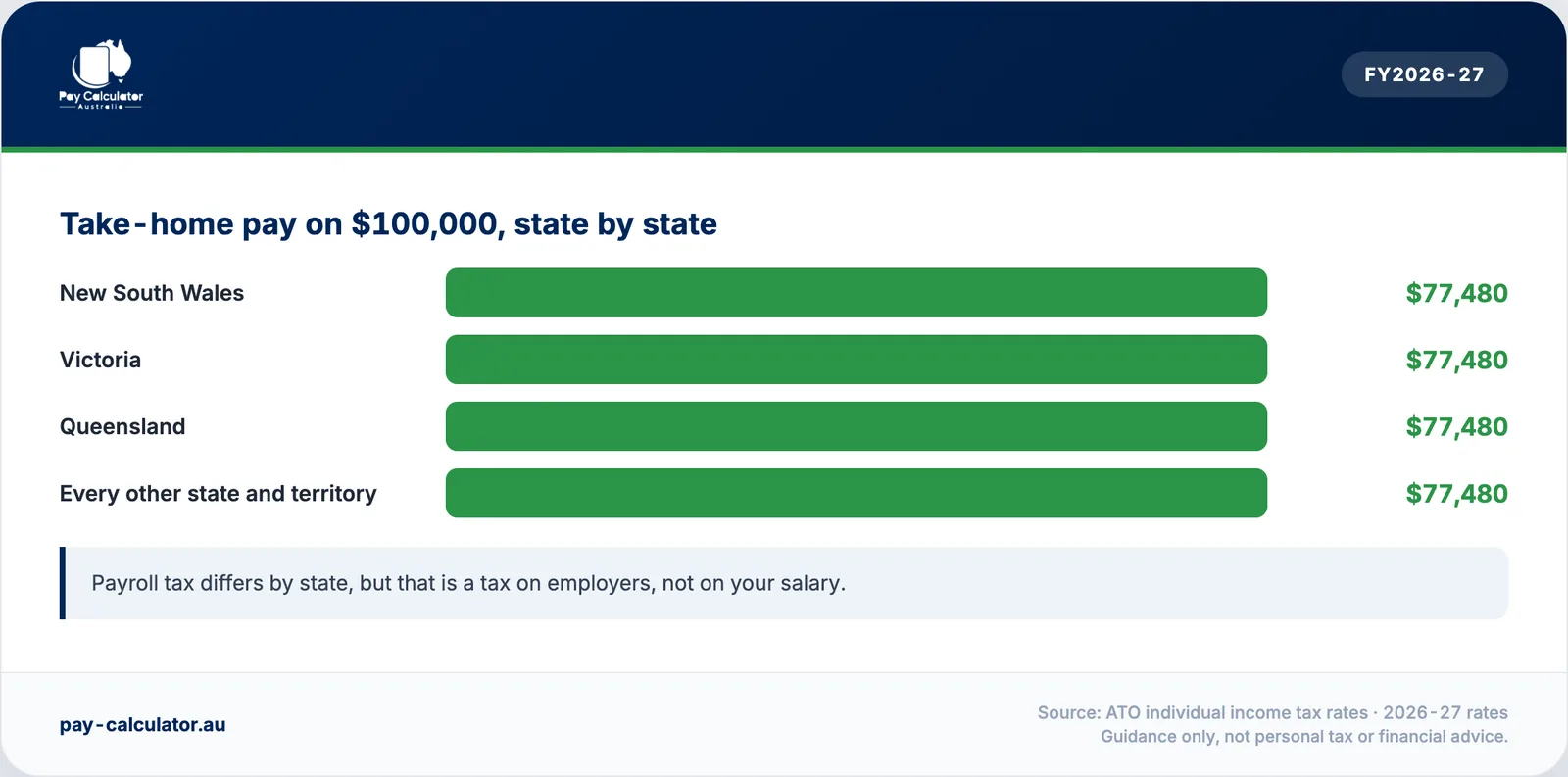
Because every deduction between your gross salary and your bank account is calculated from federal scales that contain no state variable. There is no field for your postcode anywhere in the ATO's tax tables. The table below runs four salaries through this site's FY2026-27 engine, once per state; the columns are identical by construction, and that is the entire point.
| Salary | Take-home in NSW | Take-home in VIC | Take-home in QLD | Take-home in WA |
|---|---|---|---|---|
| $60,000 | $50,380 | $50,380 | $50,380 | $50,380 |
| $80,000 | $63,880 | $63,880 | $63,880 | $63,880 |
| $100,000 | $77,480 | $77,480 | $77,480 | $77,480 |
| $120,000 | $91,080 | $91,080 | $91,080 | $91,080 |
Figures are 2026-27 resident rates with the tax-free threshold claimed, no study loan, super paid on top. Tasmania, South Australia, the ACT and the Northern Territory would be four more identical columns. How the underlying numbers are built is covered in how Australian income tax works.
Do you need a NSW, Victoria or Queensland pay calculator?
No, and any site offering you a different tax result per state is selling packaging, not information. Because income tax is federal, a correct Australian pay calculator produces the correct answer for every state with the same inputs: salary, pay frequency, residency status and study loan. That is what our take-home pay calculator does, and it is as much a Queensland calculator as a New South Wales one.
What a state-specific label cannot change: income tax, Medicare, HECS-HELP, super. What it might legitimately refer to: state payroll tax obligations for employers, which are covered next, or state differences in things like long service leave. If a calculator claims your take-home pay differs in Victoria, close the tab.
What is payroll tax, and who actually pays it?
Payroll tax is the state tax that causes most of the confusion, and it is real, substantial and entirely an employer cost. Each state and territory charges a percentage of an employer's total wage bill once that bill passes an annual threshold, generally between $1 million and $2.5 million. A cafe with three staff pays none. A company with a $5 million wage bill in NSW pays 5.45% on its wages above the threshold.
The tax is levied on the employer as a business, not on any employee's income, and it cannot lawfully be deducted from your wages. You will never see a payroll tax line on a payslip, in the same way you never see a line for the employer's rent. It can still affect you indirectly, since it is part of the cost of employing people, but it does not touch the arithmetic between your gross pay and your net pay.
What are the payroll tax rates in each state?
These are the employer payroll tax rates and annual thresholds as compiled in February 2026 from state revenue office data (2025-26/2026-27 settings). They are included so you can see the state tax that does vary, and who carries it. Employers should confirm current rates with their state revenue office or payrolltax.gov.au before relying on them.
| State or territory | Rate | Annual threshold | Notes |
|---|---|---|---|
| ACT | 6.85% | $2,000,000 | Highest rate; high threshold offsets it for smaller employers |
| WA | 5.50% | $1,000,000 | Highest flat mainland rate with a low threshold |
| NT | 5.50% | $2,500,000 | Matches WA's rate with SA's threshold |
| NSW | 5.45% | $1,200,000 | Rate stable since 2020 |
| SA | 4.95% | $2,500,000 | Generous threshold, phased-in rate |
| QLD | 4.75% / 4.95% | $1,300,000 | 4.75% up to $6.5m of wages, 4.95% above; discount for timely lodgement |
| VIC | 4.85% | $1,000,000 | Mental health surcharge adds 0.5% above $10m national wages, 1.0% above $100m |
| TAS | 4.0% / 6.1% | $1,250,000 | Two tiers: 4% to $2m of wages, 6.1% above |
Notice the spread: 2.1 percentage points and a 2.5x threshold range between jurisdictions. This is the tax behind headlines about businesses relocating between states. It has no equivalent for employees, because the tax on your own income does not move.
Does payroll tax appear on your payslip?
Never. The Fair Work payslip rules require gross pay, net pay, deductions, and super contributions to be shown, and payroll tax is none of these. It is not a deduction from your pay, so listing it would be listing someone else's tax. If an employer ever presented payroll tax as a reason your own pay is lower on the slip, that would be a payroll error worth questioning, and the required payslip lines in the payslip guide are the checklist to question it with.
What you will see instead is PAYG withholding, which is federal income tax being collected in instalments. The two get conflated because both contain the word tax and both relate to wages. One comes out of your pay; the other comes out of your employer's profit and loss.
Which parts of your pay are set nationally?
Nearly all of them. The table below is the division of responsibilities as it applies to an employee's pay in 2026-27.
| Item | Set by | Varies by state? |
|---|---|---|
| Income tax brackets and rates | Federal law, administered by the ATO | No |
| Medicare levy (2%) | Federal law | No |
| HECS-HELP repayments ($69,528 threshold, FY2026-27) | Federal law | No |
| Super guarantee (12%) | Federal law | No |
| National Minimum Wage ($26.44/hr from 1 July 2026) | Fair Work Commission, national | No |
| Awards and penalty rates | National workplace relations system | No |
| Payslip requirements | Fair Work Act 2009, national | No |
| Payroll tax (employer cost) | Each state and territory | Yes |
| Long service leave rules | State and territory laws (for most employees) | Yes |
The national character of the wage floor surprises people most: the minimum wage does not rise in expensive cities. The minimum wage guide covers the single national rate and who it applies to.
What does actually differ between states for employees?
A short list, and none of it touches the tax on your income. Long service leave is the main one: it is governed by state and territory laws for most employees, so accrual periods and entitlements differ depending on where you work, and in some states and territories long-serving casuals qualify too. Public holiday dates are declared by each state and territory, which matters for pay because working a public holiday commonly attracts penalty rates, often double-time-and-a-half under awards. A Melbourne-only public holiday is a penalty-rate day in Melbourne and an ordinary Tuesday in Sydney.
Beyond that, employer-side settings differ, payroll tax chief among them, and living costs differ in ways no calculator on this site will pretend to model. But the deduction stack itself, gross to net, is one system nationwide, which you can verify by running the same salary through the income tax calculator for any two addresses you like.
Do the Medicare levy, HECS or super change by state?
No, no and no. The Medicare levy is 2% of taxable income for most residents everywhere in Australia, with the same low-income reductions applying nationally; the Medicare levy calculator needs your income, never your address. HECS-HELP repayments start at $69,528 of repayment income for 2026-27, whether you studied in Hobart and work in Darwin or the reverse. The super guarantee is 12% of ordinary time earnings under federal law in every workplace in the country, with the new Payday Super rules from 1 July 2026 applying nationally as well; the superannuation calculator covers it.
The pattern is worth internalising, because it answers a whole family of questions before they are asked. If a levy, threshold, rate or repayment relates to your income as an employee, it is federal, it is uniform, and moving house will not change it.
State tax FAQ
Sources
- ATO, Individual income tax rates for 2026-27 (national scale, 15% first marginal rate from 1 July 2026).
- ATO, Study and training support loans rates and repayment thresholds ($69,528 for 2026-27), updated 30 June 2026.
- ATO, Super guarantee (12%, federal) and Payday Super from 1 July 2026.
- Payroll Tax Australia (payrolltax.gov.au), consolidated state revenue office resource for payroll tax rates.
- Australian Business Register payroll tax by state guide (updated February 2026), cross-referenced with state revenue offices, for the rate and threshold table.
- Fair Work Ombudsman, Minimum wages, updated 1 July 2026 (single national minimum wage), and Pay slips, updated 22 October 2025.
Last verified 23 July 2026. Take-home figures computed with this site's FY2026-27 tax engine.