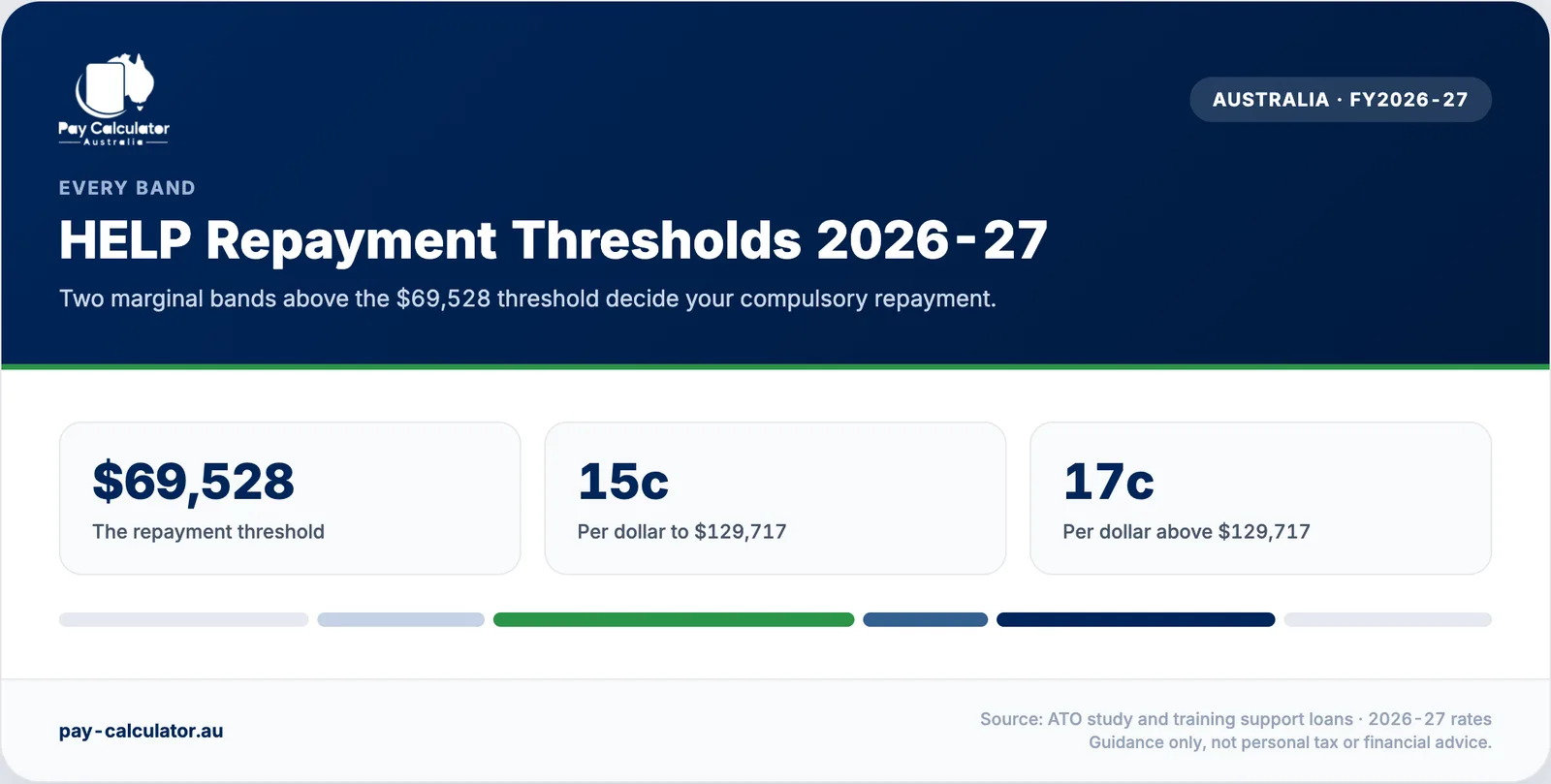
The HELP repayment threshold for 2026-27 is $69,528. At or below that repayment income you repay nothing. Above it, two marginal bands apply, 15c and then 17c per dollar, before a flat 10% of whole income takes over at $186,051. This page sets out the full band table, shows the computed repayment at every common salary level, compares this year with last, and explains why the marginal system introduced in 2025-26 charges most people less than the old whole-income method did.
Key takeaways
- Minimum repayment threshold: $69,528 for 2026-27, up from $67,000 in 2025-26.
- 15c per $1 from $69,529 to $129,717, then $9,028 plus 17c per $1 to $186,050.
- At $186,051 and over the repayment is 10% of total repayment income.
- On $100,000 the 2026-27 repayment is $4,571, about 4.6% of income.
- Thresholds are indexed to average weekly earnings each 1 July. The loan balance is indexed separately each 1 June.
What is the minimum HELP repayment threshold for 2026-27?
$69,528. If your repayment income for the year ending 30 June 2027 is $69,528 or less, no compulsory repayment applies, whatever the size of your debt. The figure comes from the ATO study and training support loans rates and repayment thresholds page, last updated 30 June 2026.
The same table covers every Study and Training Support Loan: HECS-HELP, FEE-HELP, OS-HELP, SA-HELP, VET Student Loans, SFSS, Student Start-up Loans, ABSTUDY SSL and Australian Apprenticeship Support Loans. There is one set of thresholds, not one per loan type.
The test is annual, but it can help to picture the threshold at your pay cycle. Averaged across 2026-27, $69,528 is $5,794 a month, $2,674 a fortnight or $1,337 a week of repayment income. A few pays above that line do not by themselves trigger a repayment. What counts is where the full year lands once you lodge.
What are the HELP repayment bands for 2026-27?
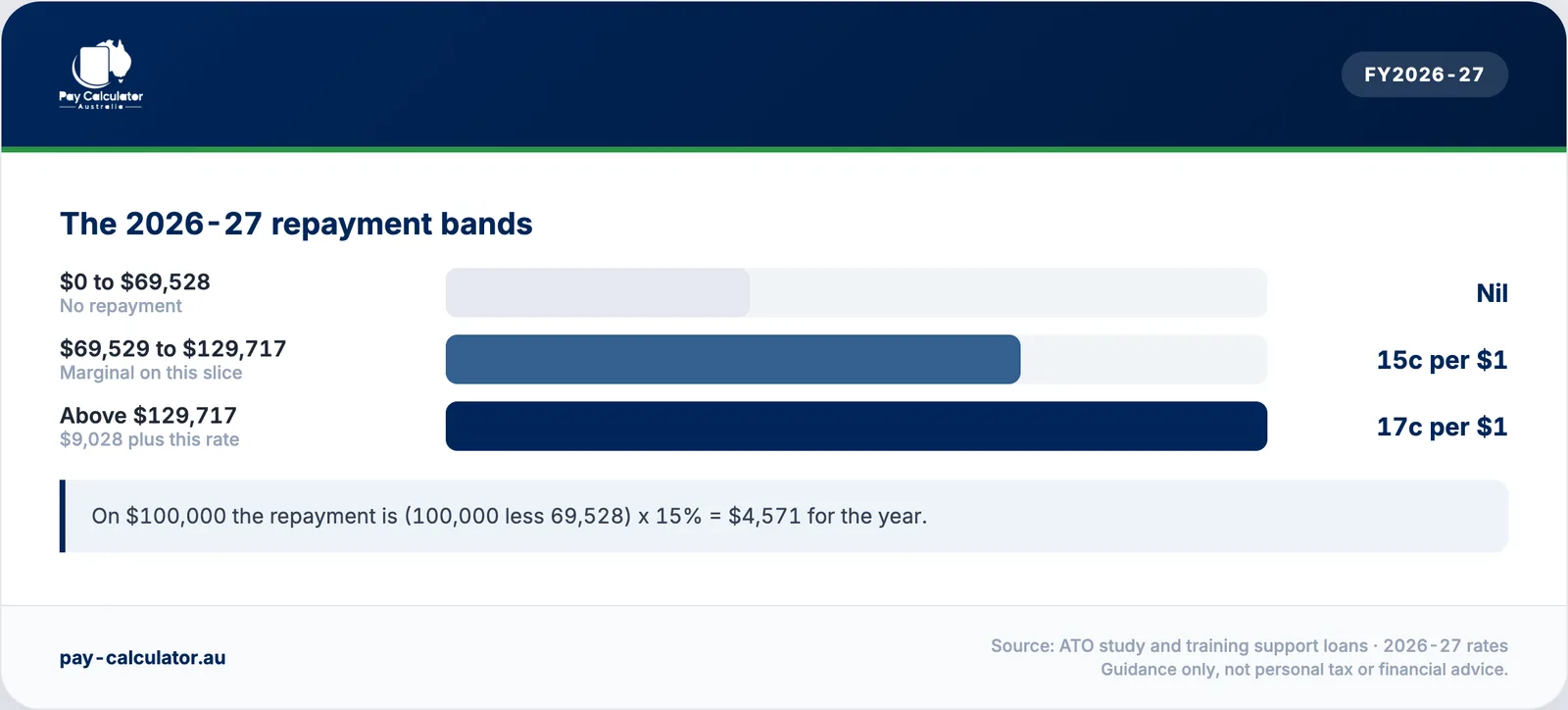
Four bands cover all incomes. The rates apply marginally, to the income inside each band, with the top band the single exception. This is the ATO table, verbatim:
| Repayment income (2026-27) | Repayment on this income |
|---|---|
| $0 to $69,528 | Nil |
| $69,529 to $129,717 | 15c for each $1 over $69,528 |
| $129,718 to $186,050 | $9,028 plus 17c for each $1 over $129,717 |
| $186,051 and over | 10% of total repayment income |
For how the system works end to end, collection, indexation and the early-payoff question, read how HECS-HELP repayments work. This page stays with the numbers.
How much do you repay at each salary level?
On $80,000 the 2026-27 repayment is $1,571. On $100,000 it is $4,571, and on $150,000 it is $12,476. Every row below is computed from the band table above, using repayment income, which for most wage earners equals taxable income.
| Repayment income | Annual repayment (2026-27) | Share of income |
|---|---|---|
| $70,000 | $71 | 0.1% |
| $75,000 | $821 | 1.1% |
| $80,000 | $1,571 | 2% |
| $85,000 | $2,321 | 2.7% |
| $90,000 | $3,071 | 3.4% |
| $95,000 | $3,821 | 4% |
| $100,000 | $4,571 | 4.6% |
| $105,000 | $5,321 | 5.1% |
| $110,000 | $6,071 | 5.5% |
| $115,000 | $6,821 | 5.9% |
| $120,000 | $7,571 | 6.3% |
| $125,000 | $8,321 | 6.7% |
| $130,000 | $9,076 | 7% |
| $140,000 | $10,776 | 7.7% |
| $150,000 | $12,476 | 8.3% |
| $160,000 | $14,176 | 8.9% |
| $170,000 | $15,876 | 9.3% |
| $180,000 | $17,576 | 9.8% |
| $190,000 | $19,000 | 10% |
| $200,000 | $20,000 | 10% |
| $220,000 | $22,000 | 10% |
| $250,000 | $25,000 | 10% |
Notice how the share of income climbs gradually, from 0.1% at $70,000 to 10% at $250,000. A marginal system produces that smooth curve. The old whole-income system produced steps. To see any of these salaries with tax, Medicare and super included, use the HECS-HELP repayment calculator.
How does the marginal calculation work?
Take $100,000 of repayment income in 2026-27. Subtract the $69,528 threshold to get $30,472, multiply by 15%, and the repayment is $4,570.80, which rounds to $4,571. Nothing is charged on the first $69,528.
The third band starts from a base of $9,028, which is the second band fully used up: 15% of the $60,189 between $69,528 and $129,717 is $9,028.35, rounded by the ATO to $9,028. So on $140,000 the repayment is $9,028 plus 17% of the $10,283 above $129,717, which is $10,776.11. The structure is identical to income tax brackets, which we cover in the income tax guide: each band has a base amount plus a rate on the excess.
How do the 2026-27 thresholds compare with 2025-26?
Every boundary moved up by roughly 3.8%, in line with average weekly earnings indexation. The minimum threshold rose from $67,000 to $69,528, and the rates themselves did not change. The 2025-26 table, for comparison:
| Repayment income (2025-26) | Repayment on this income |
|---|---|
| $0 to $67,000 | Nil |
| $67,001 to $125,000 | 15c for each $1 over $67,000 |
| $125,001 to $179,285 | $8,700 plus 17c for each $1 over $125,000 |
| $179,286 and over | 10% of total repayment income |
Threshold indexation works in your favour. If your salary is unchanged from last year, slightly more of it now sits under the threshold and in the 15c band, so the repayment on the same income is a little lower in 2026-27 than it was in 2025-26.
How is the marginal system different from the old whole-income system?
Under the old system, in place until 2024-25, one rate between 1% and 10% applied to your entire repayment income. Crossing a band boundary by a single dollar lifted the rate on every dollar you earned. The marginal system, law from 2025-26, charges each rate only on the income inside its band, so an extra dollar of income only ever costs the marginal rate on that dollar.
The ATO published a worked contrast on 2025-26 figures for a taxpayer called Grace, on a repayment income of $80,000:
| Method | Calculation on $80,000 (2025-26) | Repayment |
|---|---|---|
| Old whole-income | 3.5% of the full $80,000 | $2,800 |
| New marginal | 15% of the $13,000 above the $67,000 threshold | $1,950 |
The ATO states that most people repay less from their 2026 tax return onwards, and that people at or above the top band see no change, because 10% of whole income is the same figure under both systems at that level.
Why is the top band a flat 10% of whole income?
Because at that income the two methods meet. At $186,050, the top of the marginal bands, the formula gives $9,028 plus 17% of $56,333, which is $18,604.61. Ten percent of $186,050 is $18,605. The difference is 39 cents, so switching to the whole-income method at $186,051 creates no jump in the repayment. The design keeps the simplicity of the old top rate without reintroducing a cliff.
Above the boundary the flat rate does mean each extra dollar adds 10c of repayment, on top of the 45% top marginal tax rate that applies at those incomes for 2026-27.
What income do the thresholds apply to?
The bands are tested against repayment income, not gross salary. Repayment income is taxable income plus reportable fringe benefits, total net investment losses (including rental losses), reportable super contributions such as salary-sacrificed super, and exempt foreign employment income. Assessable First Home Super Saver released amounts are excluded.
For a wage earner with none of those add-backs, repayment income equals taxable income. The add-backs stop salary packaging or negative gearing from pulling income back under a threshold. Your spouse or family income is never counted; the test is your income alone.
Will your payslip match these thresholds?
No, and it is not meant to. Each pay, your employer withholds an extra amount using the ATO study and training support loans tax tables, which annualise that single pay period. The bands on this page are applied once, to your actual full-year repayment income, when you lodge your return. The withheld amounts are a prepayment against that assessment.
The gap matters when your income is uneven. Overtime, a bonus or a mid-year pay rise can push withholding above the assessed repayment, and the difference comes back in your refund. On a steady $100,000 salary the assessed 2026-27 repayment is $4,571, but the sum of the payslip deductions across the year will rarely equal that to the dollar. Withholding is the estimate. The band table on this page is the answer. To see the whole picture on your salary, take-home pay with tax, Medicare, super and the HELP repayment together, use the take-home pay calculator.
Frequently asked questions
The minimum repayment threshold is $69,528 for 2026-27. At or below that repayment income you make no compulsory repayment. The threshold was $67,000 in 2025-26 and is indexed each year in line with average weekly earnings. Source: ATO study and training support loans rates and repayment thresholds, last updated 30 June 2026.
From $69,529 to $129,717 you repay 15c for each $1 over $69,528. From $129,718 to $186,050 you repay $9,028 plus 17c for each $1 over $129,717. At $186,051 and over the repayment is a flat 10% of your total repayment income. Below the bands, at $69,528 or less, no repayment applies.
No. The 2026-27 system is marginal, so a higher rate only applies to the dollars above each boundary. Even the move into the 10% top band is smooth: at $186,050 the marginal formula gives $18,604.61 and 10% of $186,050 is $18,605, a difference of well under a dollar.
Not exactly. Your employer withholds an estimate each pay using the ATO study and training support loans tax tables, based on that period in isolation. The actual repayment is assessed on your full-year repayment income when you lodge. Any over-withholding is refunded at assessment, provided no other tax or Commonwealth debt is outstanding.
Yes. One combined 2026-27 band table covers all Study and Training Support Loans: HECS-HELP, FEE-HELP, OS-HELP, SA-HELP, VET Student Loans, SFSS, Student Start-up Loans, ABSTUDY SSL and Australian Apprenticeship Support Loans. If you hold several, repayments are applied to HELP first, then VSL, SFSS, SSL, ABSTUDY SSL and AASL.
Indexation. The ATO indexes the repayment thresholds each year in line with average weekly earnings, which lifted the minimum from $67,000 to $69,528 and moved every band boundary up with it. This is separate from the 1 June indexation of your loan balance, which uses the lower of CPI or the Wage Price Index.
Sources
- ATO, Study and training support loans rates and repayment thresholds (2026-27 and 2025-26 band tables, repayment income definition, band-boundary arithmetic), last updated 30 June 2026.
- ATO, Study and training loans, what is new (marginal system change and the Grace worked contrast), last updated 30 June 2026.
- ATO, Compulsory repayments (withholding versus assessment mechanics), last updated 3 June 2026.
- ATO, Study and training loan repayment calculator (official cross-check for computed figures).
All sources accessed 19 July 2026. Page last reviewed 23 July 2026. Every repayment figure in the salary table is computed from the 2026-27 ATO band table by the same engine that powers the calculators.