Low Income Tax Offset Calculator (LITO)
See the low income tax offset you get for 2026-27, the income tax it removes, and the Medicare levy it leaves untouched. Built on the ATO low income tax offset scale.
Low Income Tax Offset Calculator 2026-27
What Is the Low Income Tax Offset?
A permanent offset of up to $700 that reduces the income tax of low and middle income earners.
LITO is a tax offset, not a deduction and not a payment. A deduction lowers the income your tax is worked out on. An offset is subtracted from the tax itself, after the 2026-27 tax brackets have been applied. That makes an offset worth far more per dollar, which is the whole point of it.
It is worth up to $700 for 2026-27 and is unchanged from last year. The offset was not touched by the 1 July 2026 tax cuts, so the four steps below are the same ones that applied in 2025-26.
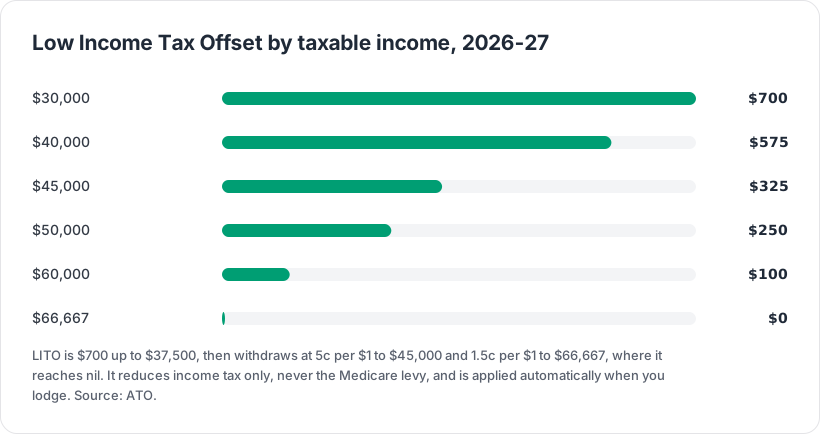
| Taxable income | Your LITO | How it is worked out |
|---|---|---|
| $37,500 or less | $700 | The full offset |
| $37,501 to $45,000 | $700 down to $325 | $700 less 5c for every $1 above $37,500 |
| $45,001 to $66,667 | $325 down to $0 | $325 less 1.5c for every $1 above $45,000 |
| $66,668 and over | $0 | Fully withdrawn, nothing left |
Amounts computed from this site’s 2026-27 offset scale at render time. Source: ATO, Low income tax offset (last updated 8 June 2026).
How Is Your LITO Worked Out?
Four steps, all of them done for you by the ATO after you lodge.
Start From Taxable Income
Your assessable income less your deductions. This is the same figure the brackets are applied to, not your gross salary and not your bank balance.
Work Out the Income Tax
Apply the 2026-27 resident scale. On $40,000 that is $3,270, being 15c for each $1 above the $18,200 tax-free threshold.
Read Your Offset Off the Scale
At $40,000 the offset is $700 less 5c for each $1 above $37,500, which is $575.
Subtract, But Never Below Zero
$3,270 less $575 leaves $2,695 of income tax. The $800 Medicare levy is then added on top, untouched.
Two worked amounts show both tapers. On $40,000 the offset is $700 less 5c times $2,500, which is $575. On $60,000 it is $325 less 1.5c times $15,000, which is $100. Between those two incomes the offset falls by $475 while the income itself rises by $20,000.
If you want the full picture of how the brackets, the offset and the levy stack up on a salary, the income tax calculator runs all three at once, and how income tax works in Australia explains the order the ATO applies them in.
How Much LITO Do You Get at Each Income?
Your offset and your income tax before and after it, across the range where LITO does anything. Australian resident, 2026-27 rates.
| Taxable income | Income tax before LITO | LITO | Income tax after LITO | Medicare levy | Total tax |
|---|---|---|---|---|---|
| $20,000 | $270 | $700 | $0 | $0 | $0 |
| $25,000 | $1,020 | $700 | $320 | $0 | $320 |
| $30,000 | $1,770 | $700 | $1,070 | $199 | $1,269 |
| $37,500 | $2,895 | $700 | $2,195 | $750 | $2,945 |
| $40,000 | $3,270 | $575 | $2,695 | $800 | $3,495 |
| $45,000 | $4,020 | $325 | $3,695 | $900 | $4,595 |
| $50,000 | $5,520 | $250 | $5,270 | $1,000 | $6,270 |
| $60,000 | $8,520 | $100 | $8,420 | $1,200 | $9,620 |
| $66,667 | $10,520 | $0 | $10,520 | $1,333 | $11,853 |
| $70,000 | $11,520 | $0 | $11,520 | $1,400 | $12,920 |
Every cell computed from the 2026-27 resident scale, the LITO scale and the 2% Medicare levy. The $20,000 row is the one to look at twice: the offset of $700 is bigger than the $270 of income tax, so $430 of it is simply lost. See the Medicare levy calculator for the levy column.
Notice what happens between $45,000 and $60,000. The income rises by $15,000, the income tax after LITO rises by $4,725, and part of that increase is not the 30% bracket at all. It is the offset being taken away.
Why Does LITO Push Up Your Effective Marginal Rate?
Withdrawing an offset costs you money exactly like a tax rate does. Between $37,501 and $66,667 your real marginal rate is higher than the bracket table says.
Your marginal rate is what the next dollar costs you. The bracket table says 15% up to $45,000 and 30% above it. That is only true once the offset has gone. While LITO is being withdrawn, each extra dollar is taxed at the bracket rate and shrinks your offset, so it costs you both.
| Taxable income | Headline bracket rate | LITO withdrawn | Effective marginal rate | With the 2% Medicare levy |
|---|---|---|---|---|
| $18,201 to $37,500 | 15% | None | 15% | 17% |
| $37,501 to $45,000 | 15% | 5c per $1 | 20% | 22% |
| $45,001 to $66,667 | 30% | 1.5c per $1 | 31.5% | 33.5% |
| $66,668 to $135,000 | 30% | None | 30% | 32% |
Headline rates from marginalRate() on the 2026-27 resident scale; withdrawal rates read directly off the LITO scale by taking one more dollar of income. The effect on marginal rates is confirmed in the ATO low income tax offset guidance. The Medicare levy column assumes the full 2% applies.
The jump is real and it is easy to miss. In the $37,501 to $45,000 range the bracket rate is only 15%, but every extra dollar also removes 5c of offset, so the true cost is 20% before the levy. In the $45,001 to $66,667 range it is 30% plus 1.5c, or 31.5%.
| Taxable income | Income tax after LITO | Tax on the next $1,000 | Effective marginal rate |
|---|---|---|---|
| $30,000 | $1,070 | $150 | 15% |
| $40,000 | $2,695 | $200 | 20% |
| $45,000 | $3,695 | $315 | 31.5% |
| $55,000 | $6,845 | $315 | 31.5% |
| $60,000 | $8,420 | $315 | 31.5% |
| $70,000 | $11,520 | $300 | 30% |
Computed by adding $1,000 to the taxable income and re-running both the tax scale and the offset scale. Income tax only, before the Medicare levy.
None of this makes a pay rise a bad thing. Earning $1 more never leaves you worse off, because the offset is withdrawn more slowly than the extra income arrives. It does explain why a raise from $40,000 to $50,000 feels thinner than the bracket table promised. The difference between the rate on your next dollar and the rate you actually paid across the year is set out in marginal vs average tax rate.
One more layer sits underneath this for the lowest incomes. The Medicare levy itself phases in between $28,011 and $35,013 of taxable income at 10c per $1, so inside that narrow band the total effective marginal rate is higher again. The ATO had not published the 2026-27 low-income levy thresholds as at 19 July 2026, so those two figures are the 2025-26 amounts carried forward, and this page will be updated when the new ones are released.
Is LITO Refundable, and Does It Cut the Medicare Levy?
No to both. This is the single most common misunderstanding about the offset.
LITO is non-refundable. It reduces income tax you owe, and it stops at zero. If your offset is larger than your income tax, the excess is not paid to you, not carried forward to next year, and not transferred to anyone else. It simply expires.
On a taxable income of $20,000 the income tax is $270 and the offset is $700. The offset wipes out the $270, and the remaining $430 does nothing. Someone on $30,000 uses the whole $700, because their income tax of $1,770 is larger than the offset.
LITO also does not reduce the Medicare levy. The levy is a separate 2% charge on taxable income, worked out after the income tax and never reduced by an offset. On $60,000 the offset removes $100 of income tax and the $1,200 Medicare levy is paid in full. Low-income earners get relief from the levy through the separate low-income reduction, not through LITO.
The distinction matters when people plan around it. Withholding is the payday estimate your employer sends to the ATO. Tax is what the assessment says you owed. LITO changes the second number, not the first, which is why a low earner can see a refund that looks larger than they expected.
Do You Have to Claim the Low Income Tax Offset?
No. The ATO applies it automatically when you lodge. There is no form, no box and no deadline.
There is no LITO label on the tax return. The ATO works the offset out from the taxable income on your assessment and subtracts it before telling you what you owe. Tax agents do not need to ask for it either. If you lodge a return and your taxable income is $66,667 or less, the offset is in your assessment.
You will see it on your notice of assessment rather than on your payslip. Employer withholding schedules already build a share of LITO into the amounts taken out each payday, which is part of why the tax on your payslip does not match a simple bracket calculation. The final reconciliation happens at assessment.
If you are not required to lodge a tax return at all, there is nothing to claim. An offset only has something to reduce when there is income tax to reduce, and below about $22,866 there is none.
Is LITO the Same as LMITO?
No. LMITO was a different, temporary offset and it ended after 2021-22.
The low and middle income tax offset (LMITO) was a separate offset that ran alongside LITO for a few years. Its last year was 2021-22. It does not exist in 2026-27 and it has not applied to any tax return since. People still search for it, and some calculators still quietly include it, which produces figures that are too generous.
| LITO | LMITO | |
|---|---|---|
| Full name | Low income tax offset | Low and middle income tax offset |
| Applies in 2026-27 | Yes | No |
| Status | Permanent, unchanged for 2026-27 | Temporary, last applied in 2021-22 |
| Maximum amount | $700 | Not applicable, the offset no longer exists |
| Refundable | No | Was not refundable either |
LITO amounts computed from the 2026-27 scale. LMITO status from the ATO historical resident rate tables, which record it as in effect for 2021-22 and ended by 2023-24.
If a calculator gives you a bigger offset than the $700 maximum shown above, it is almost certainly still running an LMITO amount from a pre-2022 tax year.
Is a Tax Offset the Same as a Deduction?
No, and the gap is large. A $700 offset is worth $700. A $700 deduction is worth a fraction of that.
A deduction comes off your income before the tax is worked out, so it saves you your marginal rate multiplied by the deduction. An offset comes off the tax itself, so it saves you the full amount, provided you owe at least that much tax. The table below runs the same $700 through both routes.
| Taxable income | Tax saved by a $700 offset | Tax saved by a $700 deduction | Difference |
|---|---|---|---|
| $25,000 | $700 | $105 | $595 |
| $40,000 | $700 | $154 | $546 |
| $55,000 | $700 | $235 | $466 |
| $90,000 | $700 | $224 | $476 |
Deduction column computed by lowering taxable income by $700 and re-running the tax scale, the LITO scale and the Medicare levy, so it includes the extra offset that a lower income restores. Income tax and Medicare levy combined.
The $40,000 row shows the effective marginal rate story from the other side. A $700 deduction saves $154 there, which is 22% of the amount, because at that income each dollar carries 15% tax, 5c of LITO withdrawal and 2% Medicare levy. That is the new $1,000 standard work deduction working harder than the bracket table suggests.
Who Uses This LITO Calculator?
The situations this page is built to answer.
The part-time or casual earner
Income under $37,500
- Gets the full $700 offset
- Pays no income tax at all below about $22,866
- May still owe the Medicare levy above $28,011
The worker in the taper
Income between $37,501 and $66,667
- Offset shrinking with every extra dollar
- Effective marginal rate of 20% or 31.5% before the levy
- Wants to know why a raise landed smaller than expected
The student or first-year worker
A part-year of income
- Income tax often lower than the offset
- Unused offset is lost, not refunded
- Any money back is over-withheld tax, not LITO
The assessment checker
The notice of assessment looks off
- Confirms the offset the ATO applied
- Separates income tax from the Medicare levy
- Rules out a stale LMITO amount from an old calculator
What Changed for LITO on 1 July 2026?
The offset itself did not change. Two things around it did, and both affect the result.
| Change | 2026-27 position | Effect on your offset |
|---|---|---|
| LITO scale | Unchanged: $700 maximum, 5c taper from $37,500, 1.5c taper from $45,000, nil from $66,668 | None. The offset was not altered by the tax cuts |
| First marginal rate | Cut from 16% to 15% | Less income tax for the offset to cancel, so the zero-tax point moved up to about $22,866 |
| $1,000 standard work deduction | New for 2026-27, claimed on the return without receipts | Lowers taxable income, which can raise your offset. At $50,000 it lifts LITO from $250 to $265 |
| LMITO | Still gone, last applied in 2021-22 | Nothing to add. LITO is the only low income offset in 2026-27 |
Sources: ATO, Low income tax offset; ATO, Personal income tax, new tax cuts for every Australian taxpayer; ATO, Standard deduction for work-related expenses. LITO amounts computed from the 2026-27 scale.
Common Mistakes With the Low Income Tax Offset
Where the offset gets misread, and what it actually does.
Treating it as a payment
The offset is not cash
- It reduces income tax, nothing else
- Unused amounts are not paid out
- Money back after lodging is over-withheld tax
Expecting it to cut the Medicare levy
The levy is worked out separately
- 2% of taxable income, untouched by LITO
- $1,200 still payable on $60,000
- Levy relief comes from the low-income reduction instead
Trying to claim it on the return
There is no box to tick
- Applied automatically at assessment
- No form, no evidence, no deadline
- Nothing to claim if you do not lodge
Using an LMITO figure
Old calculators still carry it
- LMITO last applied in 2021-22
- Any offset above $700 is wrong for 2026-27
- Check the year the tool was built for
Reading the bracket rate as your real rate
The taper is a rate too
- 20% effective between $37,501 and $45,000
- 31.5% effective between $45,001 and $66,667
- Both before the 2% Medicare levy
Low Income Tax Offset FAQ
Common questions about LITO in Australia for 2026-27.
Where These Figures Come From
Every rate-bearing claim on this page traces to a published document.
- ATO, Low income tax offset (maximum $700 for taxable income to $66,667, the 5c and 1.5c withdrawal steps, non-refundable, applied automatically after you lodge), last updated 8 June 2026: ato.gov.au low income tax offset
- ATO, Tax rates for Australian residents (the 2026-27 resident scale the offset is subtracted from, and confirmation that the bracket rates exclude the Medicare levy).
- ATO, Personal income tax, new tax cuts for every Australian taxpayer (first marginal rate cut from 16% to 15% from 1 July 2026), last updated 13 May 2026.
- ATO, Standard deduction for work-related expenses (the new $1,000 standard deduction, first applying to the 2026-27 return), last updated 26 June 2026.
- ATO, Medicare levy and the low-income reduction (2% of taxable income, with a phase-in between the low-income thresholds). The 2026-27 low-income thresholds were not published as at 19 July 2026, so the 2025-26 figures of $28,011 and $35,013 are carried forward and flagged wherever they appear.
Every LITO amount, tax amount and effective rate on this page is computed at render time by this site’s 2026-27 tax engine, so a change to the offset scale updates the whole page at once. See the methodology page for how figures are verified. Last verified 26 July 2026.