Contractor Pay Calculator Australia
Turn an ABN contract rate into taxable profit and real cash in hand for 2026-27, then see what the same headline number is worth as a salary with 12% employer super and paid leave.
Contractor Pay Calculator 2026-27
How does the contractor pay calculator work?
Four steps, in the order the ATO applies them to a sole trader.
The calculator starts with gross contract income. An hourly or daily rate is multiplied by the billable hours or days you actually invoice in a year, which is the number that matters, not the number of days in the calendar. Enter an annual figure directly if your contract is quoted that way.
Deductible business expenses come off next. Gross income minus expenses is your taxable profit, and profit is what the tax scale applies to. This is the first real difference from a salary: an employee is taxed on the whole gross figure, a contractor is taxed on what is left after the cost of running the business.
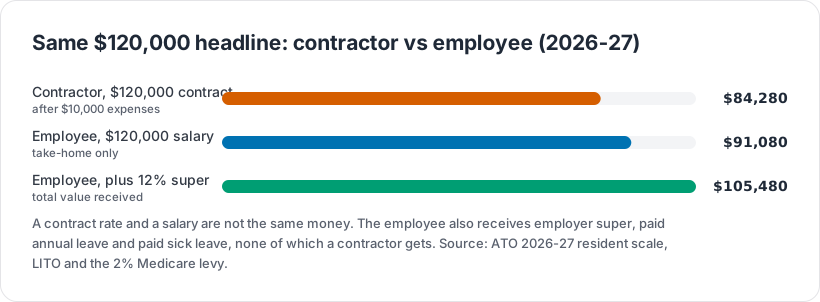
The profit then goes through the same 2026-27 resident scale used on the income tax calculator: income tax less the low income tax offset, plus the 2% Medicare levy, plus a HECS-HELP repayment if you have a study loan. What remains is net cash in hand. For a $75 hourly rate across 1,600 billable hours with $10,000 of expenses, that is $110,000 of profit and $84,280 of cash.
GST is absent from every line of that calculation, deliberately. If you are registered you charge 10% on top of your fee, collect it and remit it on your business activity statement. It is not income and it never reaches a take-home figure. The employee side of the comparison uses the same engine as the salary calculator and the gross to net calculator, with 12% employer super added on top.
What does a contract rate turn into after tax?
Hourly rates across 1,600 billable hours a year, with $10,000 of deductible business expenses, 2026-27 resident rates, no HECS-HELP.
| Hourly rate | Gross contract income | Taxable profit | Income tax | Medicare levy | Cash in hand |
|---|---|---|---|---|---|
| $60 | $96,000 | $86,000 | $16,320 | $1,720 | $67,960 |
| $75 | $120,000 | $110,000 | $23,520 | $2,200 | $84,280 |
| $90 | $144,000 | $134,000 | $30,720 | $2,680 | $100,600 |
| $110 | $176,000 | $166,000 | $42,490 | $3,320 | $120,190 |
| $130 | $208,000 | $198,000 | $54,970 | $3,960 | $139,070 |
| $150 | $240,000 | $230,000 | $69,370 | $4,600 | $156,030 |
Excludes GST, which is collected on top and remitted on the BAS. Excludes any super you choose to contribute for yourself, which a contractor funds out of this cash. Computed on the 2026-27 resident scale with the low income tax offset and the 2% Medicare levy. Source: Australian Taxation Office.
How do business expenses change your taxable profit?
The same $120,000 contract at five different expense levels.
Expenses reduce the income the tax scale sees, not your tax bill dollar for dollar. On a $120,000 contract, $10,000 of deductible expenses cuts taxable profit to $110,000 and cuts income tax and the Medicare levy by $3,200. You are still $6,800 worse off in cash than if the expense had never been necessary, because you paid the expense.
| Business expenses | Taxable profit | Income tax | Medicare levy | Cash in hand |
|---|---|---|---|---|
| $0 | $120,000 | $26,520 | $2,400 | $91,080 |
| $5,000 | $115,000 | $25,020 | $2,300 | $87,680 |
| $10,000 | $110,000 | $23,520 | $2,200 | $84,280 |
| $20,000 | $100,000 | $20,520 | $2,000 | $77,480 |
| $30,000 | $90,000 | $17,520 | $1,800 | $70,680 |
Gross contract income of $120,000 in every row, 2026-27 resident rates, no HECS-HELP, GST excluded. Whether a particular cost is deductible depends on how it is used in your business, and the personal services income rules restrict deductions where they apply. Source: Australian Taxation Office.
Is a $100,000 contract worth the same as a $100,000 salary?
No. The tax is identical. Everything around the tax is not.
Run both through the 2026-27 resident scale with no business expenses and the tax is the same to the dollar, $20,520 of income tax and $2,000 of Medicare levy, leaving $77,480. The gap opens after that. The employer must pay 12% of the salary into a super fund, which is $12,000 on $100,000, and the employee is paid for 4 weeks of annual leave and for the days they are too sick to work. A contract carries none of it.
| Headline number | Contractor cash in hand | Employee take-home | Employer super | Employee total value | Difference |
|---|---|---|---|---|---|
| $60,000 | $50,380 | $50,380 | $7,200 | $57,580 | $7,200 |
| $80,000 | $63,880 | $63,880 | $9,600 | $73,480 | $9,600 |
| $100,000 | $77,480 | $77,480 | $12,000 | $89,480 | $12,000 |
| $120,000 | $91,080 | $91,080 | $14,400 | $105,480 | $14,400 |
| $150,000 | $110,430 | $110,430 | $18,000 | $128,430 | $18,000 |
| $200,000 | $140,130 | $140,130 | $24,000 | $164,130 | $24,000 |
Contractor column assumes no deductible business expenses so the two sides start from the same taxable income. The difference column is employer super only, and does not price the 4 weeks of paid annual leave, the paid sick leave, notice or redundancy an employee also holds. See the superannuation calculator for what 12% compounds into, and the leave calculator for what accrued leave is worth. Computed on the 2026-27 resident scale.
What contract rate matches an employee salary?
The contract income you need before you are even level with the salary, super included.
Take the employee total value from the table above and ask what contract income produces the same cash. On $100,000 that total value is $89,480, and a sole trader needs about $117,700 of contract income with no business expenses to reach it. That is $73.56 an hour across 1,600 billable hours.
| Employee salary | Employee total value | Contract income to match | Hourly rate at 1,600 hours | Uplift on the salary |
|---|---|---|---|---|
| $60,000 | $57,580 | $70,800 | $44.25 | 18% |
| $80,000 | $73,480 | $94,200 | $58.88 | 17.8% |
| $100,000 | $89,480 | $117,700 | $73.56 | 17.7% |
| $120,000 | $105,480 | $141,900 | $88.69 | 18.3% |
| $150,000 | $128,430 | $179,600 | $112.25 | 19.7% |
Contract income solved in $100 steps on the 2026-27 resident scale until net cash reaches the employee total value. Assumes no business expenses, no GST, and that you bill all 1,600 hours. It buys parity with super only. Weeks between contracts, unpaid sick days and your own annual leave still have to come out of the same money, so the rate you actually need is higher. Compare employment types side by side in the employment type calculator.
Does a hirer have to pay super to a contractor with an ABN?
Often yes. An ABN does not remove the superannuation guarantee.
The ATO puts it in one sentence: “If you pay independent contractors mainly for their labour, they are employees for superannuation guarantee (SG) purposes.” The same page adds the part that surprises people: “It doesn’t matter if the independent contractor has an Australian business number (ABN).” Holding an ABN, invoicing, and calling the arrangement a contract change nothing about this test.
Three limbs have to be met, and all three, not one of them.
| Limb | What it means | Amanda, freelance admin assistant | Pete’s Paints |
|---|---|---|---|
| Mainly for labour | More than half the dollar value of the contract is for labour | Yes, the contract is 15 hours a week of her time | No, the contract covers materials and a finished job |
| Personal labour and skills | Payment is not dependent on achieving a specified result | Yes, she is paid for hours worked and invoices weekly | No, the payment is for a result, a painted shop |
| Must perform the work personally | The work cannot be delegated to someone else | Yes, she does the work herself | Not the deciding factor, the contract is for a result |
| Superannuation guarantee owed by the hirer | All three limbs met | Yes, SG is payable on top of her pay | No SG obligation |
Both worked examples are the ATO’s own, condensed. Source: ATO, Super for independent contractors, updated 29 April 2026 (QC33854).
Where it is payable, the hirer pays the superannuation guarantee percentage, 12% since 1 July 2025, on the labour component of the contract. Payments for materials and equipment are excluded, so are overtime paid at overtime rates, and so is GST. If the contract is with a company, trust or partnership rather than with you as an individual, the hirer does not pay super for the person doing the work.
One more point the ATO makes plainly, and one that costs hirers money at audit: paying the contractor an extra amount equal to the SG rate does not count as a super contribution. Adding 12% to an invoice and calling it super is not super. It has to be paid into a super fund each quarter. The mechanics of the guarantee are set out in the superannuation guarantee explained guide.
If you are a labour-only contractor and nothing has ever arrived in your fund, that is worth raising, and it is a question for the ATO or a registered tax agent rather than a calculator. This tool does not decide whether the three limbs are met in your arrangement, and it cannot.
When do you have to register for GST?
At $75,000 of GST turnover, within 21 days, and immediately for ride-sourcing.
| Trigger | Threshold | What you must do |
|---|---|---|
| GST turnover reaches the threshold | $75,000 | Register within 21 days of exceeding it |
| New business expecting to reach it in year one | $75,000 | Register from the start |
| Taxi, limousine or ride-sourcing travel | No threshold | Register regardless of turnover |
| Claiming fuel tax credits | No threshold | Register regardless of turnover |
| Non-profit organisation | $150,000 | Register within 21 days of exceeding it |
| Below the threshold | Optional | Voluntary registration generally holds for 12 months |
GST turnover is gross income from all your businesses, minus GST. Source: ATO, Registering for GST (QC22412).
Two turnover tests can put you over. Current GST turnover is this month plus the previous 11. Projected GST turnover is this month plus the next 11. Either one reaching $75,000 triggers the obligation, which is why a contractor who signs a large contract in September can be required to register before the money has actually landed.
The same exclusion applies on the super side. When a hirer works out the labour component of a contract for superannuation guarantee purposes, GST is left out of the calculation.
Is your contract income personal services income?
If more than 50% of the contract is for your skills, labour or expertise, yes.
Personal services income is income produced mainly from your personal efforts or skills. The ATO’s test is a share of the contract: if more than 50% of the income from a contract is for your skills, labour or expertise, that income is PSI. A software developer billing for their own time is producing PSI. A business selling a product, or supplying and installing equipment where the goods dominate the price, generally is not.
What follows matters more than the label. Where the PSI rules apply and you do not pass the personal services business tests, deductions are restricted and the income is attributed to you as an individual. It cannot be split through a company or trust to a lower-taxed associate. That is the single most common reason a plan to contract through a company and save tax does not work, and it is usually discovered after the structure has been set up and paid for.
This is the point where a calculator should stop. The PSI rules, the results test, the 80% rule, the unrelated clients, employment and business premises tests, and the choice between sole trader, company, partnership and trust are genuinely complex, interact with each other, and turn on the facts of your specific contracts. A registered tax agent is worth the money here, and the fee is deductible. Nothing on this page decides your PSI position.
How do you pay tax without an employer withholding it?
Through PAYG instalments, generally quarterly, not on payday.
An employee never sees the tax on their salary because the employer withholds it from every pay and sends it to the ATO. A contractor invoices the full amount and receives the full amount. Nothing has been withheld, and the tax is still owed.
The ATO closes that gap with PAYG instalments. Once your business income brings you into the system you receive instalment notices, usually quarterly, and each instalment is credited against your final assessment when you lodge. An instalment is an estimate of the year’s tax paid in advance, not the tax itself. If the instalments overshoot, the difference comes back at assessment, which is the same withheld-versus-owed distinction covered in the tax refund calculator.
The part that catches new contractors is the timing. You enter the system after the ATO has seen business income in a lodged return, so the first year of contracting can run its whole course with no instalment notices and no tax set aside. The bill then arrives for a full year at once, often alongside the first instalment for the next one. Setting aside your own share of every invoice from the first week is the practical fix, and the cash in hand figure at the top of this page is what is left after that share is gone.
Contractors in the building and construction industry are also reported to the ATO by the businesses that pay them, through the taxable payments annual report, so the income is visible whether or not it is declared.
What do you give up when you go from employee to contractor?
Straight from the ATO’s own list of what changes when you work for yourself.
| Obligation or entitlement | Employee | Independent contractor |
|---|---|---|
| Income tax | Withheld by the employer each payday | Paid yourself, generally through PAYG instalments |
| Superannuation | 12% paid by the employer on top of salary | Generally funded yourself, unless the labour-only SG rule applies |
| Paid annual leave | 4 weeks a year under the National Employment Standards | None |
| Paid sick and carer’s leave | Yes | None, not entitled to paid leave if you get sick or injured |
| Redundancy pay and notice | Yes, subject to service and exemptions | None, the contract ends when it ends |
| Damage caused at work | Generally the employer’s risk | You may have to pay the cost of fixing anything you damage |
| Accidents on someone else’s property | Generally the employer’s risk | You may have to pay costs incurred by someone else |
| ABN and business structure | Not required | Required, plus other registrations such as GST |
| Personal services income rules | Not applicable | You need to know whether your income falls under them |
| Industry reporting | Single Touch Payroll by the employer | Taxable payments annual report in building and construction |
Contractor column follows the ATO’s list in Working as an independent contractor (QC43442, updated 5 June 2026). Employee entitlements are the National Employment Standards minimums; awards and agreements can be more generous.
The leave items are the ones a rate has to fund. Four weeks of annual leave is 4 of the 52 weeks you could have billed, and a fortnight off sick is another two. A contract rate set to match a salary hour for hour quietly assumes you never take either.
Who uses this contractor pay calculator?
Four situations where the same headline number means two different things.
The employee handed a contract offer
Same work, higher headline number, ABN instead of a payslip. The comparison table shows the 12% of employer super that disappears, and the matching table shows what the rate would need to be before the move is even neutral.
The new sole trader setting a rate
Quoting an hourly rate without knowing the annual profit behind it is how contractors end up underpricing. Enter the rate and your realistic billable hours to see the cash, then add the weeks you will not bill.
The labour-only contractor owed super
If you are paid mainly for your own labour, cannot delegate the work and are not paid for a result, the hirer may owe the superannuation guarantee despite your ABN. The three limbs are set out above with the ATO’s own examples.
The contractor approaching $75,000
The GST registration obligation lands at $75,000 of turnover, current or projected, with 21 days to act. The registration changes what you invoice, and changes nothing about what you earn.
What changed on 1 July 2026?
Three changes reach contract income this year.
The first resident marginal rate fell from 16% to 15% for 2026-27. That applies to taxable profit exactly as it applies to a salary, so a contractor with profit above $18,200 keeps slightly more of the band up to $45,000 than last year.
Payday Super started on 1 July 2026. Where a hirer is already required to pay super for a contractor under the labour-only rule, that obligation continues and the timing moves to payday rather than quarterly. Source: ATO, Contractors, when to pay super under Payday Super.
The superannuation guarantee rate itself is unchanged at 12%, where it has been since 1 July 2025. For a contractor funding their own retirement, that is the benchmark the employee side of the comparison uses, and the number worth testing in the superannuation calculator.
What are the common contractor pay mistakes?
Four errors account for most of the bad numbers.
Counting GST as income
A $110 invoice is $100 of income and $10 held for the ATO. Treating the full invoice as earnings inflates your income by 10% and produces a BAS you cannot pay. This calculator excludes GST from every line.
Assuming an ABN means no super is owed
The ATO states the opposite: a contractor paid mainly for their labour is an employee for superannuation guarantee purposes, and it does not matter that they hold an ABN. Paying an extra 12% to the contractor instead of to a fund does not discharge the obligation.
Forgetting the rate has to fund leave and downtime
There is no paid annual leave, no paid sick leave and no pay between contracts. A rate that matches a salary hour for hour assumes 52 billable weeks and perfect health.
Assuming a company structure splits the income
Where the personal services income rules apply and the personal services business tests are not passed, deductions are restricted and the income is attributed back to you as an individual. The structure does not move it.
Contractor Pay FAQ
Common questions about ABN contract income, super and GST.
Sources
The documents behind every non-computed figure on this page.
- ATO, Working as an independent contractor (QC43442), last updated 5 June 2026: ABN and structure requirements, paying your own tax and super, no entitlement to paid leave, liability for damage and for accidents on another party’s property, and taxable payments annual reporting in building and construction.
- ATO, Super for independent contractors (QC33854), last updated 29 April 2026: the labour-only superannuation guarantee rule, the three limbs, the Amanda and Pete’s Paints examples, the exclusion of materials, overtime rates and GST from the labour component, and the rule that paying an amount equal to the SG rate to the contractor is not a super contribution.
- ATO, Work out if you have to pay super: the surrounding superannuation guarantee guidance for hirers.
- ATO, Registering for GST (QC22412): the $75,000 threshold, the $150,000 non-profit threshold, the 21-day registration rule, the taxi, limousine and ride-sourcing exception, fuel tax credits, and the current and projected turnover tests.
- ATO, Employee or contractor, tax and super obligations compared: the obligation-by-obligation comparison used in the trade-offs table.
- ATO, Personal services income: the more-than-50% test, the restriction on deductions and the attribution of PSI to the individual where the PSB tests are not passed.
- ATO, Contractors, when to pay super under Payday Super: the continuation of existing contractor super obligations from 1 July 2026.
- ATO individual income tax rates for 2026-27, the low income tax offset, the 2% Medicare levy, the HECS-HELP repayment scale and the 12% superannuation guarantee rate, as implemented in this site’s tax engine and used for every computed figure above.
All ATO pages accessed 26 July 2026. Last verified 26 July 2026.
Price Your Contract Rate Properly
Free, instant, 2026-27 ATO rates, GST kept out of the income.
Calculate My Contractor Pay