PAYG Withholding Tax Tables 2026-27
Weekly, fortnightly and monthly withholding amounts for the 2026-27 financial year, computed row by row from the ATO Schedule 1 formulas (NAT 1004, published 17 June 2026) rather than retyped from a PDF.
Compiled by Marcus Kelleher, Editor, pay and tax content. Every amount on this page is generated by the published Schedule 1 formulas and checked against the ATO withholding amounts sample data. Last verified 26 July 2026.
Which ATO Tax Table Applies to Your Pay Cycle?
One statement of formulas, five published tables, all reissued for 2026-27.
The ATO publishes one set of maths and several presentations of it. Schedule 1, the Statement of formulas for calculating amounts to be withheld (NAT 1004), holds the equations that payroll software implements. The pay-cycle tax tables are printed lookups derived from those same equations. All of the 2026-27 editions were published on 17 June 2026 and apply to payments made from 1 July 2026.
| Document | ATO number | What it gives you |
|---|---|---|
| Schedule 1, Statement of formulas | NAT 1004 | The coefficients and the y = ax - b formula behind every table below |
| Weekly tax table | NAT 1005 | Withholding for a weekly pay |
| Fortnightly tax table | NAT 1006 | Withholding for a fortnightly pay |
| Monthly tax table | NAT 1007 | Withholding for a monthly pay |
| Daily and casual workers tax table | NAT 1024 | Withholding for daily and casual pays |
Source: ATO, Schedule 1 (NAT 1004), published 17 June 2026; ATO, Tax tables overview.
If you want a single answer for your own pay rather than a lookup table, the PAYG withholding calculator estimates the amount per pay from your salary. This page is the reference behind it: the formulas, the coefficients and the computed amounts. For the plain-language version of what withholding is and why it exists, read what is PAYG withholding.
How Does the ATO Withholding Formula Work?
Every amount on this page is one line of arithmetic: y = ax - b.
The ATO expresses withholding as a linear equation for each band of weekly earnings. y is the weekly withholding amount in dollars. x is the number of whole dollars in the weekly earnings, plus 99 cents. a and b are the coefficients for the band that x falls in. The 99 cents is not decoration. It is what makes a whole-dollar band boundary behave like the top of a range rather than a single point.
Working out x is the step people get wrong. The ATO's own example starts with weekly income of $467.59 and an allowance subject to withholding of $9.50. Add them, ignore the cents, then add 99 cents.
| Step (ATO worked example) | Amount |
|---|---|
| Weekly income | $467.59 |
| Add allowance subject to withholding | $9.50 |
| Total earnings, cents ignored | $477.00 |
| Add 99 cents | $0.99 |
| Weekly earnings (x) | $477.99 |
Source: ATO, Working out the weekly earnings, published 17 June 2026.
Then the formula runs. Take weekly earnings of $1,000 under scale 2. The whole dollars plus 99 cents give x = $1,000.99, which falls in the band less than $1,282, so a = 0.3227 and b = 185.1935. Multiply 1000.99 by 0.3227, subtract 185.1935, and the result rounds to $138 withheld for the week.
The rounding rules that decide the last dollar
- Withholding is rounded to the nearest dollar, and values ending in 50 cents are rounded up.
- The rounding is done directly, not through a preliminary rounding to the nearest cent.
- Rounding applies across all scales except scale 4, where cents are ignored instead.
- The formulas work out withholding before any tax offsets and Medicare levy adjustments are applied.
Every band boundary is a strict test against x, not against the earnings. That is why weekly earnings of $537 and $538 sit in different bands under scale 2: x is $537.99 in the first case and $538.99 in the second. The ATO's published sample data deliberately includes pairs either side of every boundary, which is how the tables on this page were verified.
How Are Fortnightly, Monthly and Quarterly Pays Converted?
Every cycle is reduced to a weekly figure, run through the formula, then scaled back.
There is only one set of coefficients, and they are weekly. Any other pay cycle is converted to a weekly equivalent first, the weekly withholding is worked out and rounded, and only then is it scaled back to the pay cycle. The order matters. Rounding happens at the weekly step, which is why a monthly amount is rarely exactly 13/3 of a weekly one.
| Pay cycle | Work out the weekly equivalent | Then convert the withholding |
|---|---|---|
| Fortnightly | Divide fortnightly earnings plus allowances by 2. Ignore cents, add 99 cents. | Multiply the rounded weekly withholding by 2. |
| Monthly | Sum monthly earnings plus allowances. If the result ends in 33 cents, add one cent. Multiply by 3, divide by 13. Ignore cents, add 99 cents. | Multiply the rounded weekly withholding by 13, divide by 3, round to the nearest dollar. |
| Quarterly | Divide quarterly earnings plus allowances by 13. Ignore cents, add 99 cents. | Multiply the rounded weekly withholding by 13. |
| Bi-monthly | Sum the payments for the month, then use the monthly steps. | Divide the monthly withholding by 2. |
Source: ATO, Using a formula, published 17 June 2026.
The stray cent in the monthly rule is real. Monthly earnings of $1,603.33 become $1,603.34 before the conversion, because otherwise the division by 13 lands a fraction below the whole dollar and drops a dollar of withholding. On $3,000 a fortnight, scale 2 withholds $598. On $6,500 a month it is $1,296, and on $19,500 a quarter it is $3,887.
Weekly Tax Table 2026-27
Amount to be withheld from each weekly pay, by scale. Computed from NAT 1004.
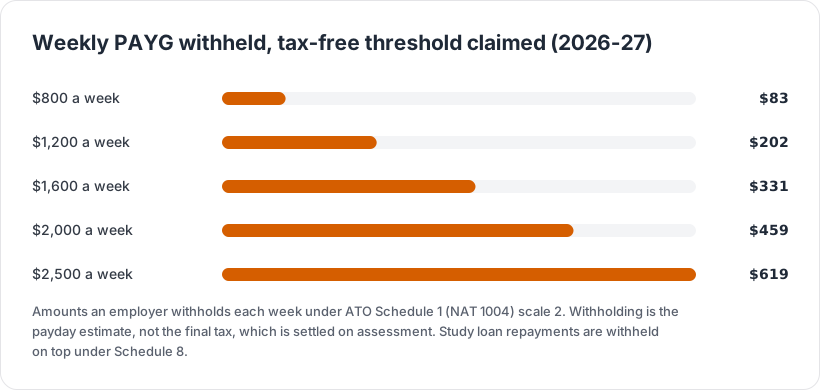
Find the row at or below your weekly earnings, then read across to the scale you declared. Scale 2 is the common case for an employee who claimed the tax-free threshold with this payer. Scale 1 applies where the threshold was not claimed, usually a second job. Scale 3 is for foreign residents.
| Weekly earnings | Scale 1 | Scale 2 | Scale 3 | Scale 5 | Scale 6 |
|---|---|---|---|---|---|
| $500 | $90 | $21 | $150 | $21 | $21 |
| $600 | $120 | $42 | $180 | $36 | $36 |
| $700 | $152 | $65 | $210 | $51 | $51 |
| $800 | $184 | $83 | $240 | $67 | $67 |
| $900 | $217 | $106 | $270 | $88 | $88 |
| $1,000 | $249 | $138 | $300 | $118 | $122 |
| $1,100 | $281 | $170 | $330 | $148 | $158 |
| $1,200 | $313 | $202 | $360 | $178 | $190 |
| $1,300 | $345 | $235 | $390 | $209 | $222 |
| $1,400 | $377 | $267 | $420 | $239 | $253 |
| $1,500 | $409 | $299 | $450 | $269 | $284 |
| $1,600 | $441 | $331 | $480 | $299 | $315 |
| $1,700 | $473 | $363 | $510 | $329 | $346 |
| $1,800 | $505 | $395 | $540 | $359 | $377 |
| $1,900 | $537 | $427 | $570 | $389 | $408 |
| $2,000 | $569 | $459 | $600 | $419 | $439 |
| $2,200 | $633 | $523 | $660 | $479 | $501 |
| $2,400 | $708 | $587 | $720 | $539 | $563 |
| $2,600 | $786 | $651 | $781 | $599 | $625 |
| $2,800 | $864 | $729 | $855 | $673 | $701 |
| $3,000 | $942 | $807 | $929 | $747 | $777 |
| $3,200 | $1,020 | $885 | $1,003 | $821 | $853 |
| $3,400 | $1,105 | $963 | $1,077 | $895 | $929 |
| $3,600 | $1,199 | $1,041 | $1,151 | $969 | $1,005 |
| $3,800 | $1,293 | $1,131 | $1,236 | $1,055 | $1,093 |
| $4,000 | $1,387 | $1,225 | $1,326 | $1,145 | $1,185 |
Computed with the ATO Schedule 1 (NAT 1004) coefficients published 17 June 2026, rounded to the nearest dollar with 50 cents rounding up. Excludes study and training support loan repayments and any tax offset claimed on a withholding declaration.
Fortnightly Tax Table 2026-27
Amount to be withheld from each fortnightly pay, by scale.
The fortnight is the default Australian pay cycle, and it is the cleanest conversion in the schedule: halve the earnings, ignore cents, add 99 cents, run the weekly formula, double the rounded result. Because the rounding happens once at the weekly step, a fortnightly amount is always an even number of dollars.
| Fortnightly earnings | Scale 1 | Scale 2 | Scale 3 | Scale 5 | Scale 6 |
|---|---|---|---|---|---|
| $1,000 | $180 | $42 | $300 | $42 | $42 |
| $1,200 | $240 | $84 | $360 | $72 | $72 |
| $1,400 | $304 | $130 | $420 | $102 | $102 |
| $1,600 | $368 | $166 | $480 | $134 | $134 |
| $1,800 | $434 | $212 | $540 | $176 | $176 |
| $2,000 | $498 | $276 | $600 | $236 | $244 |
| $2,200 | $562 | $340 | $660 | $296 | $316 |
| $2,400 | $626 | $404 | $720 | $356 | $380 |
| $2,600 | $690 | $470 | $780 | $418 | $444 |
| $2,800 | $754 | $534 | $840 | $478 | $506 |
| $3,000 | $818 | $598 | $900 | $538 | $568 |
| $3,200 | $882 | $662 | $960 | $598 | $630 |
| $3,400 | $946 | $726 | $1,020 | $658 | $692 |
| $3,600 | $1,010 | $790 | $1,080 | $718 | $754 |
| $3,800 | $1,074 | $854 | $1,140 | $778 | $816 |
| $4,000 | $1,138 | $918 | $1,200 | $838 | $878 |
| $4,400 | $1,266 | $1,046 | $1,320 | $958 | $1,002 |
| $4,800 | $1,416 | $1,174 | $1,440 | $1,078 | $1,126 |
| $5,200 | $1,572 | $1,302 | $1,562 | $1,198 | $1,250 |
| $5,600 | $1,728 | $1,458 | $1,710 | $1,346 | $1,402 |
| $6,000 | $1,884 | $1,614 | $1,858 | $1,494 | $1,554 |
| $6,400 | $2,040 | $1,770 | $2,006 | $1,642 | $1,706 |
| $6,800 | $2,210 | $1,926 | $2,154 | $1,790 | $1,858 |
| $7,200 | $2,398 | $2,082 | $2,302 | $1,938 | $2,010 |
| $7,600 | $2,586 | $2,262 | $2,472 | $2,110 | $2,186 |
| $8,000 | $2,774 | $2,450 | $2,652 | $2,290 | $2,370 |
Computed from ATO Schedule 1 (NAT 1004). For take-home pay rather than the withheld amount, see the fortnightly pay calculator.
Monthly Tax Table 2026-27
Amount to be withheld from each monthly pay, by scale.
Monthly withholding takes the longest route. The month is converted to a weekly figure by multiplying by 3 and dividing by 13, the weekly withholding is worked out and rounded, and that rounded amount is multiplied by 13 and divided by 3 before a final rounding. Two roundings in one calculation is why monthly amounts can look a dollar out from twelve times nothing in particular.
| Monthly earnings | Scale 1 | Scale 2 | Scale 3 | Scale 5 | Scale 6 |
|---|---|---|---|---|---|
| $2,000 | $360 | $65 | $598 | $65 | $65 |
| $2,400 | $455 | $130 | $719 | $126 | $126 |
| $2,800 | $585 | $234 | $841 | $186 | $186 |
| $3,200 | $711 | $308 | $958 | $247 | $247 |
| $3,600 | $841 | $381 | $1,079 | $308 | $308 |
| $4,000 | $971 | $490 | $1,200 | $407 | $412 |
| $4,400 | $1,096 | $620 | $1,317 | $529 | $555 |
| $4,800 | $1,226 | $745 | $1,439 | $650 | $693 |
| $5,200 | $1,356 | $875 | $1,560 | $771 | $823 |
| $5,600 | $1,482 | $1,005 | $1,681 | $893 | $949 |
| $6,000 | $1,612 | $1,131 | $1,798 | $1,014 | $1,075 |
| $6,400 | $1,738 | $1,261 | $1,920 | $1,131 | $1,196 |
| $6,800 | $1,868 | $1,391 | $2,041 | $1,252 | $1,322 |
| $7,200 | $1,993 | $1,517 | $2,158 | $1,374 | $1,443 |
| $7,600 | $2,123 | $1,647 | $2,279 | $1,491 | $1,569 |
| $8,000 | $2,249 | $1,772 | $2,401 | $1,612 | $1,694 |
| $8,800 | $2,505 | $2,028 | $2,639 | $1,855 | $1,941 |
| $9,600 | $2,760 | $2,284 | $2,877 | $2,093 | $2,188 |
| $10,400 | $3,068 | $2,544 | $3,120 | $2,336 | $2,440 |
| $11,200 | $3,376 | $2,795 | $3,358 | $2,574 | $2,687 |
| $12,000 | $3,688 | $3,107 | $3,653 | $2,864 | $2,986 |
| $12,800 | $4,000 | $3,419 | $3,948 | $3,163 | $3,289 |
| $13,600 | $4,312 | $3,731 | $4,247 | $3,458 | $3,592 |
| $14,400 | $4,632 | $4,043 | $4,541 | $3,753 | $3,900 |
| $15,200 | $5,009 | $4,355 | $4,836 | $4,047 | $4,203 |
| $16,000 | $5,386 | $4,680 | $5,148 | $4,359 | $4,520 |
Computed from ATO Schedule 1 (NAT 1004), including the rule that monthly earnings ending in 33 cents have one cent added before the conversion.
What Are the Schedule 1 Coefficients for 2026-27?
The a and b values for every scale, as published in NAT 1004 on 17 June 2026.
These are the numbers the tables above are built from. Each row is a band of weekly earnings x, tested as a strict less-than. Scales 1, 2, 3, 5 and 6 may be applied only if the payee has provided their tax file number. Scales 1 and 2 apply whether or not the payee is entitled to leave loading.
Scale 1: tax-free threshold not claimed
| Weekly earnings (x) | Coefficient a | Coefficient b |
|---|---|---|
| Less than $188 | 0.1500 | 0.1500 |
| Less than $371 | 0.2084 | 11.0185 |
| Less than $515 | 0.1790 | 0.1066 |
| Less than $932 | 0.3227 | 74.1674 |
| Less than $2,246 | 0.3200 | 71.6508 |
| Less than $3,303 | 0.3900 | 228.8816 |
| $3,303 and over | 0.4700 | 493.1893 |
Scale 2: tax-free threshold claimed
| Weekly earnings (x) | Coefficient a | Coefficient b |
|---|---|---|
| Less than $362 | nil | nil |
| Less than $538 | 0.1500 | 54.3462 |
| Less than $673 | 0.2500 | 108.2135 |
| Less than $721 | 0.1700 | 54.3473 |
| Less than $865 | 0.1790 | 60.8377 |
| Less than $1,282 | 0.3227 | 185.1935 |
| Less than $2,596 | 0.3200 | 181.7319 |
| Less than $3,653 | 0.3900 | 363.4627 |
| $3,653 and over | 0.4700 | 655.7704 |
Scale 3: foreign residents
| Weekly earnings (x) | Coefficient a | Coefficient b |
|---|---|---|
| Less than $2,596 | 0.3000 | 0.3000 |
| Less than $3,653 | 0.3700 | 181.7308 |
| $3,653 and over | 0.4500 | 474.0385 |
Scale 5: full Medicare levy exemption
| Weekly earnings (x) | Coefficient a | Coefficient b |
|---|---|---|
| Less than $362 | nil | nil |
| Less than $721 | 0.1500 | 54.3462 |
| Less than $865 | 0.1590 | 60.8365 |
| Less than $1,282 | 0.3027 | 185.1923 |
| Less than $2,596 | 0.3000 | 181.7308 |
| Less than $3,653 | 0.3700 | 363.4615 |
| $3,653 and over | 0.4500 | 655.7692 |
Scale 6: half Medicare levy exemption
| Weekly earnings (x) | Coefficient a | Coefficient b |
|---|---|---|
| Less than $362 | nil | nil |
| Less than $721 | 0.1500 | 54.3462 |
| Less than $865 | 0.1590 | 60.8365 |
| Less than $908 | 0.3027 | 185.1923 |
| Less than $1,135 | 0.3527 | 230.6135 |
| Less than $1,282 | 0.3127 | 185.1923 |
| Less than $2,596 | 0.3100 | 181.7308 |
| Less than $3,653 | 0.3800 | 363.4615 |
| $3,653 and over | 0.4600 | 655.7692 |
Scale 4: no tax file number provided
Scale 4 has no coefficients. A flat rate is applied to the earnings, with cents ignored in the earnings and in the withholding amount, so there is no rounding step at all.
| Payee | Rate | Withheld on $1,500 weekly earnings |
|---|---|---|
| Resident, $1 and over | 47% | $705 |
| Foreign resident, $1 and over | 45% | $675 |
Source: ATO, Coefficients to use in formulas for withholding from weekly payments, published 17 June 2026.
How the Medicare levy sits inside the scales
Scales 1, 2, 4 and 6 incorporate the Medicare levy, and scale 4 incorporates it for resident payees only. Scale 5 is for a payee who has claimed a full Medicare levy exemption and scale 6 for a half exemption. Under scale 2, no Medicare levy is payable where taxable income is $28,011 ($538 per week) or less. Between $28,011 and $35,013 ($673 per week) the levy shades in at 10% of the excess over $28,011. At $35,013 ($673 per week) or more the levy is 2% of total taxable income. That shade-in is what produces the unusual 0.2500 coefficient in the scale 2 band under $673. If you want the annual version of the same calculation, use the Medicare levy calculator.
| Medicare levy parameter | Scale 2 | Scale 6 |
|---|---|---|
| Weekly earnings threshold | 538 | 908 |
| Weekly earnings shade-in threshold | 673 | 1,135 |
| Medicare levy family threshold | 47,238 | 47,238 |
| Weekly family threshold divisor | 52 | 52 |
| Additional child | 4,338 | 4,338 |
| Shading out point multiplier | 0.1000 | 0.0500 |
| Shading out point divisor | 0.0800 | 0.0400 |
| Weekly levy adjustment factor | 538.6700 | 908.4200 |
| Medicare levy | 0.0200 | 0.0100 |
Source: ATO Schedule 1 (NAT 1004), Medicare levy parameters, published 17 June 2026.
How Do Declared Tax Offsets Reduce the Withholding?
A fixed percentage of the offsets claimed, and only on scales 2, 5 and 6.
If a payee claims tax offsets on a Withholding declaration, the calculated withholding is reduced by a set percentage of the total offsets claimed, rounded to the nearest dollar. Tax offsets may be allowed only where scale 2, 5 or 6 is applied. There is no offset reduction on scale 1, scale 3 or scale 4.
| Pay cycle | Reduction | Applies to |
|---|---|---|
| Weekly | 1.9% | Scales 2, 5 and 6 |
| Fortnightly | 3.8% | Scales 2, 5 and 6 |
| Monthly | 8.3% | Scales 2, 5 and 6 |
| Quarterly | 25% | Scales 2, 5 and 6 |
Each reduction is a percentage of the total offsets claimed, rounded to the nearest dollar. Source: ATO Schedule 1 (NAT 1004), tax offsets, published 17 June 2026.
What Happens in a Year With 53 Weekly or 27 Fortnightly Pays?
The schedule is built on 52 weekly and 26 fortnightly pays. An extra pay leaves a shortfall.
Some financial years contain 53 weekly pay days or 27 fortnightly ones, depending on where the pay dates fall. The withholding amounts are calculated as if there were 52 or 26, so an extra pay period can leave too little withheld and a shortfall at assessment time. The ATO says payers should tell payees when this happens, and the payee may ask for extra withholding each period.
53 weekly pays
| Weekly earnings | Additional withholding per week |
|---|---|
| $875 to $2,574 | $3 |
| $2,575 to $3,649 | $7 |
| $3,650 and over | $12 |
27 fortnightly pays
| Fortnightly earnings | Additional withholding per fortnight |
|---|---|
| $1,700 to $5,199 | $12 |
| $5,200 to $7,249 | $27 |
| $7,250 and over | $48 |
Source: ATO Schedule 1 (NAT 1004), 53 pays in a financial year, published 17 June 2026.
What Do These Tax Tables Not Include?
Schedule 1 covers income tax and the Medicare levy. Several things sit outside it.
The single most common reason a payslip shows more tax than the tables above is a study loan. Study and training support loan (STSL) repayments, which cover HECS-HELP and the other study and training loans, are not in Schedule 1 at all. They sit in Schedule 8 (NAT 3539) and are withheld on top of the scale amount whenever a payee has flagged a loan on their tax file number declaration. To see the repayment amount your income triggers, use the HECS-HELP repayment calculator.
Study loan repayments
STSL amounts are worked out under Schedule 8 (NAT 3539) and added to the scale amount. Nothing in the tables above includes them.
Tax offsets and levy adjustments
The formulas work out withholding before any tax offsets and Medicare levy adjustments are applied. Offsets claimed on a withholding declaration reduce the result afterwards, on scales 2, 5 and 6 only.
Bonuses and back payments
A payment covering more than one pay period is withheld under ATO Schedule 5, not Schedule 1. The bonus tax calculator works through that method.
Your deductions
Withholding runs on gross earnings. Deductions are claimed on your return, which is one reason the amount withheld and the tax you owe are different numbers. See why net pay differs from gross.
Is the Amount in These Tables the Tax You Actually Owe?
No. Withholding is the payday estimate. The final figure is settled on assessment.
A tax table answers one narrow question: how much should this payer hold back from this pay. It knows the earnings in front of it and the scale you declared, and nothing else. It cannot see your other jobs, your deductions, your offsets or the months you worked part of. Your actual tax for 2026-27 is worked out once, on your whole-year taxable income, when your return is assessed.
| Amount withheld (these tables) | Tax owed (assessment) | |
|---|---|---|
| Worked out | Every pay day, by your payer | Once a year, by the ATO, after you lodge |
| Based on | One pay, converted to a weekly figure | Taxable income for the full financial year |
| Sees your deductions | No | Yes |
| Sees your other income | No | Yes |
| Applies tax offsets | Only those claimed on a withholding declaration, on scales 2, 5 and 6 | All offsets you are entitled to |
| Result | A credit that builds through the year | A refund if the credit is larger, a bill if it is smaller |
Nothing about that gap is an error. The schedules are built to be a reasonable estimate across the whole working population, and the return is where your own numbers are settled. To see which side of the line you land on, run the tax refund calculator. To see your annual liability rather than a per-pay estimate, use the income tax calculator, and for the line-by-line reading of a payslip, see how to read a payslip.
Why Do the Formula and the Printed Tax Table Sometimes Disagree?
Above $3,400 weekly the two accepted methods can differ by a small amount.
The ATO states it plainly: withholding amounts calculated using these formulas may vary slightly from those calculated using the method set out in the footnote to the appropriate PAYG withholding tax table, and this applies if earnings exceed $3,400 weekly or $6,800 fortnightly. Withholding calculated using either method is accepted.
So a payroll system running the Schedule 1 formulas and a payroll officer reading NAT 1005 can produce figures a dollar or two apart on high earnings, and both are correct. The tables on this page use the formula method throughout, which is what payroll software does. On $2,000 a week, scale 2 withholds $459 and scale 3 withholds $600, a difference that comes from the foreign resident scale having no tax-free threshold and no Medicare levy rather than from any rounding.
Common Mistakes When Reading a Tax Table
Four errors that account for most of the mismatches people report to payroll.
Using last year's edition
The 2026-27 tables apply to payments made from 1 July 2026 and carry the 15% first marginal rate. A 2025-26 table used after 1 July 2026 will over-withhold.
Rounding the earnings first
Cents in the earnings are ignored, then 99 cents is added. Rounding $537.60 up to $538 before that step moves you into the next band and changes the answer.
Reading a scale you did not declare
Scale 2 requires the tax-free threshold to have been claimed with that payer. A second job is normally scale 1, and claiming the threshold twice is the most common cause of a tax bill.
Expecting the payslip to match to the dollar
Allowances subject to withholding are added to earnings before the formula runs, study loan amounts are added after, and rounding moves the last dollar. A few dollars either way is normal.
Who Uses These Tax Tables?
The same numbers answer three quite different questions.
Payroll officers
Checking that a payroll system is producing the 2026-27 amounts, and reconciling a query against the published coefficients rather than against a competitor's calculator.
Employees checking a payslip
Comparing the tax line on a payslip against the row for your earnings and scale, to work out whether the difference is a study loan, an allowance or an error.
Small employers without software
Working out what to withhold from a weekly, fortnightly or monthly pay, including the extra amounts in a year with 53 weekly or 27 fortnightly pays.
PAYG Withholding Tax Table FAQ
Common questions about the 2026-27 weekly, fortnightly and monthly tables.
Sources for This Page
- ATO, Schedule 1: Statement of formulas for calculating amounts to be withheld (NAT 1004), published 17 June 2026.
- ATO, Coefficients to use in formulas for withholding from weekly payments, published 17 June 2026.
- ATO, Using a formula, published 17 June 2026.
- ATO, Working out the weekly earnings, published 17 June 2026.
- ATO, Withholding amounts sample data, published 17 June 2026.
- ATO, Tax tables overview (weekly NAT 1005, fortnightly NAT 1006, monthly NAT 1007, daily and casual NAT 1024).
- ATO, Schedule 8: Statement of formulas for calculating study and training support loan components (NAT 3539), named here only to mark what these tables exclude.
All amounts in the computed tables are generated from the NAT 1004 coefficients above and checked row by row against the ATO withholding amounts sample data, including the pairs either side of every band boundary. The 2026-27 coefficients reflect the 15% first marginal rate under the Treasury Laws Amendment (More Cost of Living Relief) Act 2025, the updated Medicare levy low-income thresholds and the indexed study loan thresholds.
Last verified 26 July 2026.
Check the Withholding on Your Own Pay
Free, instant, and built on the 2026-27 ATO schedules.
Open the PAYG withholding calculator