If you start a job part way through the financial year, too much tax comes out of every pay, and nothing is wrong. Australian PAYG withholding annualises each pay period: it works out the tax as though the pay in front of it repeats for a full twelve months, then withholds a matching slice. Your employer has no way of knowing you were not working in August. Start on 1 March on a $90,000 salary and about $6,440 is withheld across those four months against an actual 2026-27 tax bill of roughly $1,269. The difference, about $5,171, comes back when you lodge.
Key takeaways
- Withholding assumes this pay period repeats all year. Part-year work breaks that assumption.
- A $90,000 salary starting 1 March has roughly $5,171 more withheld than is owed for 2026-27.
- The money is not lost. It comes back as a refund when you lodge your return.
- The tax-free threshold is annual, not monthly, and is not cut because you worked part of the year.
- The ATO withholding variation process can reduce it during the year, but late in the year there is little left to vary.
Why does a new job take so much tax?
Because the ATO withholding tables are built for one situation, and yours is not it. The tables are designed for a person on steady pay across a full financial year, and they hit that case closely. Everything else, part years, bonuses, overtime, second jobs, is approximated.
The approximation is deliberately cautious. Withholding too little produces a tax bill someone has to find the money for. Withholding slightly too much produces a refund. The system is built to err in the second direction, which is why so many Australians get money back rather than owe it. For a part-year worker that caution becomes very visible, because the gap is not slight.
How does PAYG annualisation actually work?
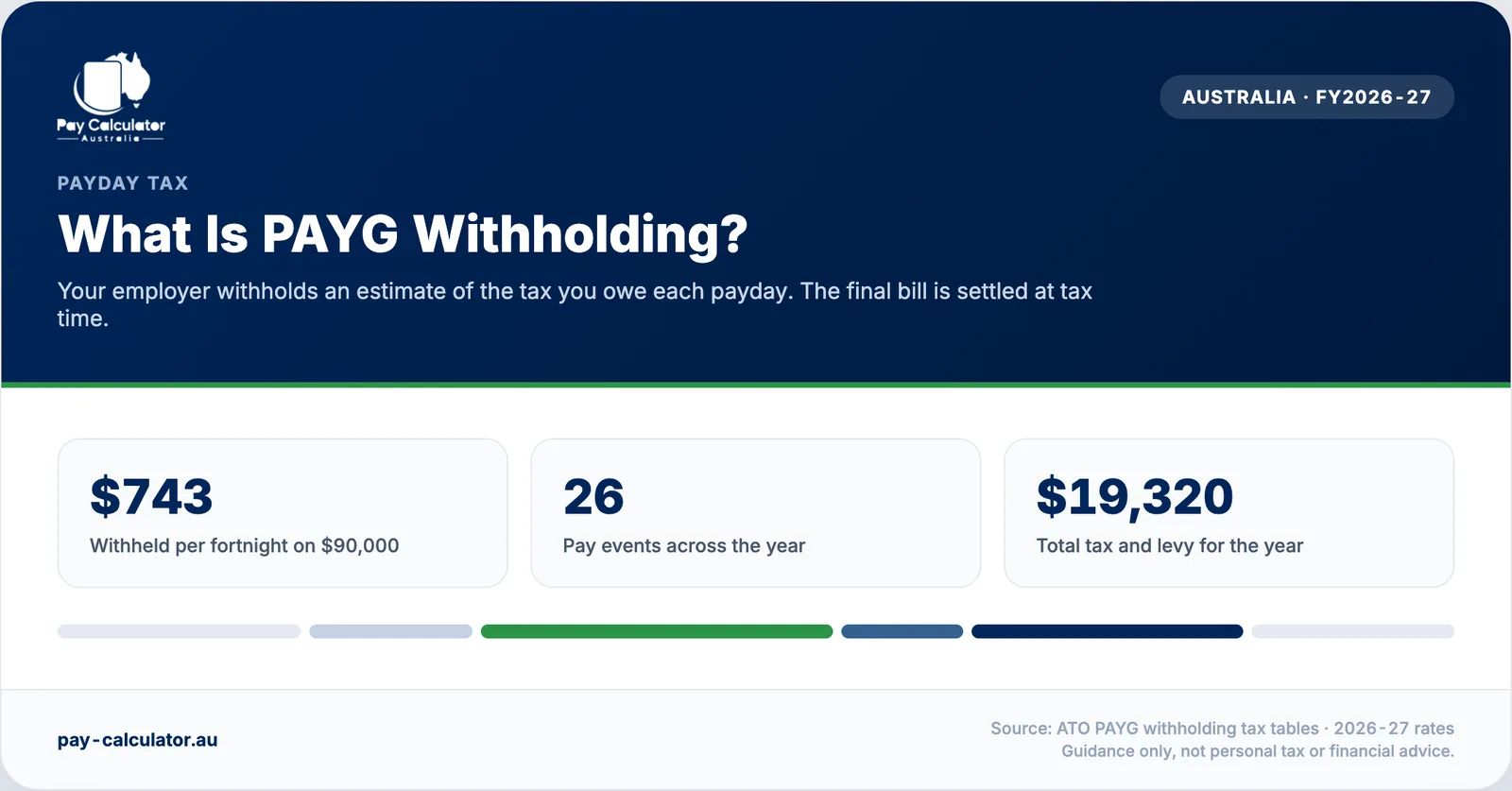
In four steps, repeated every payday. Your employer takes the gross for the period, multiplies it out to a full year, works out the annual tax on that figure, then divides that annual tax back down to the period. Nothing in that sequence looks at how many periods you have actually worked.
| Step | On a $90,000 salary paid monthly |
|---|---|
| Gross for the period | $7,500 |
| Annualised | $90,000, because 12 of those periods is a year |
| Annual tax on that figure | $19,320, income tax plus the 2% Medicare levy |
| Withheld this period | $1,610, one twelfth of it |
Computed from the 2026-27 resident scale in the pay-calculator.au engine, including the Low Income Tax Offset and the 2% Medicare levy. A real employer applies the rounded per-period coefficients in Schedule 1 (NAT 1004) rather than dividing an annual figure by 12, so a real payslip lands a few dollars either side of this.
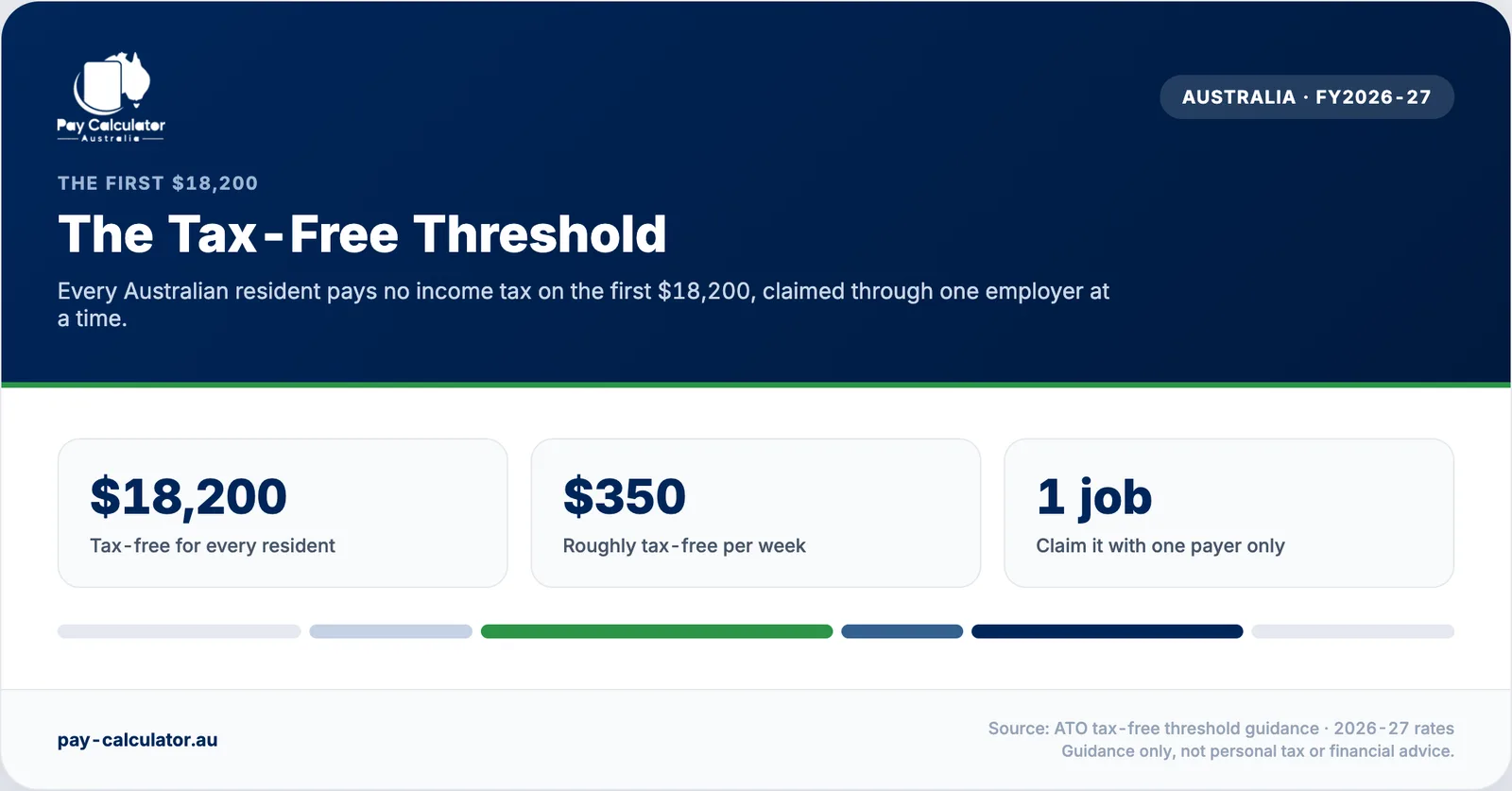
The tax-free threshold is inside that arithmetic, and it is the part that quietly does the damage. Annualising means each pay gets one twelfth of the $18,200 applied to it. Work four months and only four twelfths of the threshold has been used through withholding, but at assessment you get all of it, because $18,200 is an annual allowance and it does not shrink for a short year. That single difference accounts for most of the refund. The full mechanism is set out in the guide to PAYG withholding.
What does it cost if you start in March?
Take a graduate starting on 1 March 2026-27 on $90,000, paid monthly, an Australian resident claiming the tax-free threshold, with no study loan. They work four months of the financial year, March through June.
| Item | Amount (2026-27) | Why |
|---|---|---|
| Gross earned in the year | $30,000 | Four months of $7,500 |
| Withheld across those four pays | $6,440 | Four times $1,610, the rate for a full-year $90,000 earner |
| Tax actually owed on $30,000 | $1,269 | The 2026-27 scale on $30,000, after the Low Income Tax Offset, plus the Medicare levy |
| Over-withheld, and refundable | $5,171 | The difference, credited when the return is lodged |
The mechanism is visible in a single comparison. Withholding treated this person as a $90,000 earner, whose tax rate reaches into the 30% bracket. The assessment treats them as a $30,000 earner, most of whose income falls in the tax-free threshold and the 15% band, and who qualifies for the full Low Income Tax Offset. Same person, same payslips, two completely different pictures of the year.
How much comes back if you start in each month?
The table below holds the salary at $90,000 and moves the start date, showing what 2026-27 looks like for every possible starting month. Every figure is computed from the same engine that powers the calculators on this site.
| Start date | Months worked | Gross earned | Withheld | Tax actually owed | Refundable |
|---|---|---|---|---|---|
| 1 July | 12 | $90,000 | $19,320 | $19,320 | $0 |
| 1 August | 11 | $82,500 | $17,710 | $16,920 | $790 |
| 1 September | 10 | $75,000 | $16,100 | $14,520 | $1,580 |
| 1 October | 9 | $67,500 | $14,490 | $12,120 | $2,370 |
| 1 November | 8 | $60,000 | $12,880 | $9,620 | $3,260 |
| 1 December | 7 | $52,500 | $11,270 | $7,108 | $4,163 |
| 1 January | 6 | $45,000 | $9,660 | $4,595 | $5,065 |
| 1 February | 5 | $37,500 | $8,050 | $2,945 | $5,105 |
| 1 March | 4 | $30,000 | $6,440 | $1,269 | $5,171 |
| 1 April | 3 | $22,500 | $4,830 | $0 | $4,830 |
| 1 May | 2 | $15,000 | $3,220 | $0 | $3,220 |
| 1 June | 1 | $7,500 | $1,610 | $0 | $1,610 |
$90,000 salary, paid monthly, Australian resident claiming the tax-free threshold, no study loan, no deductions, no other income. Assumes whole months and no work at all in the rest of the year. Computed from the 2026-27 resident scale, the Low Income Tax Offset and the 2% Medicare levy.
The 1 July row is the control: work the whole year and the two columns match, because the assumption behind the tables is finally true. Everything above it is the assumption failing by degrees. The peak is a start on 1 March, worth about $5,171, and it sits in the middle rather than at the end for a reason. Start earlier and more of the tax is genuinely owed. Start later and there are fewer pays to over-withhold from.
Does the salary change the picture?
It changes the size, not the shape. The table below holds the start date at 1 March, four months of the year, and moves the salary instead.
| Annual salary | Gross earned in four months | Withheld | Tax actually owed | Refundable |
|---|---|---|---|---|
| $60,000 | $20,000 | $3,207 | $0 | $3,207 |
| $75,000 | $25,000 | $4,840 | $320 | $4,520 |
| $90,000 | $30,000 | $6,440 | $1,269 | $5,171 |
| $120,000 | $40,000 | $9,640 | $3,495 | $6,145 |
The higher the annualised salary, the further the withholding rate sits above the rate the part-year income really attracts, so the gap widens. To see the numbers for your own salary, run it through the tax refund calculator, which compares tax owed against tax withheld directly.
When do you get the money back?
At assessment, after 30 June. The ATO adds up your actual income for the year from every source, applies the 2026-27 rates, the Low Income Tax Offset and the Medicare levy, subtracts everything your employers withheld, and refunds the difference. If you have other tax debts or Commonwealth debts, the refund is applied to those first.
Nothing needs to be claimed for this to happen. Over-withholding is not a deduction you argue for; it is arithmetic the ATO does automatically once it can see the whole year. The deadlines for lodging, and the extension a registered tax agent buys you, are in the guide to when your tax return is due.
Can you get it back before tax time?
Possibly, through the ATO's PAYG withholding variation process. It lets a payee apply to have less withheld when the standard tables would clearly take too much, and your employer applies the varied amount once the ATO notifies them. It is the same route people use for ongoing rental losses or large work deductions.
Two honest cautions. First, the ATO publishes the lodgment deadlines and processing times for a variation, and pay-calculator.au does not restate them here because they are the kind of detail that must come from the ATO rather than from a summary. Check them before relying on a variation. Second, a variation only affects the pays that come after it takes effect. Someone starting in March has four pays left in the year, so even a fast variation reaches very little of the money. For most mid-year starters the refund is the practical answer, and the variation is worth the paperwork only for a longer stretch, such as starting in October or November.
Two things that are not the answer, and are worth naming. Do not stop claiming the tax-free threshold, which increases withholding rather than reducing it. And do not claim it at two employers at once to bring withholding down, because both would then treat your first $18,200 as tax-free, too little would be withheld overall, and a bill would follow. The rule is one payer, normally the highest paying one, as the second job tax calculator works through.
Does the tax-free threshold get reduced for a part year?
Not for the situation this page is about. The $18,200 tax-free threshold is an annual amount, and it does not shrink because you were only employed for part of the year. Someone who earns $30,000 in four months and nothing in the other eight still gets the whole $18,200 tax-free at assessment. That is exactly why the refund exists.
There is a separate rule that does reduce it, and it is worth not confusing the two. If you became an Australian resident for tax purposes, or stopped being one, part way through the year, a reduced tax-free threshold applies and the ATO sets out how it is worked out. That is about residency, not about employment dates. Everything on this page assumes you were a resident for the full year. Residency itself is covered in resident vs non-resident tax, and the threshold itself in the tax-free threshold guide.
Study loans do exactly the same thing
The study and training support loan amount on your payslip is worked out the same way, on the pay period in isolation. A mid-year starter on a good salary can have an STSL amount withheld from every pay and still owe nothing at all, because compulsory repayments are assessed on full-year repayment income, and the 2026-27 threshold is $69,528. Four months of a $90,000 salary is $30,000 of repayment income, comfortably under it.
That withheld amount is not applied to your loan during the year either. It goes to the ATO as ordinary withholding and is credited at assessment, which in this case means it comes back as part of the refund. The bands are in the HELP repayment thresholds guide.
Who does this catch?
Everyone whose working year is shorter than the financial year, which is a much bigger group than it sounds.
- Graduates. Most graduate intakes start in the second half of the financial year, on a full professional salary, which is the worst combination for annualisation.
- Parents returning from leave. A return in March or April on a pre-leave salary produces exactly the pattern in the table above.
- Anyone between jobs. A gap of a few months, then a new role at a higher salary, and withholding treats the higher salary as the whole year.
- People arriving in Australia to work. Note the residency caveat above: if your residency status changed during the year, the threshold rule is different.
- Seasonal and contract workers. A short, intense, well-paid stretch annualises into a very high notional salary.
Two practical habits help all of them. Keep every payslip, because the withheld total is what your refund is calculated against, and check it against what the figures should be with the payslip checker. And do not spend the refund before it arrives: other income, a second job or a partner's arrangements can change the number considerably.
Mid-year starter tax FAQ
Sources
- ATO, PAYG withholding Schedule 1, statement of formulas for calculating amounts to be withheld (NAT 1004), 2026-27 edition applying from 1 July 2026: the annualise, compute, divide-back method this page describes.
- ATO, Tax rates: Australian residents, and the 2026-27 first marginal rate of 15% set by the Income Tax Rates Amendment (Tax Reform No. 1) Act 2026.
- ATO, Low income tax offset, last updated 8 June 2026.
- ATO, PAYG withholding variations: the process, the lodgment deadlines and the processing times, none of which are restated here.
- ATO, Multiple jobs or change of job: the rule that the tax-free threshold is claimed from one payer only.
- ATO, Study and training support loans rates and repayment thresholds, updated 30 June 2026: the $69,528 2026-27 threshold assessed on full-year repayment income.
Last verified 4 August 2026. Every dollar figure on this page is computed by the pay-calculator.au 2026-27 tax engine at page render, using the annualised income on the withholding side and the actual income on the assessment side. Real payroll applies the ATO per-period coefficients rather than dividing an annual figure, so treat the withheld column as close rather than exact. This is general information, not personal tax advice.