Australian resident tax brackets have changed three times since 2019-20: the October 2020 Budget cuts backdated to 1 July 2020, the amended Stage 3 cuts on 1 July 2024, and the cut in the first taxed rate from 16% to 15% on 1 July 2026. Between those three moments the scale sat completely still, for four years at a stretch. This page lists the resident scale for every year from 2019-20 to 2026-27, shows what the same salary cost in each of them, and explains which change did what. For the scale that applies to your pay right now, the 2026-27 tax brackets guide is the page you want; this one is the history behind it.
Key takeaways
- Three sets of changes in eight years: October 2020, 1 July 2024 (Stage 3), and 1 July 2026.
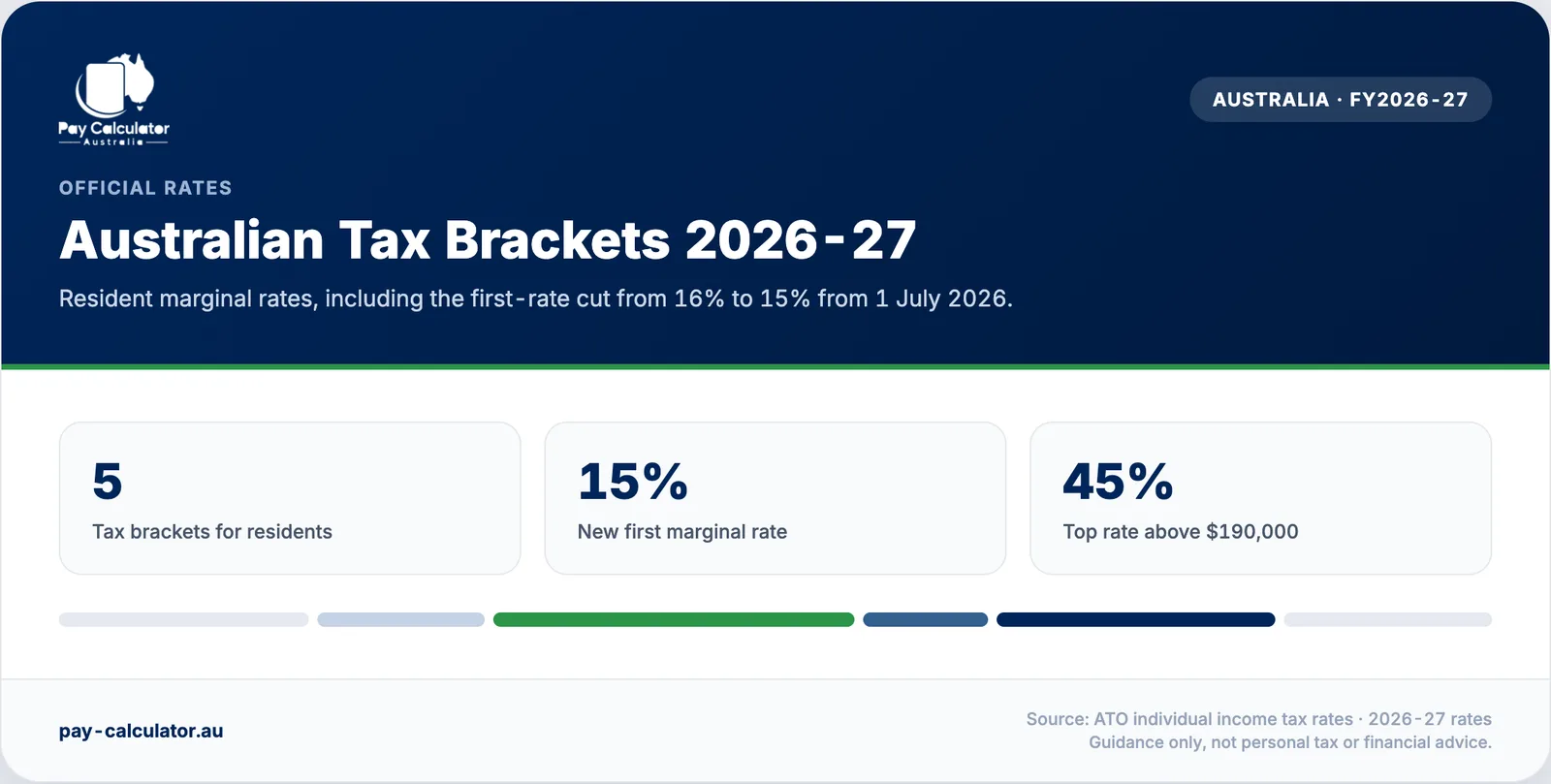
- Stage 3 cut 19% to 16% and 32.5% to 30%, and lifted two thresholds to $135,000 and $190,000.
- On 1 July 2026 the first taxed rate fell again, 16% to 15%, worth up to $268 a year.
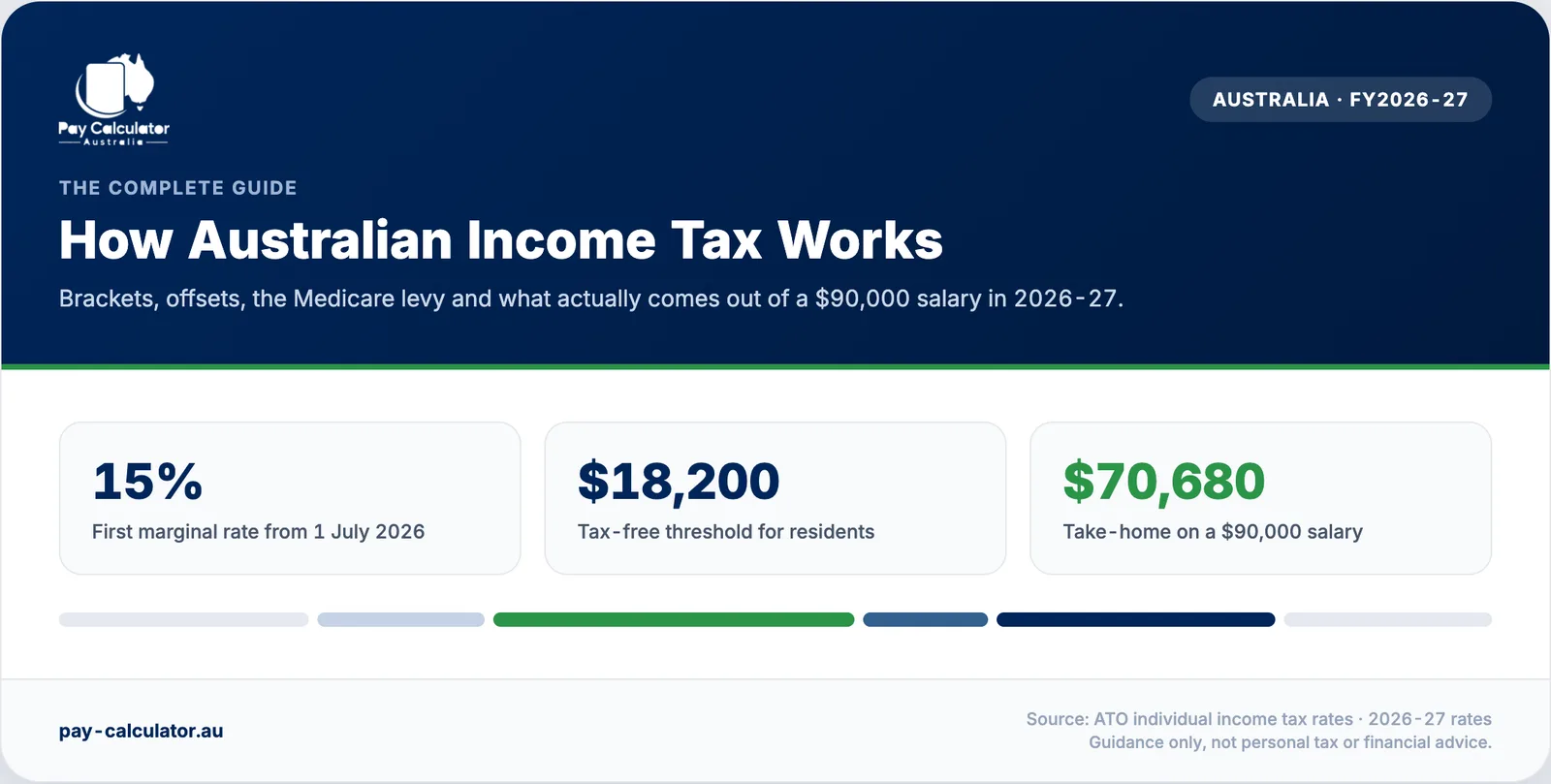
- The $18,200 tax-free threshold has not moved once across the whole series.
- Base income tax on a $90,000 salary has fallen $2,197 since 2023-24 and $3,277 since 2019-20.
What were the Australian tax brackets in each year?
Every rate below is a marginal rate: it applies only to the income inside its own band, never to your whole salary. All eight years share the same $18,200 tax-free threshold, so the table starts at the second band. Rates exclude the 2% Medicare levy and every offset. The final column is the income tax the scale produces on a $90,000 taxable income, computed band by band from that year's own thresholds.
| Financial year | Second band | Third band | Fourth band | Top rate | Tax on $90,000 |
|---|---|---|---|---|---|
| 2026-27 (current) | 15% to $45,000 | 30% to $135,000 | 37% to $190,000 | 45% above $190,000 | $17,520 |
| 2025-26 | 16% to $45,000 | 30% to $135,000 | 37% to $190,000 | 45% above $190,000 | $17,788 |
| 2024-25 | 16% to $45,000 | 30% to $135,000 | 37% to $190,000 | 45% above $190,000 | $17,788 |
| 2023-24 | 19% to $45,000 | 32.5% to $120,000 | 37% to $180,000 | 45% above $180,000 | $19,717 |
| 2022-23 | 19% to $45,000 | 32.5% to $120,000 | 37% to $180,000 | 45% above $180,000 | $19,717 |
| 2021-22 | 19% to $45,000 | 32.5% to $120,000 | 37% to $180,000 | 45% above $180,000 | $19,717 |
| 2020-21 | 19% to $45,000 | 32.5% to $120,000 | 37% to $180,000 | 45% above $180,000 | $19,717 |
| 2019-20 | 19% to $37,000 | 32.5% to $90,000 | 37% to $180,000 | 45% above $180,000 | $20,797 |
Resident rates only, excluding the 2% Medicare levy and all offsets. The 2026-27row is read from the pay-calculator.au tax engine, so it can never drift from the calculators on this site. The 2019-20 to 2025-26 rows come from the ATO page “Tax rates: Australian residents”, which publishes brackets to 2025-26 and does not yet carry the 2026-27scale. The tax column is computed from each year's own bands, not copied from anywhere.
What changed on 1 July 2026?
One rate, on one band. Income from $18,201 to $45,000 fell from 16 cents in the dollar to 15, under the Income Tax Rates Amendment (Tax Reform No. 1) Act 2026. No threshold moved. Because the band is $26,800 wide, one percentage point across it is worth $268 a year, and anyone with taxable income of $45,000 or more gets the whole $268. Below $45,000 the saving is 1% of whatever you earn above $18,200.
It is the smallest change in this series and the widest in reach, because almost every taxpayer passes through that band on the way up the scale. The full arithmetic, income level by income level, is in the news piece on the 15% income tax cut.
What did the Stage 3 tax cuts change?
Stage 3, as amended, is the largest rebuild in this series. It took effect on 1 July 2024 under the Treasury Laws Amendment (Cost of Living Tax Cuts) Act 2024 and moved four things at once, while leaving the tax-free threshold, the 37% rate and the 45% rate alone.
| What moved | 2023-24 | 2024-25 onwards |
|---|---|---|
| Rate on $18,201 to $45,000 | 19% | 16% |
| Rate on the third band | 32.5% | 30% |
| Top of the third band | $120,000 | $135,000 |
| Where the 45% rate starts | $180,001 | $190,001 |
| Tax-free threshold | $18,200 | $18,200 (unchanged) |
On a $90,000 taxable income that combination took the base income tax from $19,717 to $17,788, a fall of $1,929 in a single year. The ATO reissued all 15 withholding schedules and 12 tax tables on 1 July 2024 to match, which is why payslips changed that week without anyone doing anything.
What did the October 2020 Budget cuts change?
They moved two thresholds and left every rate alone. The 19% band, which had ended at $37,000, was extended to $45,000. The 32.5% band, which had ended at $90,000, was extended to $120,000. Both changes were backdated to 1 July 2020, so they applied to the whole 2020-21 income year even though they were announced in October.
The backdating is the reason the ATO reissued Schedule 1 mid-year, on 13 October 2020, rather than at the start of a financial year. That mid-year version then stayed in force for nearly four years. The version history is set out on the previous years tax tables page.
How much has tax on the same salary changed?
The cleanest way to read a bracket history is to hold the salary still and let the scale move underneath it. Every figure below is the base income tax the year's own scale produces, before the Medicare levy and before any offset, so the columns are comparable to each other and to nothing else.
| Financial year | Tax on $45,000 | Tax on $60,000 | Tax on $90,000 | Tax on $120,000 |
|---|---|---|---|---|
| 2026-27 | $4,020 | $8,520 | $17,520 | $26,520 |
| 2025-26 | $4,288 | $8,788 | $17,788 | $26,788 |
| 2024-25 | $4,288 | $8,788 | $17,788 | $26,788 |
| 2023-24 | $5,092 | $9,967 | $19,717 | $29,467 |
| 2022-23 | $5,092 | $9,967 | $19,717 | $29,467 |
| 2021-22 | $5,092 | $9,967 | $19,717 | $29,467 |
| 2020-21 | $5,092 | $9,967 | $19,717 | $29,467 |
| 2019-20 | $6,172 | $11,047 | $20,797 | $31,897 |
Read the $90,000 column downwards and the three change points show up as steps rather than a slope. It held at $19,717 for four straight years, dropped to $17,788 when Stage 3 landed, held there for two years, then eased to $17,520 for 2026-27. That is a total fall of $2,197 against 2023-24.
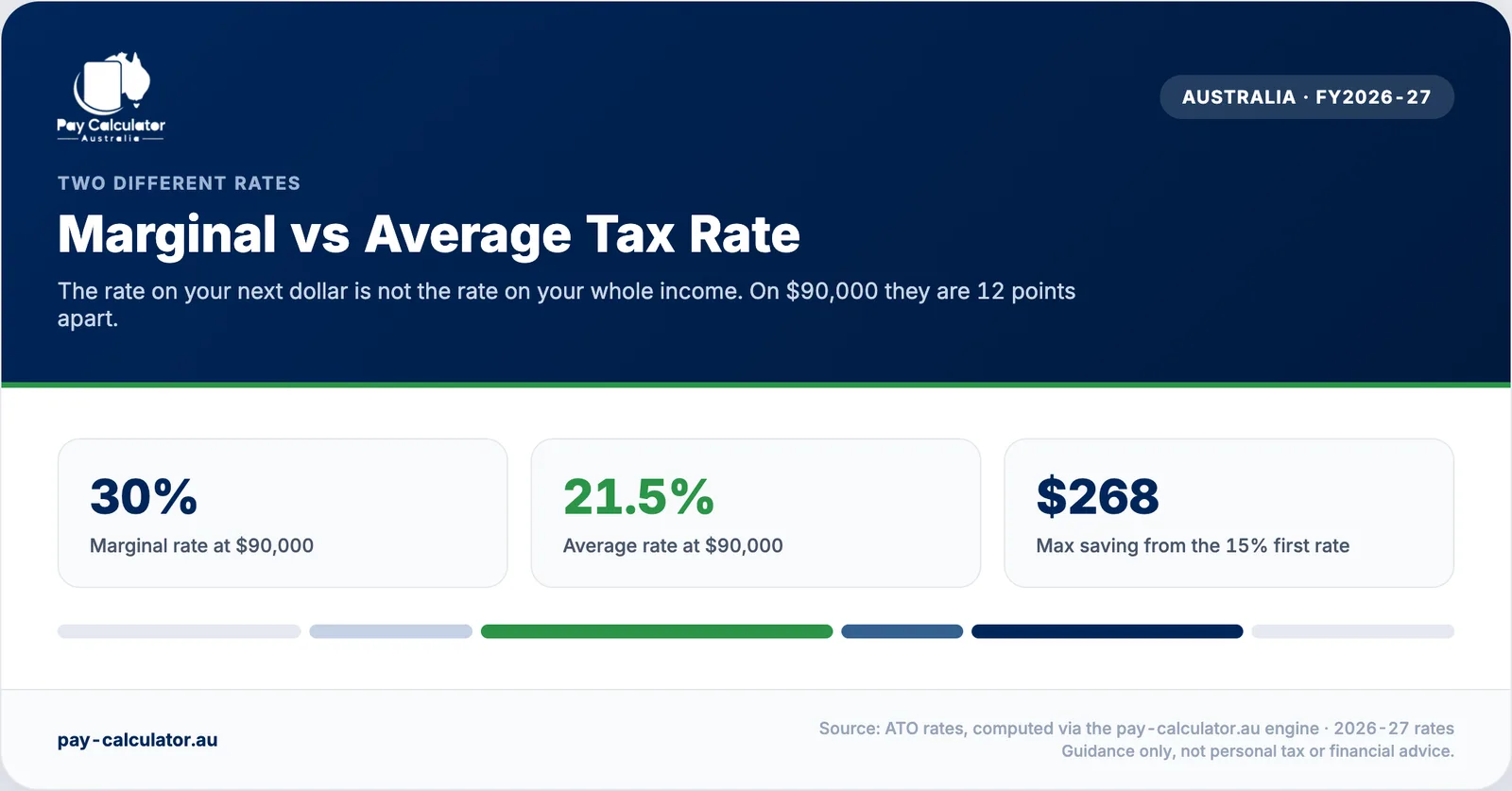
One caution before you read too much into it. A falling tax figure on a fixed salary is not the same as a falling tax burden, because wages moved as well. Someone earning $90,000 in 2019-20 is very likely earning more than $90,000 now, and the extra sits in a higher band. That is bracket creep, and no year in this series legislated against it. To see marginal against effective rates on your own income, the guide to marginal vs average tax rates works it through, or run a figure through the income tax calculator.
What has not changed?
Three things held still across all eight years. The tax-free threshold stayed at $18,200. The 37% rate stayed at 37%. The top rate stayed at 45%. Every change in this period touched either the two lowest taxed rates or the thresholds above them.
The frozen tax-free threshold is the most consequential of the three. It is the point at which tax starts, it has not been indexed once in this series, and it applies to everyone. The mechanics of who can claim it, and what happens when two employers both apply it, are covered in the tax-free threshold guide.
Which years shared the same brackets?
Two long runs, which is why so many prior-year searches have the same answer as the year either side of them.
| Years | Scale in force | What ended it |
|---|---|---|
| 2020-21 to 2023-24 | 19%, 32.5%, 37%, 45% from $18,201, $45,001, $120,001 and $180,001 | The amended Stage 3 cuts on 1 July 2024 |
| 2024-25 to 2025-26 | 16%, 30%, 37%, 45% from $18,201, $45,001, $135,001 and $190,001 | The first-rate cut on 1 July 2026 |
If you are reconciling an old payslip rather than a return, the withholding side of those same runs is on the 2021-22 tax tables and 2022-23 tax tables pages.
What happens to the brackets after 2026-27?
One more step is already law: the 15% rate falls to 14% on 1 July 2027, under the same act that delivered the 2026-27 cut. On the same $26,800 band that is worth up to another $268 a year. Nothing else is legislated, and in particular no threshold is scheduled to move, so the thresholds in the 2026-27 row of the table above are the ones to plan around until something new passes.
This page covers 2026-27 and earlier. When the 2027-28 rates take effect, a new edition of the current brackets guide will supersede the 2026-27 one, and this history page will gain a row rather than change one.
Why did your payslip not change when the brackets did?
Because brackets and withholding tables run on different timetables. The brackets on this page determine the tax you finally owe. What comes out of each pay is PAYG withholding, worked out from the ATO's Schedule 1 formulas, and the ATO only rebuilds Schedule 1 when the rates or the thresholds actually move. Between October 2020 and July 2026 that happened exactly twice, on 1 July 2024 and 1 July 2026.
In the four-year stretch when the scale sat still, the tax tables were reissued each year with the same numbers inside them. That is why a 2022 fortnightly table and a 2023 fortnightly table contain identical figures. The full version history, with the ATO publication note for each one, is on the previous years tax tables page, and the payday side of the mechanism is in the PAYG withholding guide.
Tax bracket history FAQ
Sources
- ATO, Tax rates: Australian residents (tax-rates-australian-residents). The source for the 2019-20 to 2025-26 scales on this page. That page publishes brackets to 2025-26 and does not yet carry the 2026-27 scale, which is why it is cited here for prior years only.
- ATO, Personal income tax: new tax cuts for every Australian taxpayer (new-legislation), last updated 13 May 2026. The source for the 2026-27 first marginal rate of 15%, cut from 16% by the Income Tax Rates Amendment (Tax Reform No. 1) Act 2026, and for the further cut to 14% on 1 July 2027.
- Treasury Laws Amendment (Cost of Living Tax Cuts) Act 2024. The amended Stage 3 rates and thresholds that took effect on 1 July 2024.
- ATO Software Developers, PAYG withholding tax tables, publication notes 2022 to 2026. The evidence for which years shared a withholding version, quoted in full on the pay-calculator.au previous years tax tables page.
Last verified 4 August 2026. The 2026-27 row is computed by the pay-calculator.au tax engine. Every tax figure in the two salary tables is arithmetic on the bands shown, worked out at page render, not transcribed. This page deliberately publishes no prior-year offset amounts and no prior-year withholding amounts, because pay-calculator.au has not verified those against the ATO originals.