FIFO Pay Calculator and Mining Salary in Australia
Mining is the highest-paid industry in Australia at $3,174 a week. See what that is worth after income tax, the 2% Medicare levy and 12% super for the 2026-27 financial year, and enter your own FIFO package to get your exact take-home.
Australian Take-Home Pay Calculator 2026-27
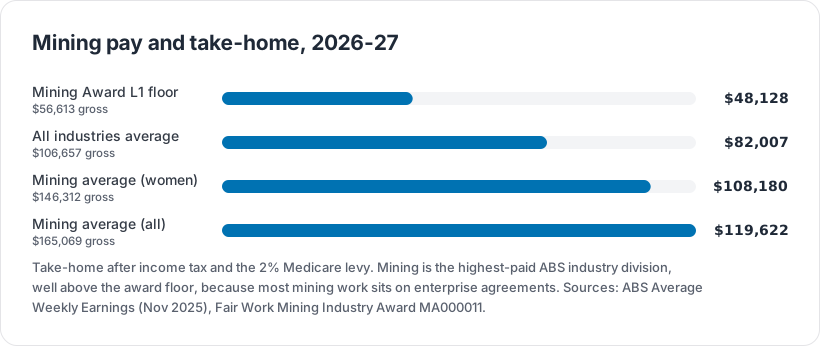
How Much Do FIFO and Mining Workers Earn in Australia?
ABS full-time adult ordinary time earnings for the mining industry (November 2025) and the Mining Industry Award 2020 (MA000011) floors, with income tax and the 2% Medicare levy for an Australian resident. Super is paid on top and is not counted in take-home.
| Mining pay level | Annual salary | Income tax | Medicare levy | Take-home pay | Super on top |
|---|---|---|---|---|---|
| Mining industry average (all workers) ABS, $3,174.40/week | $165,069 | $42,145 | $3,301 | $119,622 | $19,808 |
| Mining industry average, males ABS, $3,267.60/week | $169,915 | $43,939 | $3,398 | $122,578 | $20,390 |
| Mining industry average, females ABS, $2,813.70/week | $146,312 | $35,206 | $2,926 | $108,181 | $17,557 |
| Mining Award, Level 2 intermediate MA000011 floor, $1,127.61/week | $58,636 | $7,990 | $1,173 | $49,473 | $7,036 |
| Mining Award, Level 1 basic MA000011 floor, $1,088.71/week | $56,613 | $7,353 | $1,132 | $48,128 | $6,794 |
| Mining Award, entry level introductory MA000011 floor, $1,046.31/week | $54,408 | $6,659 | $1,088 | $46,661 | $6,529 |
Australian resident, super paid on top of salary, no HECS-HELP debt, private hospital cover assumed so no Medicare levy surcharge. Weekly figures annualised at 52 weeks. Sources: ABS, Average Weekly Earnings, Australia, November 2025 (cat. 6302.0); Fair Work Ombudsman Pay Guide, Mining Industry Award 2020 (MA000011); Australian Taxation Office.
Why Is the Mining Award Floor So Far Below Actual Mining Pay?
The Mining Industry Award 2020 (MA000011) Level 1 rate of $1,088.71 a week annualises to about $56,613. The ABS mining average is $165,069. That is a gap of roughly $108,456 a year, and it is the single most important thing to understand about mining pay.
Almost nobody in mining is actually paid the award. The award is a legal floor, not a market rate. Most mine-site workers are covered by enterprise agreements negotiated site by site, or by individual contracts, and those sit well above the floor before anything else is added.
Four things fill the gap. Enterprise agreements set base rates above the award. Site and camp allowances compensate for remoteness and living conditions. Overtime is routine on a compressed roster, and it is paid at penalty rates. Shift loadings apply to afternoon, night and permanent night work. Stack those on a base rate and the total moves a long way from $1,088.71 a week.
The award still matters as a safety net and as the basis for penalty rate calculations. But if you are comparing a job offer, compare it against the ABS industry figure, not the award. Run your own number through the salary calculator, or read marginal vs average tax rate to see why a higher bracket costs less than it looks.
Take-Home on $165,069
What Does the Mining Industry Award Actually Pay?
Adult mining industry services employees, full-time and part-time, under the Mining Industry Award 2020 (MA000011). Rates include the industry disability allowance and reflect the Annual Wage Review 2026 increase of 4.75%.
| Classification | Weekly | Hourly | Saturday, first 3 hrs | Sunday | Public holiday |
|---|---|---|---|---|---|
| Entry level, introductory | $1,046.31 | $27.53 | $41.30 | $55.06 | $68.83 |
| Level 1, basic | $1,088.71 | $28.65 | $42.98 | $57.30 | $71.63 |
| Level 2, intermediate | $1,127.61 | $29.67 | $44.51 | $59.34 | $74.18 |
Shift loadings and overtime sit on top of those base rates. On the Level 1 basis, afternoon shift is $32.95 an hour, night shift is $32.95 an hour and permanent night shift is $37.25 an hour. Overtime Monday to Friday is $42.98 an hour for the first three hours and $57.30 an hour after that. Weekly allowances on the same basis are $41.41 industry allowance, $50.92 licence allowance for electricians and $22.38 first aid allowance.
| Loading, overtime or allowance (Level 1 basis) | Rate | Basis |
|---|---|---|
| Afternoon shift | $32.95 | Per hour |
| Night shift | $32.95 | Per hour |
| Permanent night shift | $37.25 | Per hour |
| Overtime, Monday to Friday, first 3 hours | $42.98 | Per hour |
| Overtime, Monday to Friday, after 3 hours | $57.30 | Per hour |
| Industry allowance | $41.41 | Per week |
| Licence allowance, electricians | $50.92 | Per week |
| First aid allowance | $22.38 | Per week |
Source: Fair Work Ombudsman, Pay Guide, Mining Industry Award 2020 (MA000011), published 24 June 2026. Award minimums rose 4.75% from the first full pay period on or after 1 July 2026. Work out what penalty hours add with the overtime calculator.
How Do FIFO Workers Get Paid, and Do You Get Paid on Your Week Off?
There is no national FIFO pay rule. The structure comes from your contract or enterprise agreement.
FIFO pay is built by the site, not by legislation. Two structures dominate. The first is an annualised salary that already prices the roster in, so your pay lands at the same amount every cycle whether you are on swing or at home. The second pays for hours actually worked on site, usually a base rate plus shift loadings plus overtime, so the off-swing carries no earnings beyond accrued leave.
That is why the honest answer to "do FIFO workers get paid on their week off" is that it depends on which structure you are on. Read the pay clause of your agreement rather than trusting a recruiter summary. If your pay is annualised, the off-swing is already inside the number. If it is hourly, it is not.
The distinction matters for more than budgeting. An annualised salary is easier to run through a take-home calculation, because the gross is stable. Hourly FIFO pay swings with the roster and with how much overtime the site is running, which makes any single pay cycle a poor guide to the year. Annual leave accrues either way as a National Employment Standards entitlement, and the leave calculator shows what accrued leave is worth when it is paid out.
One more structural point. Advertised FIFO packages often quote a total that bundles base salary, site allowances, an overtime assumption and sometimes super. That is a gross package, not take-home, and the components are taxed differently. Put the base salary into the calculator above, then treat allowances and overtime as separate lines rather than assuming they scale the same way.
Can FIFO Workers Claim the Zone Tax Offset?
Generally no, and this is the single most common incorrect claim in mining.
The zone tax offset is not a mining benefit and it is not a remote-work benefit. It is a residence benefit. Eligibility turns on your usual place of residence being in a prescribed zone for 183 days or more in the income year. Where you work has nothing to do with it.
Apply that to the standard case. A FIFO worker lives in Perth and flies to a Pilbara site on a compressed roster. The site is deep inside a prescribed zone. The worker is not eligible, because their usual place of residence is Perth, and Perth is not in a zone. Same for a Brisbane resident flying to a Bowen Basin mine, or a Cairns resident flying to a site in the Northern Territory.
This changed in 2015. Before 1 July 2015, FIFO workers could claim the offset on the basis of where they worked, and plenty of people in the industry still believe that is the rule. The law was amended to exclude them, and it has not changed back. If you claimed the zone offset as a FIFO worker in a recent return, that claim is very likely wrong and worth correcting before the ATO raises it.
The offset is still available to people who genuinely live in a prescribed zone. A resident of Karratha, Mount Isa or Port Hedland who works locally may qualify, subject to the 183-day test. A person who lives in a zone and flies out to work elsewhere is a different case again. If your circumstances sit near the line, a registered tax agent is worth the money, because the offset is assessed on residence facts rather than on a payslip.
Do You Get Super on Overtime?
Usually not, and on an overtime-heavy FIFO package that changes the total materially.
The super guarantee is 12% of ordinary time earnings, not 12% of everything your employer pays you. Overtime paid at overtime rates is generally not ordinary time earnings, so super is usually not paid on it (ATO, list of payments that are ordinary time earnings). Ordinary time earnings is a defined concept, and overtime sits outside it.
Work through what that means. Two mining workers each gross the same amount in a year. The first earns it all as base salary and gets 12% super on the lot. The second earns a smaller base plus a large slab of overtime, and gets 12% on the base only. Same gross, different super, and the difference compounds inside the fund for decades.
On the ABS mining average of $165,069, 12% super is $19,808 a year if the whole amount is ordinary time earnings. If a meaningful share of your pay is overtime, your actual super contribution will be lower than a straight 12% of your gross, and any package comparison that assumes otherwise overstates the offer.
Two practical checks. First, look at the super line on your payslip and see whether it tracks your ordinary hours or your total gross. Second, if you are comparing a high-overtime role against a higher-base role, compare the super separately rather than folding it into one package number. The superannuation calculator shows what 12% is worth on a given base, and how the superannuation guarantee works covers the ordinary time earnings definition in more detail.
How Does Mining Compare With Other Industries?
Full-time adult ordinary time earnings by ABS industry division, November 2025, with the take-home an Australian resident would keep on each for 2026-27.
| Industry | Weekly earnings | Annualised | Take-home pay |
|---|---|---|---|
| Mining | $3174.40 | $165,069 | $119,622 |
| Information media and telecommunications | $2685.10 | $139,625 | $104,101 |
| Electricity, gas, water and waste services | $2514.20 | $130,738 | $98,382 |
| Professional, scientific and technical services | $2375.90 | $123,547 | $93,492 |
| Financial and insurance services | $2338.60 | $121,607 | $92,173 |
| Education and training | $2153.40 | $111,977 | $85,624 |
| Public administration and safety | $2147.90 | $111,691 | $85,430 |
| All industries | $2051.10 | $106,657 | $82,007 |
| Health care and social assistance | $1996.30 | $103,808 | $80,069 |
| Construction | $1958.20 | $101,826 | $78,722 |
| Rental, hiring and real estate services | $1958.00 | $101,816 | $78,715 |
| Transport, postal and warehousing | $1948.40 | $101,317 | $78,375 |
| Wholesale trade | $1921.50 | $99,918 | $77,424 |
| Administrative and support services | $1916.10 | $99,637 | $77,233 |
| Manufacturing | $1833.40 | $95,337 | $74,309 |
| Arts and recreation services | $1826.90 | $94,999 | $74,079 |
| Other services | $1605.20 | $83,470 | $66,240 |
| Retail trade | $1565.20 | $81,390 | $64,825 |
| Accommodation and food services | $1501.60 | $78,083 | $62,577 |
Australian resident, no HECS-HELP, super paid on top, private hospital cover assumed. Weekly figures annualised at 52 weeks. Source: ABS, Average Weekly Earnings, Australia, November 2025 (cat. 6302.0), released 26 February 2026, table 10G, original series. More on typical pay across the economy in the average salary in Australia.
Mining pays about 55% more than the all-industry average, $3,174 a week against $2,051. It has been the highest-paid of the 19 ABS industry divisions for years, and the margin over second place is wide: information media and telecommunications sits at $2,685.10 a week, almost $500 behind. At the other end, accommodation and food services averages $1,501.60.
What the ABS Mining Figure Does Not Tell You
The best available benchmark is not the same as a FIFO salary.
Three limits are worth stating plainly, because most pages that quote $165,069 do not state any of them.
First, the figure covers the entire mining industry, not FIFO roles. Corporate staff in a Perth or Brisbane head office, geologists, engineers, accountants and executives are all inside the ABS mining division. So are residential mine workers who live in the town they work in. It is a mining industry number, not a FIFO number.
Second, it is ordinary time earnings. Overtime is excluded by definition. For a large part of the mining workforce, overtime is a substantial share of actual annual pay, so real earnings for many individuals sit above the ABS figure even though the ABS figure already looks high.
Third, it is an average of full-time adult employees, and averages in a high-dispersion industry are pulled up by the top. A specialist on a remote site and a first-year trades assistant are in the same average. Use the award floors above as the bottom of the range, the ABS average as the industry benchmark, and your own contract as the only figure that actually pays your mortgage.
None of that makes the number useless. It is the best published, government-collected benchmark for the highest-paid industry in the country, and it is the right thing to compare an offer against. It is just not a substitute for reading your own agreement.
Common Mistakes With FIFO and Mining Pay
Where people misjudge what a mining package is worth.
Claiming the zone tax offset
The ATO is explicit that a FIFO worker who does not live in the zone is not eligible. Eligibility is about your usual place of residence for 183 days or more, not your roster. This has been the rule since 1 July 2015.
Assuming super on the whole package
Super is 12% of ordinary time earnings. Overtime at overtime rates is generally not ordinary time earnings, so the super line will usually be lower than 12% of your gross. Check it against your ordinary hours.
Comparing an offer to the award
The Mining Award Level 1 floor is about $56,613 a year. The industry average is $165,069. An offer that beats the award by a wide margin can still be well below market.
Reading a package figure as take-home
An advertised FIFO package is gross, and often bundles allowances, an overtime assumption and sometimes super. On $165,069 the take-home is $119,622. Run the base through the salary calculator first.
Forgetting the HECS-HELP step
A mining income sits well above the 2026-27 repayment threshold, so a study loan takes a further slice from every pay. The HECS-HELP repayment calculator shows how much.
Budgeting on the marginal rate
At $165,069 the marginal rate is 37%, but the average rate is 27.5%. People quote the first and budget with the second, which is why overtime feels worse taxed than it is.
FIFO and Mining Pay FAQ
Common questions about FIFO salaries, mining pay and the tax on both.
Sources
The documents behind every figure on this page.
- ABS, Average Weekly Earnings, Australia, November 2025 (cat. 6302.0), released 26 February 2026: full-time adult ordinary time earnings, table 10G, original series. Mining persons $3,174.40/week, mining males $3,267.60/week, mining females $2,813.70/week, all industries $2,051.10/week.
- Fair Work Ombudsman Pay Guide, Mining Industry Award 2020 (MA000011), published 24 June 2026: entry level $1,046.31/week ($27.53/hour), Level 1 basic $1,088.71/week ($28.65/hour), Level 2 intermediate $1,127.61/week ($29.67/hour), including the industry disability allowance, plus shift loadings, overtime rates and weekly allowances.
- Fair Work Commission, Annual Wage Review 2026: modern award minimum wages rose 4.75% from the first full pay period on or after 1 July 2026.
- Australian Taxation Office, Zone tax offset: eligibility requires your usual place of residence to be in a prescribed zone for 183 days or more in the income year. The ATO states that you are not eligible if you work in a qualifying remote or isolated area but do not live there, giving fly-in fly-out workers as its example. ato.gov.au, Zone tax offset.
- Australian Taxation Office, List of payments that are ordinary time earnings: the 12% super guarantee is paid on ordinary time earnings, and overtime paid at overtime rates is generally not ordinary time earnings.
- Australian Taxation Office, individual income tax rates and the 2% Medicare levy for 2026-27, including the 15% first marginal rate.
Take-home figures are calculated live on published ATO rates for 2026-27. ABS and award figures are gross and exclude the 12% super paid on top. The ABS mining figure covers the whole mining industry, measures ordinary time only and is not a FIFO-only number. Last verified 26 July 2026.